
When the Bills Came Due
I burst out sobbing in the bedroom.
Not the kitchen where I’d opened the correspondence. I couldn’t stay there. Couldn’t let my husband see what his inattentiveness had just cost us—how easily he’d blown through money I’d fought for, stretched for, hours of meal planning and cooking and trying so damn hard to make it work.
I froze mid-breath. Turned. Right.
And half-collapsed on the bed, my head hanging heavily between weakening arms. My hands pressing hard into my lap. My breath fragmented as anger boiled my blood, pumping all the precious hormones to get me up and running again.
And as I was gathering my strength to breathe despite the cold, terrifying sucking of our unpaid bills, one thought swayed even further from any temporary ground: I’m all alone in this. I’m all alone.
The Vigil
Through the tunnels of my dark realization, his footsteps.
Not hesitant. Not slow. Coming toward the mess he’d made, toward the wife he’d failed, toward the crying he’d caused.
He came into the bedroom. Didn’t sit beside me at a safe distance. Didn’t stand over me with explanations.
He knelt.
Half-sat on the edge of the bed, half-turned, one knee finding the floor in an awkward fold of his body—trying to get low enough, close enough, to meet me where I was.
If someone had peeked through that bedroom door, they would have seen a man on one knee before a woman with a snotty nose and swelling eyes, a woman on the edge of desperation, a woman in hurt.
Not a proposal. A vigil.
Ken’s presence didn’t pay the bill. But it took the loneliness away.
He reached for my hands.
He didn’t promise to fix anything. Didn’t explain or defend. Didn’t swear he’d never be inattentive again.
He just stayed.
Because absence wasn’t an option. Not in his mind. Not in the vows we’d made.
Vows Made Real
“For better or worse,” he said quietly, still on one knee. “For richer or poorer,” I answered.
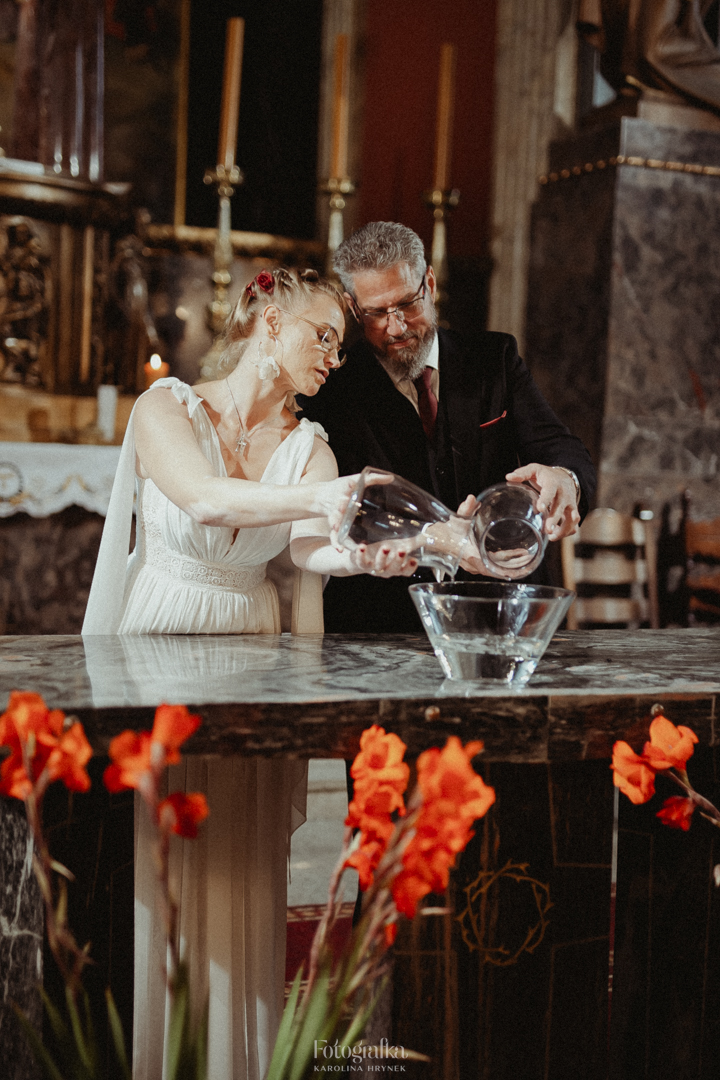
The words tasted different than they had a month before, when we’d spoken them standing at the altar. Then they were solemn, sacramental, almost abstract—a promise we made to each other and to God, beautiful in their weight.
Now they were just true. Smaller yet heavier. More real.


What I Expected From Grace
I’d thought the sacramental marriage would be different.
Like a cherry on top of the life we’d already built. God’s super-intervention into our daily mess—the wind and storm that blows the challenges away, the miraculous shift that changes everything.
I thought grace would feel like relief. Like ease. Like finally, finally, we’d stop struggling and start basking in the light.
I thought saying those vows in front of the priest, with my grandmother’s hand-crocheted corporal on the altar, with our seventeen guests circled around us in chairs instead of pews—I thought it would fix something.
Make us whole. Make us safe. Make the bills stop coming.
What Grace Actually Looked Like
But instead:
My grandmother, who so generously offered the work of her hands to contribute to our table—who crocheted that corporal, thread by careful thread, the last thing she ever completed—disappeared from the table two weeks later.
Gone.
And the funeral that followed highlighted every fracture in our family. We sat like strangers in that church. Separate pews. Four groups scattered across the space, not looking at each other. Discord and alienation and all the things we’d pretended weren’t there, suddenly visible in how far apart we chose to sit.
The requiem Mass itself? Cold. Generic. The young priest read everything himself, leaving us no space for engagement, barely spoke to my mum. No personal touch. No names learned. No space made for our grief to land anywhere.
I sat there thinking: This is what the Church offers when someone dies? This?
The country we’d moved to kept disappointing us. Bills arriving that made no sense. Systems that didn’t work. A church experience that left me empty every Sunday, wondering why I kept showing up.
And God—the God I was desperately trying to place at the centre of my life, the God I was pouring hours into serving through my Sunday resources, the God I was showing up for even when the liturgy felt dead—
He seemed to develop some deafness to my pleas.
As if I didn’t matter to Him. As if I wasn’t worth saving.
Do You even care that I’m drowning here?


Crying From the Deep
Save me, God, for the waters have closed in on my very being. I am sinking in the deepest swamp and there is no firm ground.
Psalm 69. Like our wedding date: 6th of September. And like my desperate prayers. Every day.
God, I really invested in this relationship with You.
I showed up at Your table. I brought myself to serve. I believed the promise:
Be my people, and I will be your God.
That’s the covenant. That’s what the whole Scripture is about—You being faithful. You loving the lowly. You leading those who believe in You to the promised land, to eternal life.
Jesus Christ, the foundation, the rock. That’s what You promised.
So I followed. I fell in love with You. I gave You my life.
And my husband—the blood and flesh of my daily experience—he followed too. Both of us soldiers. Both sent to the front lines with promises of provision.
Him once in war zones, now on seas. Me in the Church.
Both trusted the equipment. Trusted the ones in charge knew what they were doing.
But when the moment came—when I really needed it to work, when my life depended on it—
I pulled the trigger.
And the rifle shot water.
Not body and blood. Not nourishment. Not protection.
Just… water.
I went under.

The Question of Presence
And from that bottomless depth, I cried to You.
Because You are the God who saves. That’s who You say You are.
So if You do not save—if You do not show up—then who are You?
Who am I, in a relationship with an absent God?
What is this covenant about? What is any of this about?
It’s a question of presence.
When I Stopped Deserving
Somehow, I found grace again when I failed.
When I ran and didn’t make it. When I put out Sunday resources but failed in the flesh and blood of my own presence at church.
When I stopped deserving. Stopped showing God I could tick all the boxes.
I just brought my heart. The most vulnerable me I know how to show.
And it was in THAT encounter—not the perfect one, the broken one—that I found strength to bring myself back to the table.
The Sound of Worship
Grace came when I stopped trying so hard.
Stopped shaking God’s tunic, demanding answers, working and working and working to prove I was faithful.
Instead, I pushed everything aside—all the worries, all the prayers I thought I had to say—and I just started worshiping. Singing my heart out in front of my Savior.
And in the sound, in the waves of my voice, there was so much love happening. So much communication. It wasn’t about the words. It wasn’t about anything measurable.
It was just… me. All of me. The drowning me. The failing me. The broken me.

Salvation Happening
And somehow, from that place with no ground under my feet, I pushed. From the rock of Jesus Christ—that sometimes invisible rock that shows up in a husband kneeling on one knee, embodying God in the moment when I need His flesh most. In that moment—Ken touching my hand, speaking our sacramental words back to me, for better or worse, for richer or poorer—we embodied the sacrament. We put flesh where we needed Jesus’ flesh to be.
The two of us. Remaining faithful to our pledge to be, in that moment, sacramentally present to each other.
That’s what someone would see if they peeked through that bedroom door. Not just sorrow. Salvation happening.
Everything Changed
Cause here’s the truth: Between that moment on the edge of the bed and the next Sunday, everything changed.
Not because we suddenly got perfect. But because we reached out. We kept praying. We made conversations happen. We asked for help.
The Reading I Found By Mistake
That was the moment I truly prayed. Didn’t even know where it would lead me.
Yet God poured so much love, so much care, so much promise and presence and loving-kindness through His words—words I found by MISTAKE, by skipping pages in my Sunday Missal, landing on readings I would not have read otherwise.
But once I did read them, I couldn’t turn my inner gaze away. I wanted to be WITH that word. To focus on my embodied experience. My flesh.
This is where I am. In all my shortcomings, all my errors.
And God was already building such an incredible gift for me out of this moment, letting me draw hope and strength from another one of my errors.
Because that’s the most beautiful thing about God: He doesn’t wait for us to fix our lives. He meets us whenever we bring ourselves to Him.


The Invitation to Meet
From the bottom of my desperation and trust, I heard His familiar voice:
Natalia, you want to spend time with Me? This is how I offer you to meet Me:
When you open your eyes, before you do basically anything else—before brushing teeth, before coffee—come to Me.
Sit. Silence your soul. Take a posture that expresses your love to Me, how you are with Me in this moment. Show Me this in your body.
Pay attention to how you are moment by moment. Remain present.
Pray your own Shema: Hear, Natalia, The Lord is your God. The Lord is one.
Pray: And I will love the Lord my God with all my heart, with all my soul, with all my strength.
Then shut up for 15 minutes and just listen. Stay with the Shema in your breath. In. Out.
Make it My time and not yours.
Suffocating Into Presence
I didn’t wait till morning.
I sat down that night and practiced. Brought myself to vigilant attention, trying to figure out how to follow these instructions I’d just received.
And I nearly suffocated.
Couldn’t even make it through 15 minutes of that attention. It felt like drowning. Like going under.
Yet that’s when I heard the knock.
That’s when Presence came.
Not the next Sunday when I’d mastered it. Not when I was perfect.
Here. Now. In the suffocation.
I’d just climbed a sycamore tree, growing grace upon grace on error.