Dawn paints the shore in pearl and gold. Peter’s muscles quiver with sweet exhaustion as he guides the boat’s bow onto sand. His body remembers every wave they fought, every strike of water against wood, but now – finally – he can breathe. The morning air fills his lungs like a gift, and he lets his head fall back, savoring the simple pleasure of solid ground beneath his feet.
“Another day,” he whispers, a fisherman’s prayer of gratitude. His palms sting as he grips the boat’s edge, ready to haul it higher on shore. Earned pain, honest pain – the kind a man can be proud of.
Then a sound shatters the morning peace – half howl, half sob. Peter’s body tenses, warrior-quick, as a figure emerges from distant rocks. The man moves like a wounded animal, all jerky motion and confused step. His rags flutter in the breeze, revealing flesh marked by chains and stone.
“You!” The voice scratches like broken shells on sand. “What do you want from me?” Torn hands thrust accusingly toward Jesus, even as the man’s legs carry him closer, closer, as if pulled by an invisible tide.
Peter’s feet shift in the sand, ready to intercept. His arms, though trembling from night’s battle, rise to defend his Master. But Jesus – the same Jesus who commanded last night’s storm – lifts one hand in that familiar gesture of peace. And Peter’s body obeys before his mind catches up, stepping back even as his heart races.
The madman crosses the beach like a man drowning on dry land. His feet stumble-scratch urgent patterns in the sand. Each step seems to cost him, yet he can’t stop coming. When he finally reaches them, his collapse is total – face in the sand, hands clawing earth, body shaking with sobs.
“What do you want from me, Jesus, Son of the Most High?” The words break against the morning air like waves against stone. The man’s body curls in on itself, compress-expand with each ragged breath, caught between terror and desperate hope.
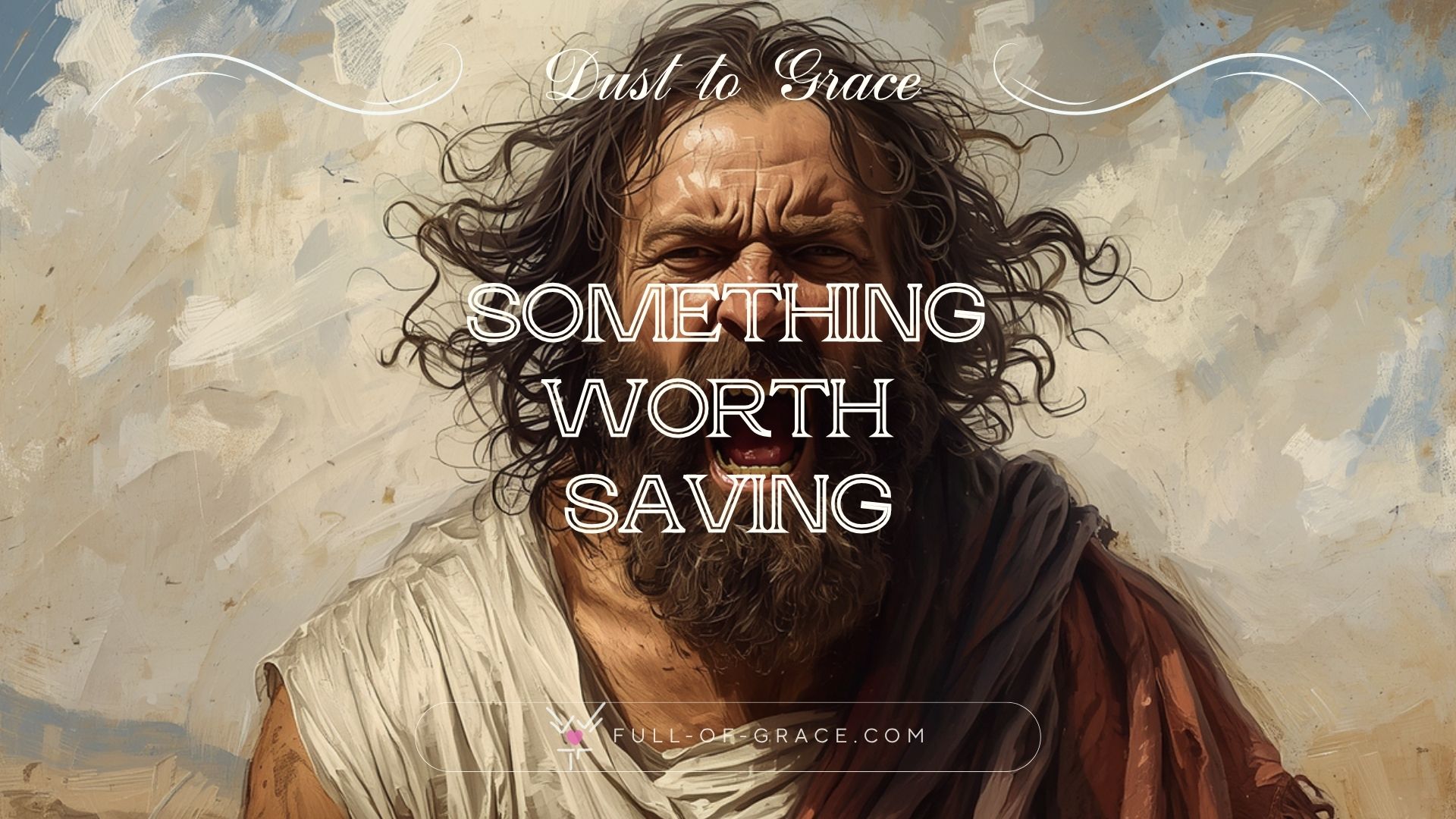
And Jesus – Jesus looks at him the way he looked at the storm. With eyes that see past the surface chaos to something deeper, something worth saving.

When Jesus was still some distance away, the man saw him, ran to meet him, and bowed low before him.
MARK 5:6
The man with no name
The man from Gerasene has no name in the Gospel.
Mark doesn’t give him one. Neither does Luke. He is simply a man — emerging from the tombs, crying out, cutting himself with stones, beyond the reach of anyone who had tried to hold him.
I called him Asher for the sake of this journey. But the absence of a name in the text is not an oversight. It is an invitation. It means the story belongs to anyone who recognises it. It means you can place your own name there. It means this was never only about him.
The stones we cut ourselves with
Look at what Asher was doing to himself.
The chains were his own. We established that at the beginning of this series — Mark tells us no one could bind him anymore, which means someone had tried, which means at some point he had allowed it, which means the chaining began somewhere he once cooperated with. By the time we meet him, he has gone further than anyone else was willing to go. He is doing to himself what others started.
And the cutting. The stones. The crying out in the night from a place where the living did not go.
Now translate that inward.
The words someone spoke over you in a moment of their own tiredness, their own fear, their own unexamined wound — and you were standing in exactly the wrong place to receive them. Vulnerable. Open. Not yet armoured. And the words landed and you believed them. Not because they were true but because the timing was precise and something in you was already listening for confirmation of your worst suspicion about yourself.
When I am not [your truest or hardest adjective], it means I am…
That sentence. The one you wrote weeks ago. The one that has been sitting in the drawer.
That is the stone. That is what we have been cutting ourselves with ever since.

What the real exorcism looks like
I made a deliberate choice in writing the core story for this week.
I skipped the exorcism.
Not because it didn’t happen — it did, it’s there in the text, vivid and strange and theologically rich. But because I wanted us to see something that the drama of that scene can sometimes obscure.
When Jesus was still some distance away, the man saw him, ran to meet him, and bowed low before him.
That is the moment. That is where the liberation lives.
Jesus looked at him — this howling, bleeding, tomb-dwelling man — and saw something worth saving. Not something worth fixing first. Not something worth waiting until it was calmer or cleaner or more coherent. Something worth crossing a storm for, worth stepping out of the boat onto foreign soil for, worth the full undivided attention of the Son of God in the early morning light.
That look — that is the real exorcism. Everything else follows from being seen that way.
Come as you are
This is what Week 6 is.
We are not adding anything new. We are not doing more work. We are taking what we found — the specific words, the specific wounds, the sentences that live in the drawer — and we are holding them inside that look.
Not despite them. Inside them.
The darkness you named is not a barrier to being seen. It is the exact place where you are being seen.
Come as you are. He is already running.
If you are arriving here without having completed Week 1, Week 2, Week 3, Week 4, Week 5 begin there — this week’s work builds directly on what you found in the previous sessions. Without that work, this week has nowhere to depart from.
More about Asher’s Biblical roots.
More about Dust to Grace series.