The Clash
Palm Sunday presents the most confusing clash of liturgical arrangements.
We begin with a procession. Branches, movement, the crowd’s excitement, Hosanna rising from voices that mean it – that genuinely, desperately mean it: Save us. And then, within the same liturgy, we settle down to read the Passion: The arrest. The trial. The cross.
The church does this on purpose. She refuses to let us celebrate the entry into Jerusalem while pretending we don’t know how this week ends. There is no Hosanna without the cross. There is no king without a throne, and in this story, the throne is wood.
What we enter on Palm Sunday is not really a week. The ancient tradition of the church understands the Easter Triduum – Holy Thursday, Good Friday, Easter Sunday – as a single liturgical movement. One act. Beginning in the upper room, passing through the garden and the trial and the hill, descending into the silence of Holy Saturday, and arriving, finally, at the empty tomb. It doesn’t end until we renew our baptismal promises at the Easter Vigil and mean them.
The temptation every year is to manage this week. Either through dramatic recreation, which is essentially theatre that flatters us into feeling we were there: keeping vigil in Gethsemane, walking the Via Dolorosa and standing at the feet of the cross, while actually insulting the true weight of it. Or to observe the events of this week from a reverent distance. To move through the liturgies as someone who already knows the story and has made peace with it. But the story doesn’t want our peace. It wants our presence.
This year, instead of the usual resources, I want to offer something different.
No biblical background. No Sunday experience. No prayer of the faithful.
Instead, I invite you to travel through this week with a single character. Not a disciple. Not a saint. Not someone who understood what was happening or who had any reason to care.
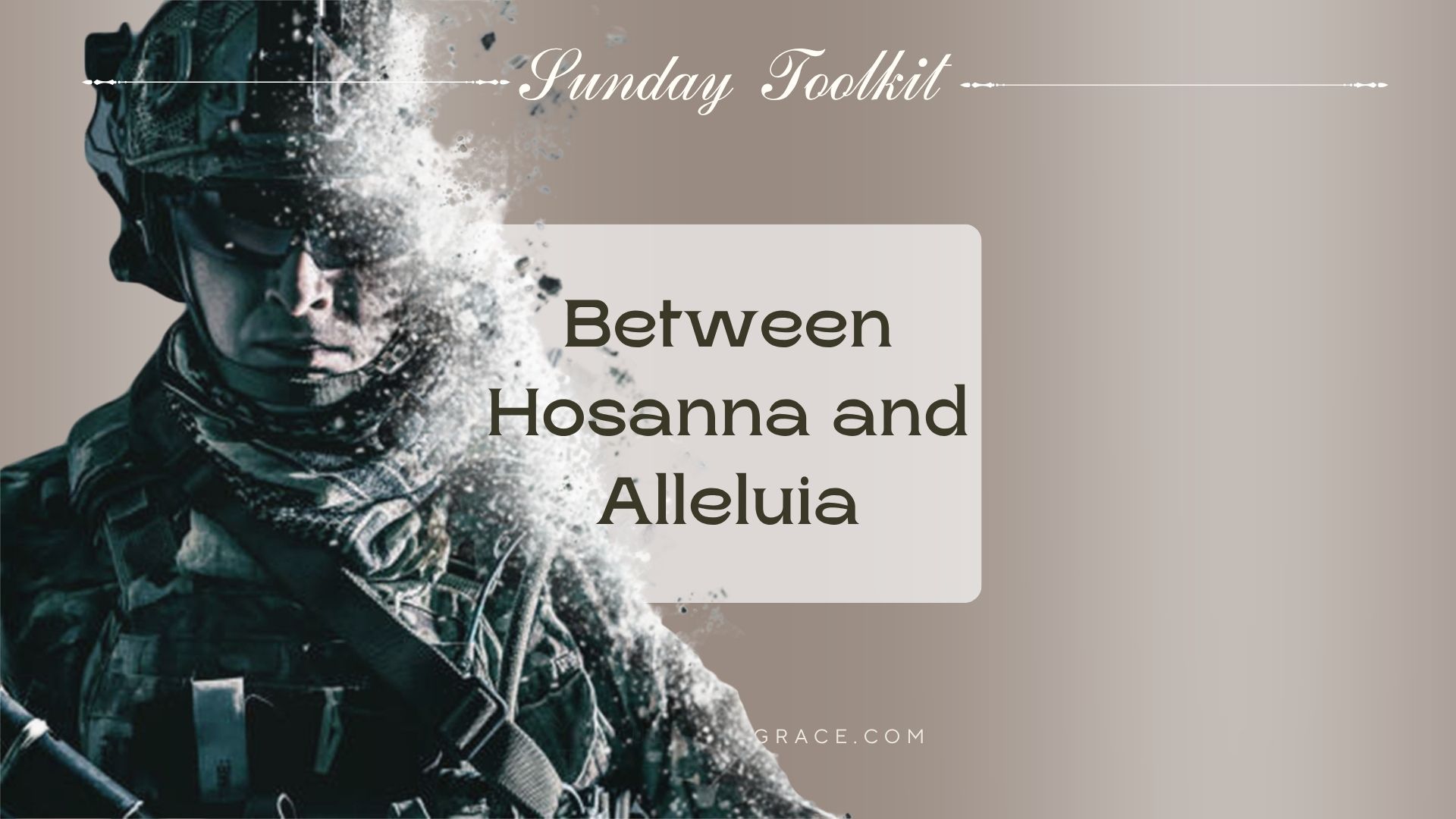
A Roman soldier. A practical man doing a difficult job in a province he despises. A man who files reports and reads crowds and trusts his training. A man who has no theology, no prior relationship with Jesus of Nazareth, no stake in the outcome.
A man who witnesses something he cannot explain and has to decide what to do with it.

His journey moves from indifference to witnessing – from scanning the edges of a crowd to standing at an empty tomb in the early morning, not sure whether what he saw was real, deciding to live as if it was.
I think most of us are closer to him than we are to Mary Magdalene or Peter. We come to Holy Week tired, distracted, carrying the weight of ordinary life. We are not sure what we believe or how much of it we mean. We have questions we haven’t asked and encounters we have filed away under province rumors, insignificant matters.
This week, let his eyes be your eyes.
There are four moments in his journey – Palm Sunday, Holy Thursday, Good Friday, and Easter Sunday. Each one is short. Each one ends not with an explanation but with an invitation – something to sit with, something to carry into the liturgy, something to bring with you when you stand up on Easter Sunday to renew your baptismal promises.
Because that, to me, is the heart of it. Not the recollection of events from two thousand years ago. But the moment you stand up and say your yes. This year. Knowing what you know. Having come the distance you have come.
The soldier didn’t have a theology. He had a face he couldn’t forget and a decision he made in the dark.
Maybe that’s enough to begin.
Begin the journey here: Palm Sunday – nothing happened, but the air was wrong.