
Date: 8 March 2026
Season: Lent, Year A — Third Sunday
Readings: Exodus 17:3–7 | Psalm 95:1–2, 6–9 | Romans 5:1–2, 5–8 | John 4:5–42
USCCB: https://bible.usccb.org/bible/readings/030826.cfm
One-sentence theme: The thirst we cannot manage is the door through which living water enters.
The Readings in Context
First Reading: Exodus 17:3–7 — Massa and Meribah
Historical placing
We are in the earliest weeks of the Exodus — probably six to eight weeks after leaving Egypt. The covenant at Sinai has not yet been made; that comes in Exodus 19–20. The people have crossed the Sea of Reeds, sung Miriam’s song, received manna and quail, and are now approaching the region of Horeb for the first time. This is not a return. It is a first arrival.
The complaint we hear is not the exhausted grumbling of a forty-year wandering. It is the almost immediate disillusionment of people who are geographically free but have not yet begun the inner journey. The text was likely shaped during the Deuteronomistic editing of the late monarchic or exilic period — a community that knew exactly what it meant to be in the wilderness, politically and spiritually, and was asking: when did we first learn to quarrel with God instead of cry out to him?

What’s happening
The people are thirsty. There is no water. They turn on Moses with a compound accusation: Why did you bring us out of Egypt? Was it so that I should die of thirst — my children too, and my livestock?
Three details require our attention.
First, the singular pronoun — so that I should die — inside what is clearly a community complaint. The Exodus is a corporate event, but thirst is felt alone, in the body, as personal abandonment.
Second, the livestock. According to Exodus 12:38, the departing Israelites brought flocks and herds with them — permitted, even blessed. But the cattle are not incidental. They are Egypt travelling with you. They are the hedge, the asset, the insurance policy carried into the wilderness because you cannot yet trust that the Promised Land will provide. (This image echoes forward into the Gospel, where the woman at the well invokes Jacob’s well and his flocks — the same cattle, now remembered as inheritance rather than anxiety.)
Third, and most importantly: where they are. Horeb. The Hebrew חֹרֵב derives from a root meaning dry, desolate, wasted — the same root as the word for drought, for sword, for the thing that lays a land bare. Horeb is the Dry Place. And it is here — not at the oasis, not at the mountaintop of abundance — that God consistently chooses to appear. The burning bush was at Horeb. Elijah’s restoration after his suicidal collapse was at Horeb. God meets Israel in the desolation, not despite it.
Key insight
The verb for the people’s action — rîv, to quarrel or complain — occurs fourteen times in the Hebrew Bible and appears almost exclusively in this wilderness period. It is a technical term for a very specific spiritual posture: bringing your need sideways, to Moses, as accusation rather than upward to God as prayer.
Moses, by contrast, cried out to the Lord — za’aq, a verb with sixty-four occurrences, the foundational language of biblical lament and prayer. The contrast is not between faith and doubt. It is between two ways of holding unbearable thirst.
The verb translated tormented by thirst (in some translations) is the same Hebrew root used in the Psalms when the Psalmist cries my soul thirsts for God. The wilderness word for desperate physical need became the image for the deepest spiritual longing. The desert is not only a problem to be solved. It is a school.
Rabbinic and Kabbalistic keys
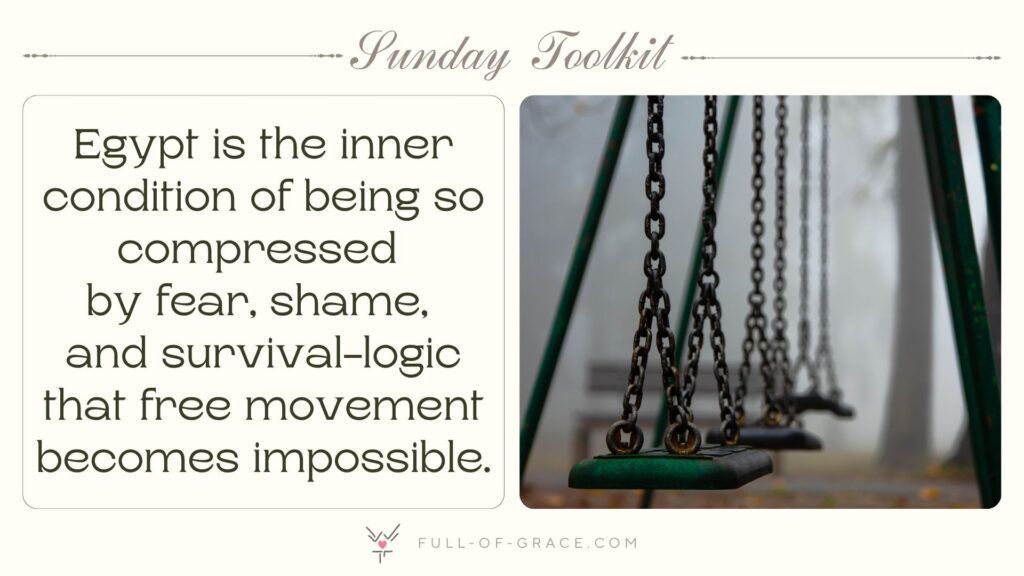
The rabbinic imagination does not read Mitzrayim — Egypt — primarily as geography. The Hebrew name מִצְרַיִם (Mitzrayim) comes from the root צָרַר (tzarar): to bind, to press, to constrict. The dual ending suggests a double narrowness pressing from both sides. Egypt is the inner condition of being so compressed by fear, shame, and survival-logic that free movement becomes impossible.
The Passover Haggadah insists that every generation must experience itself as having personally come out of Mitzrayim — not as historical memory but as present spiritual reality. And the Sfat Emet (Rabbi Yehudah Aryeh Leib Alter) teaches that the forty years in the wilderness are not punishment for specific failures, but the necessary duration of the inner work. You cannot rush the evacuation of Mitzrayim from the bones.
The cattle make theological sense in this light. When you leave the narrow place, you carry it with you. The livestock are portable Egypt — the hedged bet, the self-sufficiency dragged into the wilderness because the soul has not yet completed its inner exodus. The body crossed the sea. The Egypt-logic is still running.
The word for rock here is צוּר (tzur) — one of the primary divine names in the Hebrew Bible. Tzur Yisrael, the Rock of Israel, appears in the Song of Moses and throughout the Psalms. But here is what to notice: tzur shares its root with tzarar — to constrict. The rock and the narrow place come from the same word-family. Egypt and the hardened heart are kin.
Constriction does not only narrow. It also calcifies. The survival strategies that kept you alive in the narrow place become, in the free place, the very thing that seals the water inside you. This is the teaching of Rabbi Nachman of Breslov on the lev ha-even — the heart of stone: not evil, but the hardened scar of survival, the interior that has been held so tightly for so long that it has stopped being able to receive.
The promise at Horeb is not that God will send water from elsewhere. God says: I will be standing on the rock. The divine presence is already inhabiting the hardened place. The water is inside the constriction. What is needed is not manufacture but rupture.
Moses lifts the staff — the same instrument that struck the Nile, that parted the sea — and strikes. Life flows from the wound.
Responsorial Psalm 95 — Harden Not Your Hearts
Psalm 95 is a liturgical entrance hymn, almost certainly used in Temple worship as pilgrims arrived. Its structure pivots: come, sing, bow, kneel — and then, without warning: harden not your hearts as at Meribah.
It is worth noting that Psalm 95 is one of the four Invitatory Psalms for the Liturgy of the Hours, and the default invitatory for ordinary days — which means it has been sung at the threshold of daily prayer by monks, priests, and laypeople for centuries. Every morning, the Church enters its day by passing through the memory of Israel’s thirst. The wilderness moment is not archived. It is kept permanently at the door.
The antiphon If today you hear his voice, harden not your hearts is taken up in Hebrews 3–4, where it anchors a long meditation on rest, wandering, and the perpetual availability of divine encounter. The word today does the theological heavy lifting. Not when you have completed the inner work. Not after the hardness has softened. Today, in the thirst, in the desolation, in the dry place.
The verbs the Psalm offers — come, ring out, hail, give thanks, bow, bend low, kneel — are all postures of deliberate orientation, chosen against the pull of the complaining reflex. They are what Moses modelled at Meribah: cry out rather than quarrel. The Psalm gives us back the choice the wilderness first presented, every morning, at the threshold of prayer.
Second Reading: Romans 5:1–2, 5–8 — While We Were Still Helpless
Historical and literary context
Paul is writing to the Roman community around 57 CE, before his arrival there. Romans is his most systematic treatment of justification — how human beings come to stand rightly before God. Chapter 5 is the hinge: having argued that justification comes through faith rather than observance of the Law, Paul now explores what this justification feels like from the inside.
What’s happening
Paul’s argument turns entirely on timing. While we were still helpless. While we were still sinners. The Greek ἀσθενής (asthenēs) — helpless, without strength, incapacitated — names the condition of someone who cannot do what needs doing. Paul’s point is not that God helped those who were trying hard and failing. His point is that the decisive act happened in the condition of maximum helplessness, not after it was overcome.
This is the theological dismantling of the Egypt-logic. The Egypt-logic says: manage your standing. Keep returning to the well because you cannot trust that tomorrow there will be water. Paul says: the water was provided while you were still in the narrow place, still carrying your cattle, still turning on Moses with accusations. Not after the inner exodus was complete. In it.
The love of God has been poured out — not administered in measured doses based on performance, not rationed according to progress, but poured, overflowing, the language of abundance and recklessness. The jar we are invited to put down in this reading is the one labelled I must manage my own justification.
Key insight
We boast in hope of the glory of God. We boast in our sufferings. The Greek kauchōmetha — to boast, to exult — appears three times in these verses. What changes is not the posture but the object. We have been formed to boast in our achievements, our provisions, our management of scarcity. Paul redirects that same energy toward hope and toward suffering itself — because suffering, when held rather than managed, produces endurance, endurance produces character, character produces hope. The helplessness is not the problem to be solved before the spiritual life can begin. It is the school.
Gospel: John 4:5–42 — The Woman at the Well
Historical and literary placing
John’s Gospel reached its final form probably in the 90s CE, for a community navigating the aftermath of the Temple’s destruction and the painful separation of Jewish-Christian communities from synagogue life. The Samaritan encounter resonates in that context: the Samaritans were the theological other — the people whose worship was considered invalid, whose history was mixed, whose claim to Jacob’s heritage was contested.
Jacob’s well at Sychar places us on land given to Joseph — the beloved son, the dreamer, the one sold into Egypt and brought back out again. The well is inheritance. It is real, deep, and keeps requiring return.
What’s happening
Jesus arrives at noon — the sixth hour, maximum exposure, no shadows. A woman arrives alone. In the middle of the day.
She has built her life around the geometry of avoidance. Coming to the well at noon, when no one else is there, is not coincidence — it is the spatial expression of an interior that has decided: I will not be witnessed. She has carried her daily jar to this well, in this hour, long enough that it has become the architecture of her identity.
Jesus opens with a request, not a proclamation: Give me a drink. He is tired. He is thirsty. He arrives as the one who needs something from her — which is the last thing she expected from a Jewish man at a Samaritan well at noon. The conversation proceeds as genuine encounter rather than theological demonstration. He engages her arguments. He answers her question about the mountain. He takes her seriously as a theological interlocutor — something she has likely not experienced in the community from which she has exiled herself.
When he names her history — five husbands, the present man not her husband — he names it without accusation. He names it as knowing. To be fully seen and not rejected: this is perhaps the most terrifying and most longed-for experience a human being can have. She has arranged her entire life to prevent it. It happens anyway. And it is not destruction.
She leaves her water jar.

She came to fill it and leave quickly, unseen. It was the instrument of her managed scarcity — the daily return to the source, performed in isolation, without witness. She forgets it. She runs into the village — the community from which she has been hiding — and says: Come and see a man who told me everything I have done. And in that sentence, the thing that was her shame becomes her proclamation. The sealed place becomes the source.
She is the first evangelist in John’s Gospel — before the Twelve, before the women at the tomb. Come and see is the exact language Jesus used to call the first disciples in John chapter 1. She receives the words of call and immediately becomes a caller. The one who wanted to be permanently invisible is unhidden in the Gospel forever — read in every language, in every century, in every community that has ever known what it means to come to the well at noon.
Key insight: the cattle echo
It is not accidental that the woman describes Jacob’s well as the gift of one who drank from it himself, with his children and his flocks. The livestock reappear. In the first reading, the Israelites’ complaint about their cattle is the voice of Egypt-logic in the wilderness — I cannot trust that God will provide, so I brought what I could carry. Here, the same flocks are invoked as inheritance, proof that the well is real. But Jesus has already said: Everyone who drinks this water will be thirsty again. Jacob’s well is real. It is not enough. You will keep coming back.
The jar is the cattle. The managed scarcity is the portable Mitzrayim. And in both cases, the moment of liberation is the moment you forget to pick it back up.
The Common Thread
Across all four readings, the same movement traces itself: a thirst that cannot be managed, an encounter that sees the hidden thing directly, and a letting go that makes proclamation possible.
The Israelites carry their cattle into the wilderness and discover that the water they need flows not from their provisions but from the rock that God is already standing on. Paul insists that the love poured out for us arrived in our helplessness, not after we overcame it. The Psalmist calls us to bend low rather than harden — and does so every morning, at the threshold of the day. A woman at a well in Samaria, having arranged her entire life around not being seen, is seen completely — and leaves her jar behind.
The jar. The cattle. The hardened heart. The self-salvation project. These are the same thing in different forms: the portable Mitzrayim, the Egypt-logic of managed scarcity that travels with us into the free place and seals the living water inside the rock.
Tzur and tzarar — the rock and the narrow place — come from the same root. What forms under the pressure of constriction is hardness. And the hardness is not the enemy of the water. The water is already inside it. God is already standing on it. What the rock needs is not to be destroyed, but to be struck — to crack open — so that what was always there can finally flow.
The invitation of this Third Sunday is not to try harder. It is to notice what you are still carrying, and to consider whether the thing that kept you alive in the narrow place has become the thing that is sealing the spring.
Introduction to the Liturgy of the Word
For use by presider or lector
Today we stand at Horeb — the Dry Place — with Israel, with a woman at a well, with Paul’s community in Rome, with everyone who has ever arranged their life around not being seen or carried their survival strategies into spaces that no longer require them. The readings ask us not whether we are thirsty, but what we do with the thirst. Do we quarrel and accuse? Or do we cry out? Do we fill the jar and leave quickly, unseen? Or do we let ourselves be found — and in being found, discover that the water we have been returning to every day was never going to be enough?
If today you hear his voice, harden not your hearts.
Check out other resources for This Sunday:
Cattle, Jars, and Calcified Chests – an introduction to this Sunday’s spirit.
The Jar You Carry – an embodied penitential rite.
Come to the Water – a ready to use Prayer of the Faithful.
















One thought on “The Spring Inside the Stone: Third Sunday of Lent, Year A — Biblical Background”