

Quick Reference
Season: Easter – Week 3, Year A
First Reading: Acts 2:14, 22–33
Responsorial Psalm: Psalm 16 (15):1–2, 5, 7–11
Second Reading: 1 Peter 1:17–21
Gospel: Luke 24:13–35 (The Emmaus Road)
USCCB Link: https://bible.usccb.org/bible/readings/041926.cfm
One-Sentence Theme: The risen Christ walks with those who have stopped expecting him – and the recognition of his presence does not come through sight alone.
The Readings in Context
First Reading – Acts 2:14, 22–33
Historical Placing
The Book of Acts was written by Luke, almost certainly the same author as the third Gospel – the two volumes are a single literary and theological project. The time of narration is Pentecost: approximately 50 days after the Passover of the Crucifixion, ca. AD 30–33. The time of composition is commonly dated to the late 70s or 80s AD, possibly earlier. Luke is writing for a predominantly Gentile community, providing an ordered account of how the movement began and how it spread from Jerusalem to Rome.
The passage we hear is a fragment of Peter’s Pentecost speech – the first recorded Christian proclamation. Peter is standing before a Jerusalem crowd that includes Jews from across the diaspora, all gathered for the feast.
What Is Happening
Peter’s argument is structured as a midrash – a Jewish interpretive tradition of reading a present event through the lens of scripture, and scripture through the lens of a present event. He begins with Jesus of Nazareth, whom he describes as apodedeigmenon – attested, demonstrated, shown forth – by miracles and signs and wonders. The Greek carries the sense of public proof, something put on display before witnesses.
Then he moves to the resurrection, which he reads through Psalm 16 (15 in the LXX). David wrote – or so the tradition held – “I saw the Lord always before me.” Peter’s argument: David died and was buried, his tomb is among us to this day. So he was not speaking of himself. He was speaking prophetically of the one who would not see corruption.
The speech ends with the claim that comes directly before today’s excerpt: “God raised this Jesus; of this we are all witnesses. Raised to the heights by God’s right hand, he has received from the Father the Holy Spirit, who was promised, and what you see and hear is the outpouring of that Spirit.”
Key Insight
The visible and the hidden are operating simultaneously. Signs and wonders made God’s action publicly arguable – yet the crowd killed him anyway. The resurrection is not a sign in the usual sense: no one witnessed it. What is witnessed is its effect – the community alive with the Spirit, the tomb empty, the scripture fulfilled. Peter is not asking the crowd to have seen the resurrection; he is asking them to read the visible evidence as transparent to something that cannot be directly seen.
Responsorial Psalm – Psalm 16 (15):1–2, 5, 7–11
Historical Placing
Psalm 16 is a miktam of David – the word miktam is obscure, possibly meaning golden or inscription, suggesting a text of particular weight. It is a psalm of trust and alignment, probably from the second-temple period even if older traditions lie beneath it. The Greek Septuagint (Psalm 15) renders it into the language Peter cites.
What Is Happening
The psalm is a sustained declaration of interior orientation toward God. The key verse – quoted in Acts – is verse 8:
שִׁוִּיתִי יְהוָה לְנֶגְדִּי תָמִיד – Shivviti YHWH l’negdi tamid
Translated: “I have set the Lord always before me.” The Irish Missal renders this as “I saw the Lord before me always” – but the Hebrew does not say I saw. It says I have set, I have placed, I have aligned.
שִׁוִּיתִי (shivviti) – I have set / placed / made level – from שָׁוָה (shavah), to equalize, to align
לְנֶגְדִּי (l’negdi) – before me / in front of me / opposite me
תָמִיד (tamid) – always / continually / the word used for the perpetual offering in the Temple
The shivviti tradition became central in Jewish mystical practice: the Shivviti boards found in synagogues – often decorated tablets bearing the divine Name – are not windows through which God is seen, but instruments of alignment. The practitioner sets the Name before themselves as an act of interior orientation, of levelling one’s life to the divine ground.
This is not seeing. This is positioning. It is the difference between a photograph and a compass.
Key Insight
“I keep the Lord ever in my sight” – the translation most people hear – quietly mistranslates the whole movement of the psalm. The Hebrew is not about visual apprehension. It is about a discipline of alignment, a choice of orientation. You can set the Lord before you even in darkness, even when nothing is visible. This is the psalm’s gift: a practice of shivviti that does not depend on God being perceptible.

Second Reading – 1 Peter 1:17–21
Historical Placing
The First Letter of Peter was written to communities in Asia Minor – scattered Christian households navigating minority status within the Roman world. Most scholars date it to the 70s–90s AD; some to Peter’s lifetime (before 64 AD). The opening of the letter addresses them as parepidēmoi – resident aliens, sojourners – a social and spiritual condition in one word.
What Is Happening
The passage draws a sharp contrast between two kinds of knowledge: the proegnōsmenou – the foreknown, known before the foundation of the world – and the phaneroōthentos – the made manifest, revealed, brought to light – in these last times. Christ was always known by God; he has now been made visible to us.
The ransom metaphor – “you were redeemed not with corruptible things, silver or gold, but with the precious blood of Christ” – invokes the language of liberation from slavery. The contrast with silver and gold is pointed: the visible, quantifiable media of exchange are insufficient. What purchases freedom operates in a different register altogether.
Key Insight
Revelation does not create the reality – it uncovers what was always there. The pre-cosmic knowledge of Christ and his historical appearance are held in a single breath. This means that what the disciples encountered on the Emmaus road was not a new reality breaking in, but an unveiling of what had been present all along. Their eyes were opened to what was already there.
Gospel – Luke 24:13–35 (The Emmaus Road)
Historical Placing
The Emmaus narrative is found only in Luke – it is one of his most carefully crafted resurrection accounts. The time of narration is the afternoon and evening of Easter Sunday itself. The time of composition follows Luke’s usual dating (late 70s–80s AD). Emmaus itself is geographically uncertain; the manuscripts give conflicting distances from Jerusalem (60 stadia in most texts, 160 in others). This ambiguity may be deliberate: Emmaus is less a place than a direction.
What Is Happening
Two disciples – one named Cleopas, one unnamed – are walking away from Jerusalem. This is not neutral geography. In Luke’s Gospel, Jerusalem is the city of fulfillment, the destination of the entire journey, the place where Jesus “set his face” (9:51). To walk away from Jerusalem on Easter Sunday is to walk against the narrative’s grain.
They are processing grief in motion – rehearsing the story to each other, and to the stranger who joins them. Their account of what happened is given in the past tense throughout. The most devastating phrase in the entire passage comes in verse 21:
“We had hoped that he was the one to redeem Israel.”
The past tense is not grammatical carelessness. It is the grammar of mourning. Hope that has died speaks in the past tense.
The Greek: Three Crucial Words
ἐκρατοῦντο (ekratounto) () – “they were held back” from recognising him. Passive voice – the restraint was from outside. Their eyes were not failing; recognition was being withheld.
ἐπεγνώσθη (epegnōsthē) () – “he was known” – full recognition, from epi + gnōsis. The same word Paul uses for the eschatological knowing “even as we are known” (1 Cor 13:12). Not identification of an object but arrival at full relational knowledge.
ἄφαντος ἐγένετο (aphantos egeneto) () – “he became un-apparent.” From phainō – to shine, to appear, to manifest. The root of epiphany. His disappearance is not departure; it is the completion of the manifestation.
What Breaks the Restraint
Jesus does not reveal himself on the road. He asks questions. He listens to their account of what happened to him – which must have been extraordinary to hear. He opens the scriptures. Their hearts burn. But they do not know him.
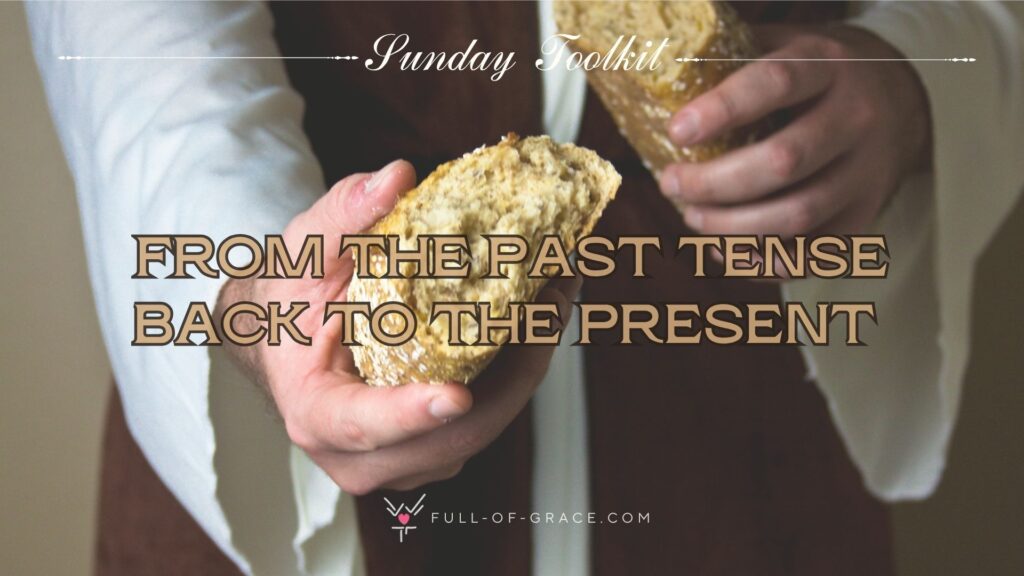
It is only at the table, in the specific gesture of taking bread, blessing, breaking, giving, that recognition breaks through. This gesture carried embodied memory that bypassed the grief-fogged mind and landed directly in the kardia – the heart-that-understands. They had been at table with him days ago. The gesture was unrepeatable, recognisably his.
In the instant of full recognition – he vanishes. He has done what he came to do. His disappearance confirms the recognition: he cannot remain localised in the visible now that he is known as the one who is everywhere.
The Return to Jerusalem
They set out that same hour – in the dark, seven miles back, without deliberation. The direction reverses automatically, as a consequence of encounter rather than as a moral decision. This is theologically precise: recognition of the risen Christ reorients not by demand but by gravity.
Jerusalem is where the community is assembling. When they arrive, before they can speak, the eleven say: “The Lord has risen and has appeared to Simon.” Their story fits into a story already being woven together. The return is from private grief to communal witness, from the past tense back to the present tense, from scattered to gathered.
Key Insight
The Emmaus account traces a pedagogy of perception: signs → sight → recognition → knowing – but none of these stages is the destination. They are conditions of approach. The destination is encounter with a living person, and encounter changes direction. The disciples’ journey from and back to Jerusalem is not incidental geography; it is the shape of what meeting the Risen Christ does.
The Common Thread
These four texts share a single, precise movement: from seeing to knowing to aligning. In Acts, Peter uses visible signs to argue for what cannot be directly seen – the resurrection – and calls his hearers to reread the visible world as transparent to the invisible. In Psalm 16, David does not see the Lord; he sets the Lord before him – a discipline of orientation that transcends visual access. In 1 Peter, revelation is the uncovering of what was always already known. And in Luke, recognition comes not through sustained observation but through a single embodied gesture – and then the one recognised immediately vanishes.
The temptation the readings identify is to fix on any one of these stages and treat it as the whole. Signs without interpretation breed only wonder or scandal. Sight without alignment produces the grief-walked road to Emmaus. Recognition without return to community stays private and unconfirmed. And knowing without the encounter that precedes it remains abstract.
What the Sunday offers is not better eyes but rightly ordered ones – eyes blessed to see through the visible to the living person it conceals and carries. The journey ends not in seeing more clearly, but in setting out again: “They set out that instant and returned to Jerusalem.”
Introduction to the Liturgy of the Word
“The readings today trace a journey from evidence to encounter. Peter, standing before a Pentecost crowd, uses visible signs to point toward what cannot be seen. The psalm practices a form of seeing that has nothing to do with eyes. And in the Gospel, two disciples walk seven miles in the wrong direction – until a gesture at a table breaks through everything that grief had obscured, and they find themselves already turning around. We listen now for the word that orients us.”
Go Deeper:
The Road That Turns Around: introduction to the Spirit and resources for This Sunday.
The Road and the Bread: Walk the Emmaus road through your body, not your mind – a sensory guided experience of the Gospel.
We Were Already Turning: Spirit-driven Prayer of the Faithful.




























One thought on “Set Before Me – 3rd Sunday of Easter: Biblical Background”
Comments are closed.