

One-sentence theme: God recreates — through clay and breath, through anointing oil and living light — the ones the world forgot to see.
Quick Reference
| Date | March 15, 2026 |
| Season | Fourth Sunday of Lent, Year A |
| Readings | 1 Samuel 16:1b, 6-7, 10-13a · Psalm 23:1-6 · Ephesians 5:8-14 · John 9:1-41 |
| USCCB link | https://bible.usccb.org/bible/readings/031526.cfm |
| Theme | Re-creation: God gives sight to those the world has rendered invisible |
| Previous Sundays Biblical Background | 1st Lent A: The First Hiding · 2nd Lent A: The Face That Shines · 3rd Lent A: The Well at Noon |
Where We Are in the Arc
This Lenten journey has been tracing one thread: hiding and unhiding. In the first week, we watched Jesus in the desert refuse to hide — standing face to face with the tempter, with God, with himself. In the second, we climbed the mountain and saw a face shine like the sun — glory erupting through concealment. In the third, we stood at the well at noon beside a woman who had arranged her entire life around not being seen.
Now, in the fourth week, we go deeper still. We move from the wilderness (exposure of the self in space) to the face (the surface that reveals or conceals) to the water jar left behind at the well (the object of an old life abandoned) — and now, to the eyes themselves. To the very organ of perception. The question this Sunday is not: where do we hide? It is: what keeps us from seeing at all?

The Readings in Context
First Reading: 1 Samuel 16:1b, 6-7, 10-13a
Historical and literary context
We are deep in the period of the early monarchy — approximately 1020–1000 BCE. The previous king, Saul, has failed not through battlefield defeat but through something more interior: disobedience, a drift from covenant. God now sends the prophet Samuel on a covert mission to Bethlehem to anoint a replacement. The word covert is worth pausing on: Samuel is afraid. He asks what he will say if Saul finds out. God gives him a cover story — bring a sacrifice. This anointing cannot happen in the open.
And yet what unfolds is a meditation on the nature of seeing.
What’s happening
Jesse brings his sons before Samuel one by one. Seven of them. Samuel looks at the eldest, Eliab — tall, impressive, exactly what a king should look like — and thinks: surely this is the one. The Hebrew word for his appearance is mar’eh (מַרְאֶה), related to the verb ra’ah (רָאָה), to see. Samuel sees the mar’eh — the visible appearance — and draws a conclusion. God stops him: “Not as man sees does God see, because man sees the appearance but the LORD looks into the heart.”
The Hebrew for “heart” here is lev (לֵב) — not the seat of emotion as in modern usage, but the centre of the whole person: thought, will, memory, perception. God doesn’t look at what presents itself to the eye. God sees into the core of what a person actually is.
Seven sons pass. None of them is chosen. And then: “Are these all the sons you have?” The question implies something — a gap, an absence, a person unaccounted for. Jesse’s answer is revealing: “There is still the youngest, who is tending the sheep.” The Hebrew od (עוֹד) — still, yet, remaining — carries a faint sense of afterthought. The boy was not summoned to the sacrifice. He wasn’t brought in to be evaluated.
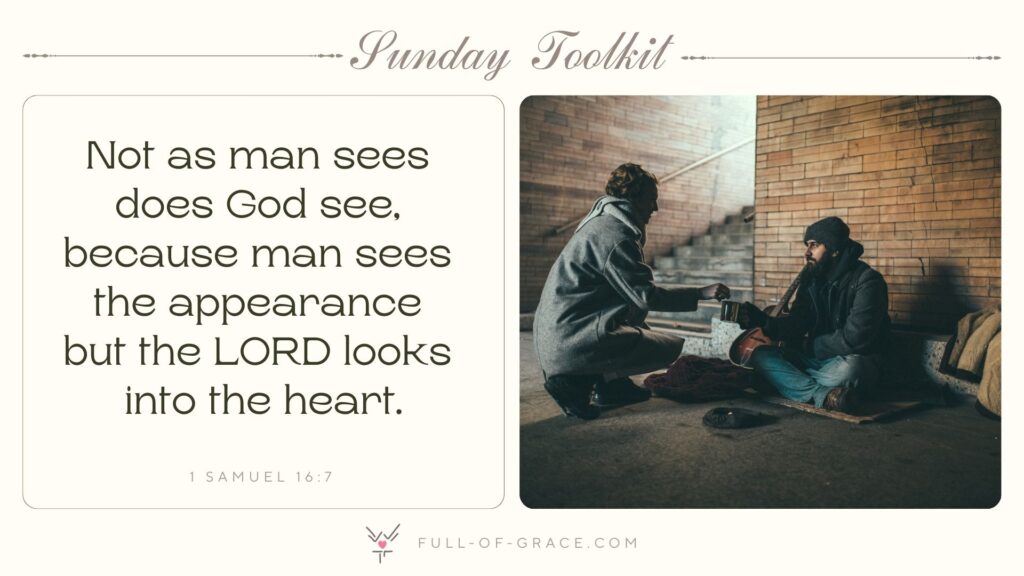
Key insight: David, hidden by his father’s shame
Commentators have long noted something uncomfortable in Jesse’s omission. David’s description when he is finally brought — admoni (אַדְמוֹנִי), ruddy, used in the Hebrew Bible only for David and for Esau — carries an echo of the rejected brother. His physical appearance, described as unusually fine-looking, has led some rabbinic and patristic sources to suggest that Jesse may have been uncertain of his youngest’s standing, perhaps even embarrassed by him. The boy looks almost too beautiful. He is tending sheep alone while his brothers stand in ceremonial array.
God has to say twice — to Samuel and, implicitly, to Jesse — this one. Even the prophet who has just been warned against judging by appearance hesitates when he sees David approach.
The one chosen is the one no one thought to call.
Rabbinic key
The Talmud (Sanhedrin 93b) records that Samuel himself feared David when he first saw him, because of his ruddy complexion — which he associated with the capacity to shed blood. God reassures him: he kills with God’s permission, as David killed Goliath. Even the choosing of David is shadowed by ambiguity. And yet: the spirit of the LORD rushes upon him. The anointing with oil — shemen (שֶׁמֶן) — is simultaneously a royal, prophetic, and priestly act. From that moment, David is not who the world thought. He has a new identity, conferred from outside, before he has done anything to justify it.
Responsorial Psalm: Psalm 23
What this psalm is doing here
Psalm 23 is universally beloved, which is also why it is so easy to read too quickly. In the context of this Sunday — and particularly in the shadow of what happens in the Gospel — it becomes the prayer of the re-created one.
David the shepherd boy, now anointed king, writes of God as shepherd. This is not purely metaphorical humility. It is the reversal of the gaze. The one who was left with the sheep is now describing his relationship with God in the language of sheep and shepherd — and finding in it not shame but protection, belonging, abundance.
The verse that unlocks everything
“You spread the table before me in the sight of my foes.”
The Hebrew is neged tzorerai (נֶגֶד צֹרְרָי) — before, in front of, in the sight of, those who press against me. The banquet is not held somewhere private and safe. It is held in the open, witnessed by enemies. Being seen in one’s full need and one’s full provision — not hiding, not performing — is the shape of the feast.
By the time we reach the Gospel, we will meet a man thrown out of the synagogue — publicly shamed, expelled, stripped of community. And the psalm says: God prepares a table right there. The anointing with oil (shemen again — the same word as David’s anointing) is not a private grace. It is poured out in the sight of those who said there was nothing worth anointing.

Second Reading: Ephesians 5:8-14
Historical and literary context
Paul is writing to the church at Ephesus, a community navigating what it means to live as followers of the Way within a thoroughly pagan urban culture. The letter is thought to date to the late 50s-early 60s CE, possibly from imprisonment in Rome. This passage falls within the parenesis (practical instruction) section of the letter, where Paul moves from the great theological arc of chapters 1-3 into its ethical implications.
What’s happening — and why the grammar matters
“You were once darkness, but now you are light in the Lord.”
This sentence is often softened in reading. We hear: you were in darkness. But Paul writes something more radical. The Greek is ēte… skotos (ἦτε… σκότος) — you were darkness. Not surrounded by it, not struggling in it. The old identity was ontological. Darkness was not your condition; it was your substance.
And the new identity is equally ontological: nun de phōs en Kyriō — now you are light, in the Lord. Not illuminated. Not approaching light. You are light.
The staggering logic of verse 13
“But everything exposed by the light becomes visible, for everything that becomes visible is light.”
Read this slowly. The claim is not merely that light reveals what was hidden. The claim is that the act of being exposed transforms. To be seen by light is to become light. Unhiding is not just revelation — it is transformation. The thing brought into the light does not remain what it was in the dark.
This is the theological spine of the entire Sunday. And it is what happens to the blind man in the Gospel.
The fragment of an ancient hymn
“Awake, O sleeper, and arise from the dead, and Christ will give you light.”
Most scholars believe Paul is here quoting an early Christian baptismal hymn — a liturgical cry, the kind of thing that would have been sung over those coming up from the baptismal waters. It is startling in its directness: arise from the dead. The movement from darkness to light is described as resurrection. Not gradual improvement. Not spiritual progress. Rising from the dead.

Gospel: John 9:1-41
Historical and literary context
John’s Gospel is theological in a way the Synoptics are not — each episode is placed with care, woven into a larger pattern of signs and discourses. We are in the middle section of the Book of Signs (chapters 2-11), following the Feast of Tabernacles and the declaration “I am the light of the world” in chapter 8. That declaration is now enacted. Jesus does not only say he is light. He gives sight.
The setting is Jerusalem. The Pharisees referenced here are not a monolith — the text itself shows some of them divided (v. 16: “And there was a division among them”). They represent institutional religious authority, and their relationship to the miracle is one of the most devastating portraits in all the Gospels.
The moment the disciples speak — and what they do
“Rabbi, who sinned, this man or his parents, that he was born blind?”
There is a man sitting right there. He can hear everything they are saying. And he is not being spoken to — he is being spoken about. The disciples have reduced a human person to a theological problem. Their framework is clear: suffering is the consequence of sin. Someone must be to blame. The man’s blindness has swallowed the man.
Jesus refuses the entire framework. He does not answer the question. He reframes it: “Neither he nor his parents sinned; it is so that the works of God might be made visible through him.” And then, immediately: “While I am in the world, I am the light of the world.” He does not philosophise about theodicy. He acts.
The clay: a second creation
“He spat on the ground and made clay with the saliva, and smeared the clay on his eyes.”
The Greek word for clay here is pelos (πηλός) — appearing only twice in the New Testament, both in this passage. In the Greek Septuagint, the word used in Genesis 2:7 for the dust of the ground from which God forms the human being is choun (χοῦν), but the Latin Vulgate renders Genesis 2:7 with limus terrae — mud of the earth. The theological resonance is unmistakable across traditions: this is the same material. Ground and moisture. Earth and breath.
The Hebrew word in Genesis 2:7 is aphar (עָפָר), which the lexicon defines not only as dust but also as clay, earth, mud. The same root — dust-that-becomes-clay when water is added. And crucially: the verb used in Genesis 2:7 for God forming the human being is yatsar (יָצַר) — to press, to shape, as a potter presses clay into a vessel.
Jesus picks up dirt. He adds the moisture of his own body — his saliva, ptysma (πτύσμα) in Greek. In the ancient world, saliva was understood to carry something of the life-force of the person, the breath made liquid. He presses the mud onto the man’s eyes: yatsar, the potter’s gesture. A second creation, using the same materials as the first — earth and the breath-force of God — to form what was not there before.
The Pool of Siloam, where Jesus sends the man to wash, means Sent — which is John’s constant name for Jesus himself, the one sent by the Father. To wash in the pool of the Sent One is already a theological statement.
The man who cannot hide
Most healing stories in the Gospels include a request. Someone asks, on their own behalf or on another’s: what do you want from me? Do you believe? Do you want to be healed? Not here. This man never speaks before the healing. He is approached by strangers who debate him as if he isn’t present. He is touched by someone he cannot see. He is given instructions he has no reason to trust. And he goes. He washes. He comes back able to see.
There is something devastating and beautiful in this. He has no hiding strategy. He has no credentials to manage, no performance to maintain. He has nothing except — as it turns out — one sentence he will not unsay: “One thing I do know is that I was blind and now I see.”
The courage of the expelled
The word John uses three times for what happens to this man is aposynagōgos (ἀποσυνάγωγος) — one who is put out of the synagogue. This compound word appears only three times in the entire New Testament, all in John, all referring to the threat or reality of expulsion from the Jewish community. The synagogue in the first century was not merely a religious institution; it was the social, economic, and legal centre of community life. To be aposynagōgos was to lose everything: belonging, legal standing, the network of relationships that sustained daily existence.
His parents, when summoned to testify, refuse to speak for him — explicitly because they fear this expulsion. They say: he is of age, ask him. They choose safety over their son. And the son, who has just been healed and knows nothing of theological controversy, stands before the Pharisees and argues. They tell him: “You were born totally in sin.” He answers: “I told you already and you did not listen. Why do you want to hear it again? Do you want to become his disciples, too?”
He is thrown out with the same verb — exebalon (ἐξέβαλον) — used in the Gospels for casting out demons. The mud thrown at him now is not clay and saliva. It is the language of religious certainty: you are a sinner, through and through, since birth.
The second finding
“When Jesus heard that they had thrown him out, he found him.”
This is one of the most quietly extraordinary sentences in the Gospel. Jesus goes looking. The man has lost everything — community, religious standing, the social fabric of his life. And Jesus walks toward him. Not toward the Pharisees. Not to settle the argument. To find the man who was thrown out.
“Do you believe in the Son of Man?” Now Jesus asks. Now the man can answer. The consent, the relationship, the recognition — these come after the healing, not before. Jesus first makes him visible enough to be found. Then he asks to be known.
“I do believe, Lord” — and he worshiped him.
The Greek prosekynesin (προσεκύνησεν) — he worshiped, he prostrated himself — is the same gesture the disciples make after the Transfiguration, faces to the ground on the mountain. The man born blind falls before the light. Not because he has worked out the theology. Because he has been seen.
The reversal
“I came into this world for judgment, so that those who do not see might see, and those who do see might become blind.”
The Pharisees ask: “Surely we are not also blind, are we?” Jesus says: “If you were blind, you would have no sin; but now you are saying, ‘We see,’ so your sin remains.”
The most dangerous blindness in this Gospel is not the kind you are born with. It is the kind that calls itself vision. It is the hiding that doesn’t know it is hiding — the concealment that wears the face of clarity, doctrine, certainty. We know. The two words that close the Pharisees off from everything.
The Common Thread: The New Genesis
Hold all four readings in your hands at once and something becomes clear.
Genesis is being re-enacted.
In the beginning: Let there be light. The first creative act is light, without which nothing else can take shape. John opens his Gospel: In the beginning was the Word — and quickly, The light shines in the darkness. Now in the Gospel, Jesus says I am the light of the world — and immediately presses clay onto the eyes of a man who has never seen.
The formula is the same as Genesis 2:7: earth, and the breath-force of God, pressed together into a new form. The first creation made the world visible. This re-creation makes one man visible — to himself, and to God. And Ephesians gives us the principle: what is exposed by the light does not merely become revealed. It becomes light itself.
David, the leftover son, is remade by anointing. The blind man, who has lived his entire life as a category rather than a person, is remade by mud and water and the act of being found. And Psalm 23 sings the prayer of the one who has been remade: the shepherd sees me, leads me, spreads a table for me in full view of those who said I was nothing.
The thread running through all four Sundays of this Lenten arc converges here: God keeps choosing the ones who cannot perform their own worthiness. The one who hid in the desert. The one who fell on his face on the mountain. The woman who came to the well at noon. And now: the man no one called, the man no one asked, the man whose expulsion became the ground of his encounter with the Light.
There is something in this Gospel that undoes the logic of the Fall. In Eden, being seen brought shame — so they hid. Here, being seen brings restoration. The man who was most exposed — born blind, publicly expelled, abandoned by his parents, called a sinner through and through — falls before the light and finds not judgment but worship. The new genesis does not ask you to clean yourself up first. It presses mud on your face and says: go wash.

Introduction to the Liturgy of the Word
For proclamation before the readings, or for use in a worship aid.
Today we enter the Sunday of clay and light. The readings invite us into the ancient story of re-creation: God seeing past what the world sees, God pressing new eyes from earth and breath, God spreading a table in the sight of our shame. We will hear of a boy no one thought to summon and a man no one thought to ask. We will be told that we were darkness — not that we were in it — and that now we are light. And we will watch a man thrown out of everything he knew find, in that very expulsion, the one who had been looking for him. Come. Let us listen.
More
Dive deeper into the Spirit of This Sunday
Now You Are Light: A map of where we are in the liturgical context and an overview of the resources for This Sunday.
You Are the One They Went to Call: A 5–7 minute embodied penitential rite — usable also as a post-communion reflection or proclamation of faith
We Will Not Begin Without Them – Prayer of the Faithful including Intercessions for those left out, omitted, passed over.























One thought on “The New Genesis: 4th Lent Year A: Background”