

One-sentence theme:
God lays his body down as the gate and calls – but the green pastures, the restful waters, the overflowing cup all wait on our response-ability: the freely chosen turn toward the voice that never stops leading.
Quick Reference
| Date | April 26, 2026 |
| Season | Fourth Sunday of Easter, Year A |
| First Reading | Acts 2:14a, 36–41 |
| Responsorial Psalm | Psalm 23 (22):1–6 |
| Second Reading | 1 Peter 2:20b–25 |
| Gospel | John 10:1–10 |
| USCCB Link | https://bible.usccb.org/bible/readings/042626.cfm |
| Theme | Response-ability: having been pierced, led, and called by name, what does it mean to actually follow? |
| Born to Recognise – Week 3 | Lips / Response-ability |
| Previous Sundays in this series | Week 1 – Ears: Divine Mercy Sunday · Week 2 – Eyes: 3rd Sunday of Easter |
Where We Are in the Arc
Born to Recognise is a seven-week journey from Easter Sunday to Pentecost, tracing the blessing of the senses as the risen Christ restores our capacity to perceive him. We began with ears on Divine Mercy Sunday – Thomas, the Shema, the breath that made the first community. Last Sunday, eyes – the road to Emmaus, the pedagogy of seeing that moved from signs through alignment to full recognition at the breaking of bread.
This Sunday, we arrive at lips – and the sense being restored is not speaking but responding. The heart that has heard, and seen, and recognised, is now asked to open in response. Not to perform. Not to recite a formula. But to answer a voice it already knows.
The entrance antiphon sets the frame: The merciful love of the Lord fills the earth; by the word of the Lord the heavens were made. Creation itself is the first response-ability – the world spoken into existence, the heavens formed by the breath of God’s mouth. Everything that follows in today’s readings is an unfolding of this: what happens in us when the same creative Word addresses us directly, and what we do – or fail to do – with the moment of being addressed.

The Readings in Context
First Reading – Acts 2:14a, 36–41
Historical Placing
The Book of Acts is Luke’s second volume, written for the same Gentile community as the third Gospel, most likely in the late 70s–80s AD. The time of narration is Pentecost – approximately fifty days after the Passover crucifixion, ca. AD 30–33. Peter is standing in Jerusalem before a diaspora crowd gathered for the feast. What we hear this Sunday is the conclusion of his Pentecost speech – the moment the argument lands and the question breaks open.
What Is Happening
Peter has built his case from scripture outward. He has cited Psalm 16, invoked David’s tomb, quoted Joel. Now he drives to the point with a force that has no pastoral cushioning:
“Let all the house of Israel know with certainty that God has made him both Lord and Messiah, this Jesus whom you crucified.”
The sentence is a thunderclap. It names the crowd as participants in the execution of the one God has now vindicated. There is no escape clause.
And then – the verse that is the hinge of this entire reading:
κατενύγησαν (katenygēsan) – they were cut to the heart.
This is not a gentle metaphor. The verb κατανύσσω (katanyssō) means to stab, to pierce, to sting. It is used in the Septuagint of Psalm 109 (110) for the kind of wound that takes a person down. Something got through the skin. The skin that normally manages, deflects, organises incoming information into acceptable categories – that skin was pierced. Not persuaded. Pierced.
And the wound produces a question: “Brothers, what must we do?”
This is response-ability in its most naked form. Not yet action. The moment before action, when the person who has been pierced knows they cannot remain as they were. The question – what must we do? – is itself the sign that something real has happened. The crowd is not asking for more information. They are asking what their life now requires of them.

The Sequence: Repent – Be Baptised – Receive
Peter’s answer moves through three registers, and the grammar is worth attending to.
μετανοήσατε (metanoēsate) – Repent. This is a second-person plural aorist imperative – a direct, active command. Do this. Now. The word is metanoia: μετά (meta) – beyond, after, across + νοῦς (nous) – mind, perception, understanding. A crossing-over of the mind. Not remorse – a reorientation of perception itself. You were looking at reality one way; now look again.
βαπτισθήτω (baptisthētō) – Let each person be baptised. The imperative shifts to the passive. After the active turning, something must be done to you. You cannot baptise yourself. You turn; then you are plunged. The active and the passive are both required – and in this order.
λήμψεσθε (lēmpsesthe) – You will receive the gift of the Holy Spirit. Future indicative – not another command but a promise, a consequence. The word receive here is not passive absorption. The Greek lambanō implies an active taking-hold-of – as when you receive a gift not merely by having it placed in your hands but by closing your hands around it, bringing it home, unwrapping it, putting it to use.
This three-beat rhythm – active turning, passive immersion, co-created receptivity – is the shape of the entire Sunday’s theology of response.
Key Insight
The piercing precedes everything. Repentance, baptism, the reception of the Spirit – none of these is available to the person who has successfully kept the Word at a managed distance. The question what must we do? is only possible for someone the Word has already reached. Response-ability, in this reading, is not a capacity we bring to the encounter. It is the capacity the encounter creates in us – by getting through the skin.
Responsorial Psalm – Psalm 23 (22):1–6
Historical Placing
Psalm 23 is so beloved it has become almost invisible through familiarity – which is precisely why this Sunday invites a different kind of reading. The psalm is attributed to David; whether in his voice or written in his memory, it carries the perspective of the shepherd-king. The man who was himself left with the sheep while his brothers were summoned to Samuel (1 Samuel 16 – the Fourth Sunday of Lent reading, now resonating backward through Easter) has found, in the language of pastoral care, the vocabulary for his relationship with God.
What Is Happening
The psalm is written entirely in the present tense with what the Hebrew grammarians call the imperfect aspect – ongoing, continuous, incomplete action that is happening now and keeps happening. Not he led me but he leads me. Not I shall not want as a future promise, but there is nothing I want as a present reality. The grazing, the leading, the restoration of the drooping spirit (נֶפֶשׁ, nefesh – the living soul, the throat, the very breath of life) – all of this is happening now.
This matters because it is easy to read Psalm 23 as a promissory note: one day, when the suffering ends, the green pastures will be available. But the psalmist is not writing from a place of comfort already achieved. He is writing from the place of the ongoing journey – “Though I walk through the valley of the shadow of death” – and asserting that the shepherding is present in the valley, not waiting on the far side of it.
The table spread in the presence of enemies is not held somewhere private and safe. The anointing with oil (שֶׁמֶן, shemen – the same root as the anointing of David in 1 Samuel 16, the same word in Ruth, the same substance as the Samaritan’s wound-dressing in Luke 10) is poured out in full view of those who said there was nothing worth anointing.

A Different Key
This Sunday, Psalm 23 is best read not as a declaration but as an examination of consciousness – the difference between what the psalm says the shepherd is doing and what we are actually allowing.
The psalm says: fresh and green are the pastures where he gives me repose. The question is: am I taking the repose being offered? Or am I still moving, still managing, still insisting that rest must be earned before it can be received?
The psalm says: near restful waters he leads me to revive my drooping spirit. The question is: am I following where I am being led? Or am I choosing my own route to water – faster, more efficient, less dependent?
The psalm says: you anoint my head with oil, my cup overflows. The question is: have I held out my cup? Or am I still waiting to deserve the anointing?
The green pastures, the restful waters, the overflowing cup – none of these are future realities the psalm is promising. They are present realities the psalm is describing. The shepherd is already there. The question Psalm 23 asks this Sunday is not when will God take care of me? but am I letting myself be cared for?

Key Insight
The grammar of Psalm 23 is the grammar of ongoing availability, not deferred promise. The Lord is my shepherd – present tense, now. The challenge is not to believe that the pastures exist, but to lie down in them. Response-ability, for the psalm, means accepting what is already being offered: the guidance, the rest, the anointing, the feast. The one thing Psalm 23 does not do is make any of this happen automatically. It describes a relationship, not a mechanism.
Second Reading – 1 Peter 2:20b–25
Historical Placing
The First Letter of Peter is addressed to scattered Christian communities in Asia Minor – people the letter calls parepidēmoi, resident aliens, sojourners. The letter was composed between the 60s and 90s AD for communities navigating what it meant to live as followers of the Way within Roman social structures that they did not control and could not easily escape. The passage we hear sits within a longer section on household relationships – which makes the language of slavery literal for a portion of the original audience.
The Translation Problem
The Irish Missal renders verse 20 as: “The merit in the sight of God is in bearing punishment patiently when you are punished after doing your duty.”
This is a significant mistranslation that changes the entire meaning of the passage. The Greek reads:
ἀγαθοποιοῦντες (agathopoiountes) – doing good. Not fulfilling an obligation. Not performing a role. Actively, freely choosing to do what is genuinely, morally good.
The sentence is: if you suffer while doing good and endure it patiently, this is grace before God.
That is a completely different claim from “if you suffer while doing your duty.” Duty is something owed, contracted, required. Good is something chosen, given, freely offered. The passage is not about compliance. It is about the person who has freely chosen to do good and discovers that the good they chose has cost them – and who endures that cost without collapsing into bitterness or retaliation.
What Is Happening
The key word is what Peter says Jesus did in the face of unjust suffering:
παρεδίδου (paredidou) – he handed himself over to the one who judges justly.
This is not the language of passivity or defeat. It is an active, deliberate, costly act of trust. Jesus does not go limp. He does not become a victim in his interior. He places his cause, his vindication, the outcome – into hands other than his own. He refuses to let the injustice of the situation determine his inner orientation.
And beneath it all – the slave mentality the reading is really naming is not the condition of those who are literally enslaved. It is the interior condition of anyone who does good in order to be rewarded for it. The person who counts their services rendered, who waits for the ledger to balance, who gives because it buys something – that person is a slave regardless of their social position. They are owned by the expectation. Every act of love becomes a transaction, and every unpaid debt becomes either a grievance or a collapse.
The contrast Peter is drawing is between two orientations: one that does good in order to receive, and one that does good because the Good itself is its own sufficient reason. Jesus did not endure the cross because it would be recompensed. He endured it because he had handed himself over to the one who judges justly – and that was enough.
The Guardian of Souls
The reading ends with a compressed Christological statement that ties directly to the Gospel:
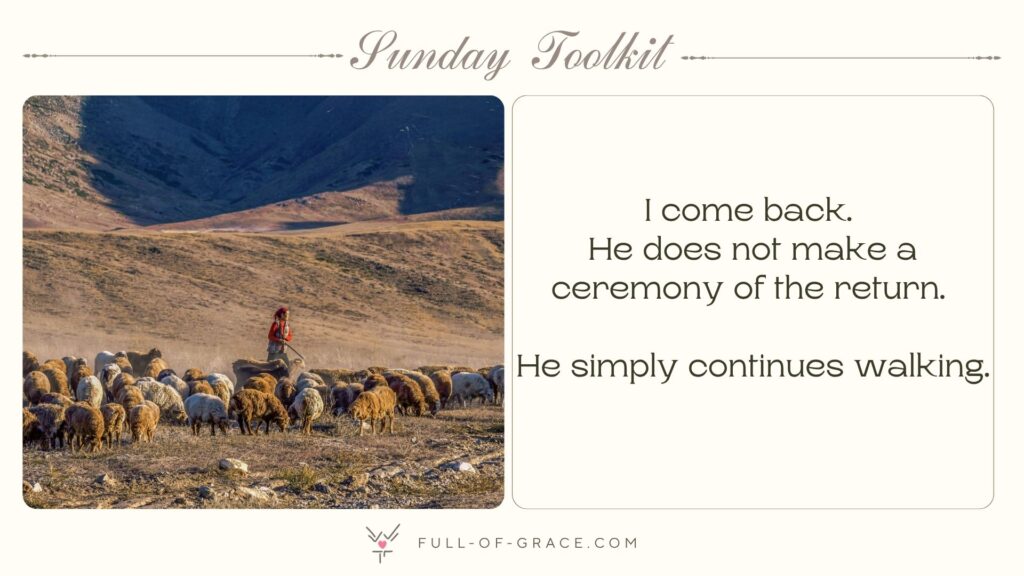
“You had gone astray like sheep, but now you have come back to the shepherd and guardian of your souls.”
The Greek word translated guardian is ἐπίσκοπος (episkopos) – overseer, the one who watches from above, the one who holds the wider view. It is the same root as bishop, and it appears here in combination with ποιμήν (poimēn) – shepherd, the same word as Psalm 23.
Peter is calling Jesus both shepherd and gate-guardian simultaneously – and in doing so he anticipates the Gospel with precision. The one who lies down in the threshold to protect is also the one who watches over from above, who sees what the sheep inside the fold cannot see, whose view encompasses both the dark of the night and the pastures of the morning.
Key Insight
The reading is not asking us to endure abuse. It is asking us about the interior orientation from which we act. When we do good in order to be rewarded – by God, by community, by our own sense of moral achievement – we have already turned our good into a form of self-management. We are climbing the wall rather than coming through the gate. The response-ability this Sunday requires is the freedom to do good without a ledger: not because we have been told to, not because it will be counted, but because we have encountered the one who did the same for us – and something in us knows the difference.
Gospel – John 10:1–10
Historical Placing
John’s Gospel was written in the late first century, most likely in the 90s AD, for a community with deep roots in Jewish scripture and practice. Unlike the Synoptics, John organises his narrative around signs and discourses – each sign enacted, then interpreted. The Good Shepherd discourse in chapter 10 is the interpretive expansion of the seventh sign: the healing of the man born blind in chapter 9.
This is not a new scene. There is no chapter break in the original. The Pharisees who interrogated the healed man and threw him out of the synagogue are still standing there when Jesus begins speaking. They are the immediate audience for everything that follows.
Slow Down: This Is Not the Good Shepherd Gospel
Before entering this Gospel, it is worth pausing to notice what it does not say.
The instinct of every reader who knows the tradition is to hear Good Shepherd Sunday and rush toward “I am the good shepherd.” We have the image already – the pastoral scene, the gentle shepherd carrying a lamb. We think we know what Jesus is saying.
But he does not say it. Not yet. Not this Sunday.
What he says – twice – is: “I am the gate.”
The church, with characteristic precision, has set the lectionary to stop before the familiar proclamation. It leaves us with a stranger, less comfortable image. Not the shepherd who carries us, but the threshold we must pass through. Not the one who walks beside us, but the one whose body is the condition of all movement in and out.
This is not accidental. It is an invitation to look more slowly at what is actually being constructed here.
The Scene John’s Audience Would Have Seen
For the first-century listeners who grew up watching shepherds, this image was Tuesday afternoon, not theological metaphor. A sheepfold in first-century Judea or Galilee was a low stone enclosure – fieldstones stacked chest-high – where several flocks from the surrounding area might be gathered together overnight for safety and warmth. One opening. No hinged door. Often, a person: a hired gatekeeper, or one of the shepherds taking his turn, lying across the threshold through the night. His body was the gate.
Nothing came in or went out without passing over him or through him. And in the morning, each shepherd came – and the gatekeeper recognised him. Not by certificate, not by credentials, but by face and voice and the knowledge of belonging. The shepherd who belonged could come through. Anyone who went over the wall had already revealed themselves: they could not be recognised, so they bypassed recognition altogether.
The sheep, for their part, sorted themselves out. In a fold containing several mixed flocks, each group recognised its own shepherd’s voice – a particular call, a distinctive pattern of sound – and followed. Not because they reasoned it out. Because they knew.

The Strange Construction of the Passage
Notice how oddly this passage is built. Jesus begins not with himself but with the thief and the brigand – the ones who climb the wall. Then he introduces the shepherd who enters through the gate, the gatekeeper who recognises and admits him, the sheep who hear their shepherd’s voice and follow. He goes ahead of them. They follow because they know his voice. They will not follow a stranger.
The listener waits. The whole narrative machinery is pointing toward a single identification: who is the shepherd?
And Jesus says: “I am the gate.”
Not the shepherd – yet. The gate.
John tells us the Pharisees did not understand. So Jesus speaks again. The second declaration – the doubled testimony, the two witnesses of Hebrew legal tradition sealing a truth – is:
“I am the gate. Anyone who enters through me will be safe; such a one will go in and come out and will find pasture.”
Twice stated. Ratified. This is the claim Jesus is making this Sunday, and it is worth sitting with it rather than skipping past it to the good shepherd who is still coming.
What Came Before: The Man Born Blind
The disciples’ question in John 9:2 is the question that opens the entire sequence: “Rabbi, who sinned – this man or his parents – that he was born blind?”
There is a man sitting right there. He can hear every word. And he is not being spoken to. He is being discussed. He has been reduced to a theological problem, a category requiring resolution. The question is not about him; it is about the correct assignment of blame. Whose sin is it?
This is the primal reflex – the one that goes all the way back to the garden. The woman. No – the snake. Redistribute the guilt. Find the origin point. Fix the category.
Jesus refuses the entire framework. “Neither he nor his parents sinned.” He does not reassign the guilt. He dissolves the question and acts.
The man is healed. He is interrogated by the Pharisees – twice. His parents are summoned and back away from him to protect themselves. He stands alone before the religious authorities and argues with a clarity and courage that the trained theologians cannot match. He says one thing and will not unsay it: “I was blind and now I see.”
For this, he is thrown out of the synagogue. The Greek is ἐξέβαλον (exebalon) – cast out, the same verb used for casting out demons. He is expelled, publicly shamed, stripped of community, legal standing, the social fabric of everything his life had depended on.
And this – this expulsion – is what moves Jesus to a different level entirely.
“When Jesus heard that they had thrown him out, he found him.”
He goes looking. Not for the Pharisees, not to settle the argument. For the man who was thrown out. He finds him and asks: “Do you believe in the Son of Man?” And the man who has lost everything falls before the light and says: “Lord, I believe.”
It is in this exact atmosphere – the healed man found, the Pharisees confronted, the question of spiritual blindness crackling through the air – that Jesus turns and says: I tell you most solemnly, anyone who does not enter the sheepfold through the gate but gets in some other way is a thief and a brigand.
The thieves and brigands are not an abstract category. They are standing right there.

Who Are the Thieves?
The Pharisees are shepherds of Israel. Real ones – by lineage, by appointment, by genuine religious authority. Jesus does not dispute this. What he names is how they got in.
They climbed the wall. Not by malice necessarily, but by a route that bypasses the essential question: are you recognised? They have authority, credentials, religious standing – all of it real. But none of it required them to stand at the threshold and have someone look at them and say: yes, this one belongs here. They got in by inheritance, by institution, by the accumulated weight of social structures built on other people’s sacrifice. They never had to be known.
And what do they do with that position? They decide who belongs in the sheepfold. They question the healed man until he is exhausted. They call him a sinner through and through. They throw him out. They use the wall they climbed to determine who gets expelled.
But here is what Jesus is saying: it is not your body lying in the gap. The authority to determine who is in and who is out belongs to the one who is willing to be the threshold – to be passed over, stepped on, vulnerable. The gatekeeper does not climb. The gatekeeper lies down.
Sin as Unwholing
The word behind the Pharisees’ accusation – you were born totally in sin – is χατα (khata) in Hebrew, rendered as ἁμαρτία (hamartia) in Greek. The standard translation is missing the mark. But the etymology reaches deeper.
The Greek hamartia appears to be formed from hama (together, in union) and artios (fit, complete, whole, in proper order). To sin is not merely to break a rule. It is to fall out of sync with what is whole, to act out of rhythm with the fittingness one was made for. Sin is dis-integration: the collapse of what should have been rightly ordered, timely, complete.
The Pharisees are accusing the blind man of precisely this: you are broken, you are not whole, you have been out of order since before you could choose. Your very existence is a dis-integration.
And Jesus – who presses clay from the earth (the same gesture as Genesis 2:7, the same materials as the first creation) onto the man’s eyes, who goes looking for him after his expulsion, who asks him a question and listens for the answer – Jesus is doing the opposite. He is refusing to let any human being be reduced to their brokenness. He does not accept that any person is beyond the fold.
The body lying in the gate is the body that protects the wholeness of the enclosure. Not by selecting who deserves to be inside. By being the threshold itself – by being what all legitimate passage must go through. No one gets to bypass that body and decide who belongs. The sheepfold’s wholeness is protected by a presence, not by a policy.

The Gate Opens Both Ways – and the Fold Has a Name
“Anyone who enters through me will be safe; such a one will go in and come out and will find pasture.”
In and out. Both directions. Through the same gate.
The sheepfold is not the destination. It is the night shelter – the place of safety during darkness, during the hours when the wolf might come. Morning comes, the shepherd calls, and the sheep go out through the gate into the open pasture where there is food and life and movement. The fold is not where the sheep are meant to stay. It is where they are kept whole until they can move again.
This matters because the Greek word the early church chose for itself – ἐκκλησία (ekklēsia) – is built from the same logic. Ek (ἐκ): out of, from. Kaleō (καλέω): to call. The church is literally the assembly of those who have been called out. Not called in, not gathered behind walls, not defined by who stays inside – but called out. Out of the flock of the night, through the gate, into the morning.
The word was not new with the early Christians. In the Greek world, ekklēsia described the assembly of free citizens called out of their homes into the public square to deliberate together. In the Septuagint, it translates the Hebrew qahal (קָהָל) – the congregation of Israel, the gathered people summoned by God. What the early church did was take both resonances and hold them together: a people called out of their private lives, gathered not around a political agenda but around a voice they had recognised, and then sent back out again into the world that needed them.
The sheep, in this image, are the ekklēsia in their most unguarded form. They are not defined by their theology. They are not sorted by their worthiness. They are defined by one thing only: they heard the voice, and they followed.
The Blind Man and the Dream of a Different Kind of Fold
But here is what the passage does not say directly, and what the contrast with the synagogue scene makes unmistakably clear.
The man born blind was not only healed. He was, for the first time in his life, seen.
He had spent his entire existence as an object of other people’s categories. A problem to be explained. A theological puzzle. The disciples spoke about him as though he were not there. His parents distanced themselves from him to protect their own standing. The Pharisees interrogated him twice, not to understand him but to find a way to dismiss him. His blindness had swallowed the man. What other people saw when they looked at him was not him – it was the question of whose sin caused this.
What Jesus does is refuse that reduction entirely. He does not ask whether the man is worthy of healing. He does not inquire about his faith, his family, his synagogue standing. He presses clay onto his face – the same materials, the same gesture as the first creation – and sends him to wash. He makes him visible before he makes him able to see.
And when the expulsion comes – when the man loses the community, the legal standing, the social fabric that the synagogue represented – Jesus goes looking for him. Not to argue with the Pharisees. To find the man who was thrown out.
It is hard not to read in this scene a kind of grief in Jesus – and a kind of dream. The synagogue should have been the fold. It should have been the place where the vulnerable are kept warm and safe through the night, where the wounded are tended, where the lost are found and brought back in. Instead it became the place that decided who was too broken to belong. The institution meant to gather became the institution that expelled.
And watching this, Jesus begins to describe a different kind of enclosure. One where the gatekeeper’s body is the only criterion for belonging. One where the sheep are not selected but called – where recognition flows not from credentials but from the knowing of a voice. A fold where the one who was thrown out is precisely the one who gets found and brought home.
ἐκκλησία – the called-out ones – is, from the sheep’s perspective, not primarily an institution. It is a warmth. It is the experience of arriving in the night after wandering, finding the enclosure, hearing a voice that knows your name, and being let in. Not because you passed a test. Because the gatekeeper recognised you. Because you had heard that voice before, somewhere, and you knew it was safe to follow it.
The fold exists for the morning. The safety of the night makes possible the movement of the day. And the gate opens both ways – inward to rest, outward to pasture – always through the same body, always through the same recognition, always through the one who chose to lie down in the gap so that nothing that enters or exits has to face the dark alone.

Key Insight
This Sunday does not give us a shepherd to trust. It gives us a gate to pass through – and a fold to come home to. The ekklēsia, seen from the sheep’s perspective, is not primarily an institution with rules about belonging. It is the experience of being called by name, led through, kept safe through the night, and sent out again into the morning.
The man born blind arrived at this gate with nothing left to protect. No credentials, no community, no family standing behind him. He had been stripped of everything the institutional fold could offer. And he was found. That finding – that deliberate, searching, particular recognition – is what the gate makes possible. Response-ability, in the Gospel’s terms, is simply this: hearing the voice, and following it through.
The Common Thread
Four texts, one movement: the piercing that makes response possible, and the gate that makes it real.
In Acts, a word gets through the skin of a Pentecost crowd and produces the question that changes a life: what must we do? The wound is not the end – it is the opening through which repentance, baptism, and the gift of the Spirit can enter. In Psalm 23, the shepherd is already in the pasture, already leading toward the restful waters, already anointing, already setting the table – and the psalm’s quiet challenge is whether we are actually following, actually resting, actually holding out the cup. In 1 Peter, the call is to do good without a ledger – to act from love rather than from the calculation of reward, which is the only interior freedom available in conditions we cannot change. And in the Gospel, Jesus names himself twice as the gate: the body lying in the threshold, the one through whom all legitimate passage moves, the one whose presence protects the wholeness of the sheepfold against everyone who would climb the wall and decide who belongs.
All four readings assume the same thing: God does not force. The Word pierces, but the question of what we do belongs to us. The pastures are green and the shepherd is leading, but the following is ours to choose. The gate is open, the voice is calling, the flock is moving out into the morning – and the sheep who do not respond are not expelled. They simply do not reach the pasture.
The green pastures, the restful waters, the overflowing cup – all of it is available, already prepared. The Sunday’s one question is: will you follow?
Introduction to the Liturgy of the Word
“Today we arrive at the fourth week of Easter with the sense of response on our lips. We have heard – and something pierced us. We have seen – the bread broken, the stranger recognised. Now the question opens: what do we do with what we have received? The readings today trace the shape of response-ability: a crowd cut to the heart asking what they must do, a psalm practiced in the present tense of ongoing trust, a letter about what it means to do good without keeping score, and a Gospel about a gate – not a shepherd yet, but a gate – whose body is the only legitimate way into the life that is being offered. We listen now for the voice we already know.”
Go Deeper
- The Sheep Who Answered – Sunday Experience: embodied response for the Fourth Sunday of Easter
- The Fold and the Morning – Prayer of the Faithful
- The Gate Is Open – Resources and Spirit of the Sunday










3 thoughts on “The Body in the Gap – 4th Sunday of Easter, Year A: Biblical Background”