
Quick Reference
| Date | April 26, 2026 |
| Season | Fourth Sunday of Easter, Year A |
| Placement | Post-communion reflection |
| Duration | 5–6 minutes |
| Format | Brief introduction + meditative psalm reading with interior noticing |
| Born to Recognise – Week 4 | Lips / Response-ability |

For the Minister
This experience follows communion. The congregation has just been at the table – the table set in the presence of everything that frightens us, the cup that overflows. This is the right moment to ask not do you believe? but what do you notice when you actually try to live it?
A few weeks ago, during Lent, we read Psalm 23 alongside the Gospel of the man born blind. In that experience, we invited the congregation to insert their own names – The Lord is my shepherd, I [name] shall not want – as a way of feeling the familiarity of the voice that calls us each by name. [Link to previous experience here.]
Today we come at the same psalm from the other side. Not the shepherd’s voice naming us – but our voice answering. Not the promise of green pastures – but the honest question of whether we let ourselves be led there.
This is not an examination of conscience. There is no accounting, no scoring, no inventory of failures. It is simpler and harder than that: a listening inward, to notice which lines of this psalm-response feel true in the body, which feel like a reach, which we quietly skip past.
Tone: Unhurried. Warm but unafraid of silence. This is not a performance – it is an invitation into the interior. Read slowly enough that the pauses are real pauses, not decoration.
Voice: Soft, grounded, present. Not dramatic. The psalm does its own work; your voice is simply the container.
Music: If your community uses music after communion, allow it to fade fully before beginning. Silence for at least fifteen seconds before the first word.

The Experience
(Allow silence after communion settles. Then:)
A few weeks ago, as we were preparing to walk into Holy Week, we read Psalm 23 together – the psalm of the shepherd who knows our name, who leads us beside restful waters, whose goodness and mercy follow us all our days.
We felt as if we could place our own names inside that psalm. The Lord is my shepherd. I, [name], shall not want. We listened for what it felt like to be the one called by name – known, held, led.
Today, having heard the Word, having sat at this table, we come at the same psalm from a different angle.
Not the shepherd’s voice. Ours.
If the sheep could pray – not the idealised sheep of religious imagination, but the actual sheep: the one who has wandered, the one who stood at the edge of green pastures and chose the dry ground because it felt safer, the one who sometimes finds restoration more difficult than wandering – what would that prayer sound like?
In a moment, I am going to read a psalm written in the voice of that sheep. As you listen, I invite you to close your eyes, or lower your gaze, and simply notice – without judgment, without pressure – which lines feel true in your body. Which ones you recognise immediately. Which ones feel like a challenge. Which ones you find yourself quietly moving past.
There is no right answer. There is only what is honest.
(Pause. Allow the space to settle.)
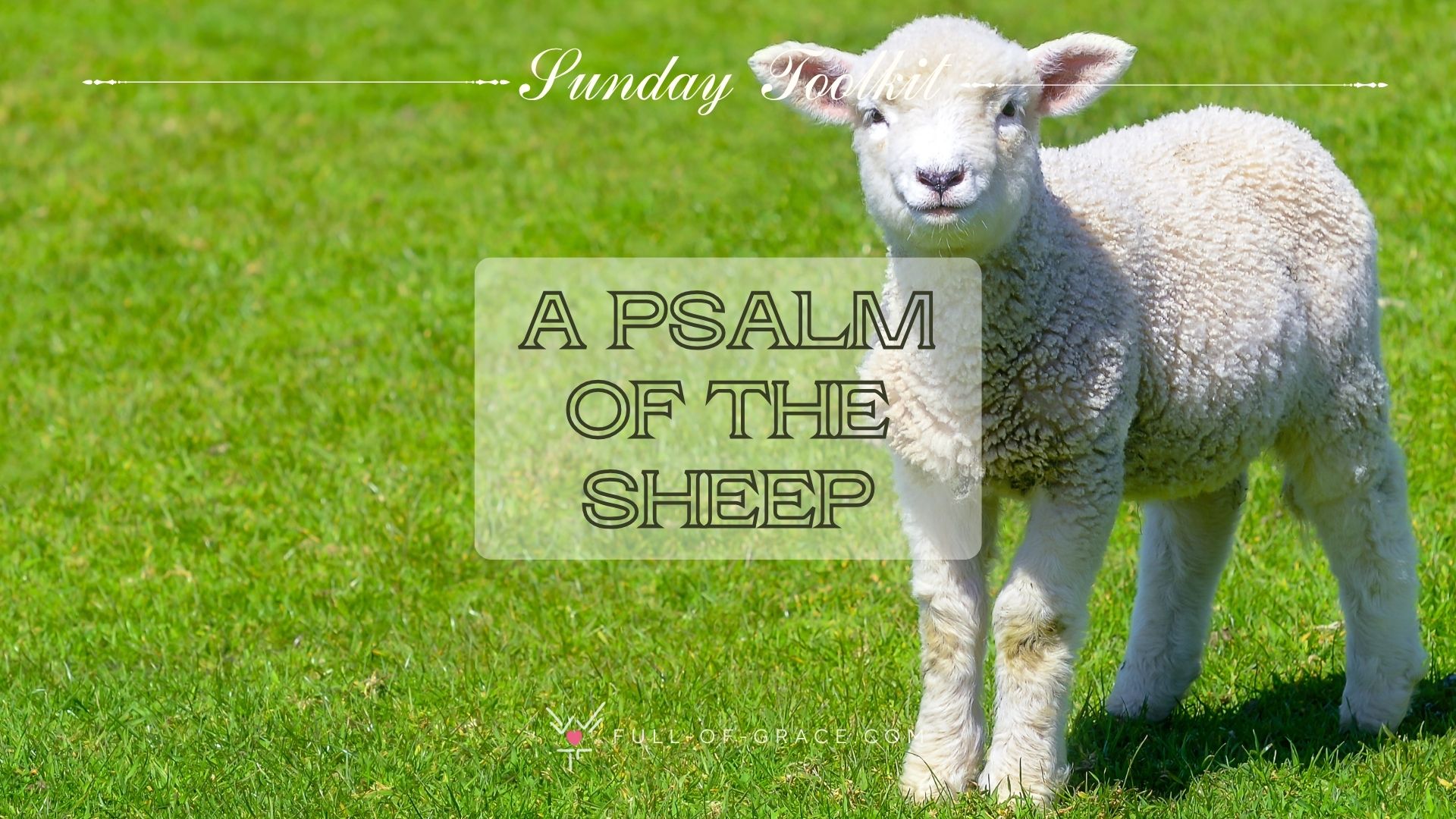
A Psalm of the Sheep
(Read slowly, with genuine pauses between stanzas – at least three seconds. The congregation is noticing internally; give them time.)
I am the sheep of the Lord.
There is nothing I shall want.
Sometimes my Shepherd’s generosity intimidates me
and every day I need to choose his green pastures
over and over again,
for the dry ground still feels more familiar.
(pause)
The Shepherd leads me beside restful waters.
Every morning I wait at the gate
and listen for the voice I have learned not to mistake.
I do not always follow immediately.
Sometimes I stand still and let the sound wash over me
before I remember that I know this voice,
that I have always known this voice,
that it called me by name
before I had a name for myself.
(pause)
He restores my soul
– the soul I wore down by wandering,
by eating what did not feed me,
by drinking from the streams of confusion.
I let him restore me.
This is harder than it sounds.
Sometimes it feels like a chore.
(pause)
But He is patient with me
and guides me along right paths.
I have learned to notice when my feet begin to turn away
– the small drift, the distraction, the familiar shortcut
that leads nowhere I want to be.
I come back.
He does not make a ceremony of the return.
He simply continues walking.
(pause)
Even when I walk through the dark valley
I am learning not to run ahead of him,
not to lag behind where the shadows gather,
but to stay close enough to hear his breathing
– that steady presence that does not panic,
that does not hurry,
that has walked this valley before
and knows where it opens.
(pause)
You have set a table for me
in the middle of everything that frightens me.
I am learning to sit down.
To let your love shower me.
To hold out my hands
and not move them away
when I doubt if I deserve what overflows.
(pause)
Goodness and mercy are following me
– I used to run from them,
thinking they were traps.
Now I recognise their sound.
I will dwell in the house of the Lord.
Not because I have earned the right to stay
but because I have finally stopped leaving.
(Longer pause – ten seconds at least. Let the psalm land.)
(Quietly, without rushing toward resolution:)
Notice what stayed with you.
One line, perhaps. One image. One place where something in you said yes – or not yet – or I wish.
You don’t need to do anything with it now. You don’t need to fix it or confess it or promise anything.
Just let it be what it is. The shepherd already knows which pasture you’re standing at the edge of. He is patient. He simply continues walking.
Whenever you are ready, you are welcome to open your eyes.
(Return to the liturgy at the minister’s discretion. No further words are necessary.)

Practical Notes for Ministers
On the pauses: The pauses between stanzas are structural, not decorative. Three seconds feels long when you are the one holding the silence. It is not long enough for the person listening. Err toward more.
On the final silence: Ten seconds after leaving is the minimum. Fifteen is better. This is the moment the psalm completes its work – do not talk over it.
On the closing words: He simply continues walking is a return to the psalm’s own language. It is meant as comfort, not challenge. Keep the voice warm and unhurried there.
On vulnerability in the room: Some people will find sometimes it feels like a chore unexpectedly destabilising – it names something they have been ashamed of. The warmth of your voice and the absence of any demand in the closing words is what makes the space safe. You are not asking them to change. You are asking them to notice.
On adaptation for the penitential rite: If you wish to use this at the opening of Mass instead, the introduction would need adjustment – removing the references to having already heard the Word and sat at the table. The psalm itself requires no change. The closing would become an invitation to turn toward the shepherd rather than to rest in having done so.
On music: If your community sings a post-communion hymn, this experience works best either before the hymn (as a bridge from communion to song) or in place of it. It does not sit well between two musical moments – it needs clear space on either side.
Feel free to use the slides if your community is familiar with visual aids.
Go Deeper
- The Body in the Gap – Biblical Background for this Sunday
- The Fold and the Morning – Prayer of the Faithful
- The Gate Is Open – Resources and Spirit of the Sunday
- Set Before Me – last Sunday’s Biblical Background, where shivviti opened the question this psalm now answers
- Previous Experience – Psalm 23 with names in Lent








2 thoughts on “The Sheep Who Answered – 4th Sunday of Easter, Year A: Experience”
Comments are closed.