

Sunday Experience — Penitential Rite: Second Sunday of Lent, Year A — 1 March 2026
Quick Reference
Date: 1 March 2026
Season: Lent, Year A — Second Sunday
Readings: Genesis 12:1–4a | Psalm 33 | 2 Timothy 1:8b–10 | Matthew 17:1–9
Theme: The light came for you too — on receiving God’s love as spoken to you personally
Primary Placement: Penitential Rite
Duration: 5–7 minutes
Practical note on placement: With minimal adaptation this piece can also serve as a post-communion reflection. If used after communion, the minister may omit the opening invitation to stillness — the silence after the Eucharist already holds that space — and move directly into the week’s invitation. The words of God and the closing prayer stand without change. Trust the assembly to find their own adaptation; it is not necessary to provide a separate script.
Full Script
Opening — settling into stillness
We begin, as always, by arriving.
[ pause — 5 seconds ]
If it helps, lower your gaze. Or close your eyes.
[ pause — 5 seconds ]
Let this week come back to you — not to analyse it, not to judge it. Just the headlines. The moments that shine, the moments that cost something, the moments you would rather not look at again. Let them rise, briefly, and be seen.
[ pause — 30 seconds. Hold the silence. Do not fill it. ]
Whatever is there — it is welcome here.
[ pause — 10 seconds ]
The words of God
Through the mouths of the prophets, through the voice that spoke on the mountain, God says this to you — today.
[ pause — 10 seconds ]
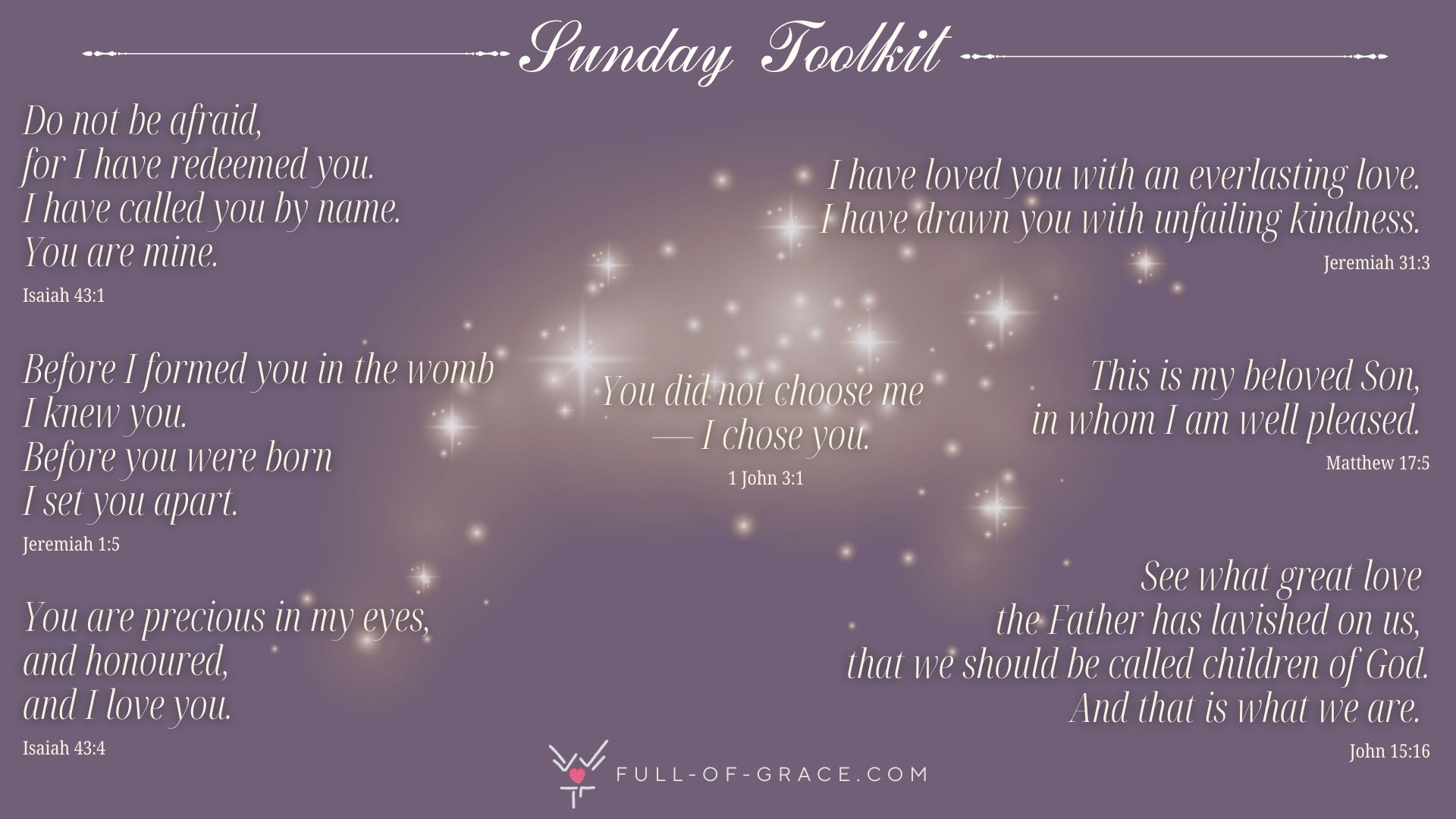
“Do not be afraid, for I have redeemed you. I have called you by name. You are mine.”
[ pause — 15 seconds ]
Notice what happens as you hear that. Do you receive it as spoken to you — or does it slide past, meant for someone else, someone further along, someone more deserving?
[ pause — 15 seconds ]
“Before I formed you in the womb, I knew you. Before you were born, I set you apart.”
[ pause — 15 seconds ]
This is not a general announcement. It is spoken to someone specific. Is that someone you?
[ pause — 15 seconds ]
“You are precious in my eyes, and honoured, and I love you.”
[ pause — 20 seconds ]
Am I willing to be loved like this? Or is it easier to stay with what I know — the weight, the failure, the familiar shape of my sin — than to let that be replaced by this?
[ pause — 15 seconds ]
“I have loved you with an everlasting love. I have drawn you with unfailing kindness.”
[ pause — 15 seconds ]
“This is my beloved Son, in whom I am well pleased.”
[ pause — 20 seconds ]
On the mountain, that voice broke through everything. Here, in this space, it speaks again. Can you let it reach you?
[ pause — 20 seconds ]
“You did not choose me — I chose you.”
[ pause — 15 seconds ]
“See what great love the Father has lavished on us, that we should be called children of God. And that is what we are.”
[ pause — 20 seconds ]
That is what we are. Not: what we might become. Not: what we will be when we have fixed enough of ourselves. What we are. Now. In this room. You, here, as you are.
[ pause — 20 seconds ]
Closing — returning to the rite
We have heard what God says about us.
[ pause — 10 seconds ]
We do not have to have an answer ready. We do not have to be certain we believe it yet. We only have to be here, in the hearing of it.
[ pause — 10 seconds ]
The light on the mountain was not asked for. It was not earned. It simply shone — and three people were there to see it.
[ pause — 10 seconds ]
We are here. That is enough.
[ pause — 10 seconds ]
Practical Notes for Ministers
Voice and pacing
This piece lives or dies in the silence. The words of God should be read as though each one is the only sentence in the room. If you feel you are going too slowly, slow down further.
The questions between the words of God are interior invitations, not homily. They should be quieter than the Scripture — almost a murmur. If the minister is uncertain whether to include them, err on the side of fewer. The words themselves carry the weight.
Do not explain, connect, or summarise between the Scripture sentences. Trust the assembly. Trust the silence.
Tone
Warm, unhurried, non-directive. This is not a guided meditation with a destination. It is a held space in which something may or may not happen. The minister’s job is to protect that space, not to fill it.
The opening invitation to let the week surface is not an examination of conscience. It is simply permission to arrive honestly. Some people will bring difficult things; most will bring a mixture. Do not steer what surfaces.
Potential discomfort
Some people find it very difficult to receive God’s love as personally addressed to them. Years of wrapping identity around sin, failure, or unworthiness make the words of God feel like they must be meant for someone else. This piece does not try to fix that. It simply names the question — is this for you? — and leaves it open. Do not close it for them.
If the assembly is visibly restless or unfamiliar with embodied prayer, the minister may shorten the silences slightly. But resist the urge to fill silence with words. A shorter silence is better than a verbal bridge.
The Scripture references
For parishes who wish to provide a printed or projected resource, a reference sheet is available listing the source of each Scripture sentence used. This allows people to return to the texts at home without the minister naming each reference during the rite, which would break the contemplative register. See the companion flyer for this Sunday.
Safe return
The closing section is the return sequence. Do not skip it or shorten it significantly. People may have gone to tender places. The three short sentences — we have heard, we do not have to have an answer, we are here — serve as a gentle landing before the formal rite resumes. The fig leaves matter: do not leave people exposed.
Check out more resources, including an overview of where we are This Sunday in the liturgical year and the Biblical narrative.
A reading-by-reading exploration of all four texts, tracing the common thread of presence and encounter.
Intercessions for the people who are actually in our pews — those hiding from the light, those managing God’s radiance at a safe distance, those who cannot quite believe the love is addressed to them personally.
















3 thoughts on “Are You Ready to Shine?: 2nd Lent, Year A, Experience”