We light the fourth and final candle of the Advent wreath. Traditionally called the Angel's Candle, it reminds us that God speaks through messengers—angels who appear in dreams, prophets who declare signs, voices that bypass our rational defenses and speak directly to sleeping, vulnerable hearts. At the threshold of Christmas, we encounter two fathers—one who refuses God's sign through control, one who receives it through surrender—and discover that Emmanuel comes anyway, calling us to belong to a family built on receptivity rather than our own orchestration.
Related Posts
Four readings, one Sunday, one unfolding fear: that God's care has to be earned. Isaiah, the Psalm, Paul in his cell, and the vineyard's late-hired workers each answer it a little further - until rest stops looking like something we owe and starts looking like nothing required.
Jesus looks at the crowd and his entrails move. The Greek word Matthew uses – splanchnizomai – is not sympathy observed from a distance. It is the same gut-response he has when he meets a mother walking behind her dead son's coffin. What does he see in the living that registers at the same depth as death? The 11th Sunday in Ordinary Time Year A takes us through Exodus 19, Psalm 100, Romans 5 and Matthew 9-10 – from the wilderness of Sinai to the missionary sending of the Twelve – following the thread of God's womb-mercy, the heartbeat that never stopped, and the cost of lending your flesh to carry it forward.
Trinity Sunday exists because of false gods. It was born in the fourth century when the Church faced a crisis – a theologically tidy Christ who didn't quite go all the way – and responded not with a better argument but with a feast. Every year on this Sunday the Church does what God did on Sinai: parades, calls out the Name, and asks whether we know what we are holding. Four free resources for the Solemnity of the Most Holy Trinity, Year A (May 31, 2026): biblical background, embodied Sunday experience, prayer of the faithful, and this overview of where we are and why it matters.
The first response to Pentecost was mockery. The Spirit arrived and things roughened. Resources for Pentecost Sunday Year A – biblical background, Sunday experience, and Prayer of the Faithful.

The Ascension of the Lord is one of the oldest feasts in the Christian calendar – and one of the strangest, because it barely describes the event it celebrates. This resources overview for Year A (May 17, 2026) explores the history of the solemnity, the order of the Great Commission and what it asks of us, an honest communal examination of where we are as Church, and a bridge into the final week of the Born to Recognise Easter series before Pentecost.

This Sunday We are six weeks into Easter. Six weeks of sitting with the Risen Christ before the Church sends us into Pentecost – and the readings are doing what they always do at this point...
Make room. This Sunday Jesus says: do not let your hearts be troubled – and every reading asks the same thing from a different angle. Free resources for the Fifth Sunday of Easter Year A: exegesis, a Taizé post-communion practice, and seven intercessions for parish use.
Good Shepherd Sunday Year A arrives with a surprising Gospel: Jesus calls himself the gate, not the shepherd. This hub gathers all the resources for the Fourth Sunday of Easter – deep biblical background on the sheepfold, the man born blind, and the etymology of ekklēsia; a post-communion psalm written in the sheep's own voice; and intercessions for all who are finding their way back. Part of the Born to Recognise Easter-to-Pentecost series on the blessing of the senses. Free liturgical resources for parishes, homilists, and liturgy teams.

Full liturgical resource suite for Easter Week 3, Year A: biblical background on shivviti and the Greek of recognition, a guided sensory journey through Luke 24, and intercessions for the pilgrim Church. Plus a teaser for this Saturday's Born to Recognise Week 2 – inner sight prompts and Joseph's story.
Complete free Sunday toolkit for Divine Mercy Sunday, Second Sunday of Easter, Year A (April 12, 2026). This week opens the Born to Recognise series – a seven-week Easter journey through the blessing of the senses toward Pentecost. Week 1 is the ear: the Shema, Thomas’s refusal of secondhand faith, the enephysesen as second creation, and the community breathed into by the risen Christ as the body through which hearing becomes possible. Includes biblical background, three-part embodied liturgy experience, Prayer of the Faithful centred on listening, and a personal reflection from the Scattered to Whole pillar.

A complete Prayer of the Faithful for Divine Mercy Sunday (Second Sunday of Easter, Year A, April 12, 2026), with celebrant introduction and conclusion. This week’s intercessions are centred on the sense of hearing: praying for the Church’s attentiveness, for leaders who must learn to listen, for all whose vocation is to receive another person’s reality, for confessors emerging from the Easter season, for those who confessed at Easter, for families, and for each person making room for the breath of God. Includes practical notes for readers and presiders.

Easter Sunday has passed. The tomb is empty. And now the real journey begins — fifty days the Church has always known it takes to grow into resurrection. Born to Recognise is a seven-week Easter season journey through the Sunday readings, following the ancient blessing of the senses from Thomas and the locked room all the way to the fire of Pentecost. For liturgy teams, for parish communities, and for anyone whose body knew something their head hadn't yet caught up with.
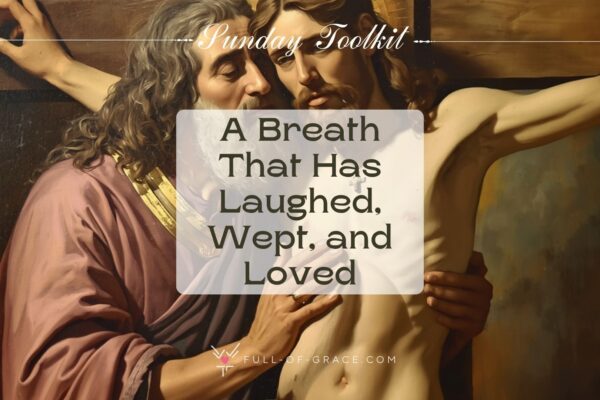
From the cross Jesus is quoting Psalm 31 almost word for word. But he makes one change — and that change alters everything. A close reading of the Greek and Aramaic of Luke 23:46: what Jesus actually said, what it cost him to say it, and why the Father was already running before the breath left his lips.
There is no Hosanna without the cross. The church reads both on Palm Sunday on purpose — refusing to let us celebrate the entry into Jerusalem while pretending we don't know how the week ends. This year, instead of the usual resources, an invitation to travel through Holy Week with one unexpected witness.
One Sunday before Holy Week, we arrive at a tomb. God unhides his tears. The sealed yetzer — the forming impulse that stopped expecting anything — is the theological heart of this Sunday's readings, and it runs from Genesis through Ezekiel, Romans, and John 11. Free resources for the Fifth Sunday of Lent Year A: in-depth biblical background, a near-silent guided stillness for presiders, and intercessions for the forgotten, the imprisoned, the grieving, and the ones who have stopped waiting.

What dies first is not hope but the capacity to expect. The Hebrew yetzer — the forming impulse, the faculty that reaches toward what doesn't yet exist — can seal itself so quietly we don't notice it's gone. The Fifth Sunday of Lent arrives with Ezekiel's promise, Paul's present-tense Spirit, and Jesus shouting into a four-day-old tomb. Free in-depth biblical background with rabbinic and Kabbalistic keys for liturgy teams, homilists, and Bible study groups.

Some Sundays need fewer words. This one needs almost none. A short guided stillness for the Fifth Sunday of Lent Year A — built around silence, a series of bare images, and the two sentences at the heart of John 11. Suitable for post-communion reflection or the penitential rite. Full script with pacing notes for presiders and liturgy coordinators.
One Sunday before Holy Week, we bring everyone to the tomb: the elderly abandoned in care homes, the imprisoned and rejected, those who cannot stop grieving, those in whom hope sealed itself shut so quietly they didn't notice. A complete Prayer of the Faithful for the Fifth Sunday of Lent Year A, ready to use, with a celebrant introduction and conclusion. Stands completely alone — no liturgical background required.
It is Laetare Sunday — the midpoint of Lent, the Sunday of rose vestments and the first glimpse of where all this is going. The Fourth Sunday of Lent Year A readings move the arc of hiding-and-unhiding to its deepest point yet: from wilderness, to face, to well, now to the eyes themselves. God presses clay on a blind man's face and re-enacts Genesis. David the overlooked son is anointed king before he has done anything to deserve it. And Paul tells the Ephesians something that should stop us cold: not that you were in darkness, but that you were darkness — and now you are light. Free resources for liturgy teams, presiders, and anyone preparing for this Sunday.
From David hidden among the sheep to the man born blind thrown out of the synagogue, the Fourth Sunday of Lent Year A readings tell one story: God re-creates those the world forgot to see. This biblical background post explores the Hebrew aphar (earth/clay/dust) that links Genesis to John 9, the Greek aposynagōgos and what expulsion from the synagogue actually meant in the first century, the ontological shift in Ephesians ("you were darkness"), and Psalm 23 as the prayer of the newly anointed one dining in the sight of enemies.
This embodied penitential rite for the Fourth Sunday of Lent Year A centres on one claim: God chose David knowing exactly who he would become — adulterer, the man who covered sin with death, the man who wept on the floor. And still called him a man after God's own heart. From that starting point, the rite moves into a participatory Psalm 23 where each person in the congregation speaks their own name into the gaps — stripping the familiar psalm back to something personal, unavoidable, and true.
Prayer of the Faithful for the Fourth Sunday of Lent Year A, with the response: Lord, let there be light — Jesus, you are the light. Intercessions for those passed over, children growing up in unworthiness, parents struggling to see their children, communities that exclude, and those living behind the certainty that keeps them blind.
This Sunday, the readings ask what we are still carrying from our narrow places into the free one. Israel drags its cattle into the wilderness. A woman carries her jar to a well at noon. Paul insists love arrived while we were still helpless. Free liturgical resources for the Third Sunday of Lent, Year A: in-depth biblical background with rabbinic and Kabbalistic keys, a somatic penitential rite built around the I Am exercise, and intercessions for the excluded, the thirsty, and the waters of the earth.
In Exodus 17, Israel quarrels at Horeb — the Dry Place — carrying cattle from Egypt into the wilderness, unable to trust that God will provide. In John 4, a woman carries a water jar to a well at noon, avoiding the gaze of her community. Paul tells the Romans that love was poured out while they were still helpless. The thread connecting all three: the portable Egypt we drag with us into the free place — and the moment we forget to pick it up.
Based on John 4 and the woman at the well, this embodied penitential rite invites the assembly into two movements: a somatic arrival at the well — heat, dust, the weight of what we carry — followed by a precise silent exercise. Who are you when you set down the jar? Full script with pacing notes and practical guidance for ministers.
Based on John 4 and the woman at the well, these intercessions pray for all who come to the well at noon — who avoid community, who define themselves by exclusion, who are thirsty in ways they cannot name. Includes petitions for clean water, ecological responsibility, the departed, and a celebrant introduction and conclusion that carry the spirit of the Sunday.

The Second Sunday of Lent moves us from desert to mountain. Last week the question was: where do you hide? This week it becomes: what do you do when the light comes toward you? Free resources for 1 March 2026 include a full biblical background tracing the Transfiguration through Moses, Elijah, and Abraham; a contemplative penitential rite built around God's words of love from Scripture, with space to ask whether you receive them as personally addressed to you; and a Prayer of the Faithful with intercessions for those hiding from the light, managing God's radiance, unable to receive forgiveness, and finding their way back. A personal reflection on the Gospel that brought one person home is coming soon.

What if the Transfiguration was not a once-only event staged to strengthen the disciples before the passion — but simply a glimpse of what always happened when Jesus was alone in prayer? This biblical background for the Second Sunday of Lent Year A explores Moses and Elijah not as symbols of law and prophecy, but as two human beings who knew from experience what it costs and what it means to shine with God's presence. One through prayer so sustained his face became unbearable to look at. One through depression so complete he lay down and asked to die. Together, alongside Abraham's embodied obedience and Paul's language of grace made manifest, they give us a Transfiguration that is not about spectacle — but about the passive, transforming gift of staying in the presence of God.

One of the quiet struggles at the heart of the confessional is that people return, year after year, carrying sins already absolved — not because they have not been forgiven, but because they cannot receive the forgiveness as given to them. This penitential rite for the Second Sunday of Lent, Year A, addresses that wound directly. Drawing on the Transfiguration's theme of light received rather than managed, it moves through a series of God's own words — from Isaiah and Jeremiah, through the Gospel of John, to the voice on the mountain — with space between each sentence to ask: do I hear this as spoken to me? A 5–7 minute fully scripted experience for the Penitential Rite, with pacing notes, minister guidance, and a note on adaptation for post-communion use.
Prayer of the Faithful: Second Sunday of Lent, Year A — 1 March 2026 Quick Reference Date: 1 March 2026 Season: Lent, Year A — Second Sunday Readings: Genesis 12:1–4a | Psalm 33 | 2 Timothy...
Complete free liturgy toolkit for the First Sunday of Lent (Year A). Includes in-depth biblical background on Genesis, Psalm 51, Romans 5 and the desert temptations, an embodied penitential rite, and Prayer of the Faithful. Explores the Lenten theme of hiding and unhiding — from fig leaves to the open desert. For liturgical coordinators, priests, and parish ministers.
In-depth biblical context for all four readings of the First Sunday of Lent (Year A): Genesis 2–3 and the Fall, Psalm 51's prayer for a clean heart, Paul's Adam-Christ parallel in Romans 5, and Jesus' three temptations in the desert. Includes a rabbinic key from the Talmud (Sanhedrin 38b) that reframes the Genesis story, the Greek behind "the tempter," and an introduction text for the Liturgy of the Word. Traces the common thread of hiding and presence across all readings.

A guided meditation designed as an embodied penitential rite for the First Sunday of Lent (Year A). Leads the assembly through body awareness into the places we hide — including our digital lives — and gently back to presence. Includes full script with pacing notes, practical guidance for ministers, and adaptation for post-communion reflection. Body-centred, pastorally sensitive, immediately usable.
Ready-to-use Prayer of the Faithful for the First Sunday of Lent (Year A). Seven intercessions rooted in the Sunday's theme of hiding and unhiding — praying for those who hide in loneliness, in performance, in shame, and behind screens. Includes celebrant introduction and conclusion referencing Genesis and the desert. Pastorally honest, immediately adaptable for any parish context.

This Sunday offers a unique opportunity to physically embody what it means to be the family of families, the domestic church gathered as one body. The family is the first church. Not because families are perfect, but because this is where we first learn what covenant means: staying when it's hard, protecting the vulnerable, making space for one another's growth, learning the rhythm of pouring out and being replenished. Consider incorporating these simple but profound resources to enhence your liturgy.
The peaceable kingdom isn't just a nice image for children's Bibles. It's the reality we're baptized into. The world where God's breath fills everything, where no one has to pay the cost anymore, where death itself is undone. As you prepare for this Sunday—whether you're preaching, planning, praying, or simply showing up—ask yourself: How much of this impossible vision do I actually believe? How much am I willing to live out? Enjoy these free resources designed to support your spiritual life and your ministry

Entering the Season of Threefold Coming Advent begins. But not as our culture often imagines it - not primarily as a countdown to Christmas, not as premature celebration with nativity scenes and...

QUICK REFERENCE Date: November 23, 2025Liturgical Season: Solemnity of Our Lord Jesus Christ, King of the Universe (Last Sunday in Ordinary Time, Year C)Readings: USCCB Lectionary #162 One-Sentence...

Free Catholic liturgical resources for the 33rd Sunday in Ordinary Time, Year C. This final Ordinary Sunday before Christ the King explores Jesus's loneliness as the temple falls and the widow's poverty-encounter that proves stronger than magnificent worship. Includes comprehensive liturgy planning guidance, music suggestions, biblical background, Prayer of the Faithful intercessions, and post-Communion contemplative practice. Perfect for homily preparation, liturgy coordinators, and parish teams.

Free Catholic Mass resources for 30th Sunday in Ordinary Time Year C (October 26, 2025). Biblical background, penitential rite, and liturgy planning help for parishes.
Complete free liturgy planning toolkit for 29th Sunday in Ordinary Time (Year C). Includes Prayer of the Faithful, biblical background, and embodied meditation. Perfect for liturgical coordinators, priests, and parish ministers preparing meaningful worship.

For years I treated Mass as individual worship time—me and Jesus, one-on-one, while other people became obstacles to my personal spiritual experience. I'd get annoyed at imperfect liturgy, off-key singing, wrong bell timing.
But what if that's backward? What if the question isn't "Will I be saved?" but "How do we enter fellowship at this table?"
The Onkalo metaphor gives us permission to have our own relationship with the Word—based on tradition and always connected to community, not running wild, but ultimately our own difference between life and death. We read that Word as if our life depended on it, and I truly believe it does.
The bread we encounter at Mass exists beyond anything we could discover in Haran—beyond the crossroads of religious achievement and spiritual grief, transcending all the liturgical preparations we might offer. Jesus himself represents the difference between tent-dwelling (temporary, provisional, always anticipating something better) and promised-land living (complete, satisfying, eternally fulfilling).
The Passover night, Abraham's city with foundations, the master's wedding feast—all point to the same reality: God's promises aren't just future hope, they're present invitation. The Eucharist is where tent becomes promised land, where servant becomes friend.
What connects a silver mirror, biting serpents, and the Bible's first murder mystery? The answer might change everything you thought you knew about spiritual life—and help you discover whose breath is actually sustaining you. An investigation into this Sunday's most challenging readings. 🐍🪞✨
Why does Jesus refuse to judge in this Sunday's Gospel? Why does Ecclesiastes call everything 'vanity'? Your biblical roadmap to the readings—plus a murder mystery hook that will change how you read Genesis forever. 📖🔍
Abraham's story teaches us something profound about prayer and relationship with God. The man who learned he couldn't trust his earthly father discovered he could completely trust his heavenly one. The God who listened as Abraham bargained from fifty down to ten righteous people is the same God who invites us to bring our daily bread concerns, our forgiveness needs, our fears about evil.
In this Sunday's readings, we witness a remarkable pattern of prayer that spans millennia. Abraham, walking alongside divine visitors on the dusty road from Mamre toward Sodom, dares to bargain with God for the lives of strangers. Centuries later, Jesus teaches his disciples to approach that same God as 'Abba'—Daddy. Both moments reveal the stunning truth at the heart of our faith: the Creator of the universe invites us into intimate, persistent, confident conversation. Prayer is not begging a distant deity, but trusting dialogue with a loving Father.
This embodied penitential rite invites us to notice where we're holding on—like Ahaz making treaties instead of trusting God's sign, like Joseph planning to leave before the dream changed everything. Through gentle body awareness and examination of conscience, we explore where we refuse control and where we're being called to receive what we cannot orchestrate. Perfect for the final Sunday before Christmas when we prepare to welcome Emmanuel into the grip and release of our actual lives. Can replace the standard penitential rite at the beginning of Mass.
Related Posts

What if the most ancient trinitarian blessing in Christianity – the grace of the Lord Jesus Christ, the love of God, and the fellowship of the Holy Spirit – wasn't just a liturgical sign-off, but a sentence you could actually use? This post-communion reflection for Trinity Sunday, Year A moves through five quiet movements of human need, and each time the whole assembly proclaims the blessing together. Not over strangers. Over each other. Over themselves. One sentence. One community.
We keep waiting for the tongues of fire. But the Spirit has been filling the whole world all along – the drawer where you keep your keys, the warmth of a voice on the radio, the weight of what your shoulders have been holding. This Pentecost litany invites each sense to pray in its own voice: not for more capacity, not for spectacular transformation, but for the permission to recognise what was already true. Part of the Born to Recognise Easter-to-Pentecost series on the blessing of the senses.

This Sunday experience for the Ascension of the Lord (Year A) invites the gathered community into an embodied encounter with their own hands – exploring the same hands that wipe and feed and type and receive communion – before gathering what is too heavy to carry alone, lifting it in offering, and resting in the silence that follows. Part of the Born to Recognise series on the blessing of the senses.

The sweatshirt counts. The most delicious meal counts. The rainy day you were inside for counts. A post-communion guided meditation that finds the Advocate not in the extraordinary — but in every ordinary moment of having been held.
What if post-communion singing became worship rather than performance? This Sunday Experience offers a Taizé-based post-communion practice –with breath-awareness prompts, multilingual options, and a note on guiding your music ministry into the space of the heart.
This post-communion reflection for Good Shepherd Sunday Year A builds on the Born to Recognise Easter series. Rather than reading Psalm 23 as the shepherd's promise, it offers a psalm written in the sheep's own voice – honest about wandering, about the familiar pull of dry ground, about the restoration that is harder than it sounds. The congregation is invited to close their eyes and notice, without judgment, which lines feel true, which feel like a challenge, and which they quietly pass by. A gentle, body-aware experience rooted in Gestalt awareness and the theology of response-ability.
This week’s Sunday Experience is distributed across three moments of the Mass: a thirty-second prayer before the Liturgy of the Word inviting the assembly to close their missalettes and receive the Word through the ear alone; a two-to-three minute somatic exercise after communion, placing the community in the upper room in the moment before Jesus breathes, attending to the quality of their own auditory anticipation; and at the Final Blessing, the ancient formula from the Rite of Christian Initiation – “Receive the sign of the cross on your ears, that you may hear the voice of the Lord” – spoken as the assembly traces the cross on their own ears. Full script with pacing notes for presiders and ministers.
Some Sundays need fewer words. This one needs almost none. A short guided stillness for the Fifth Sunday of Lent Year A — built around silence, a series of bare images, and the two sentences at the heart of John 11. Suitable for post-communion reflection or the penitential rite. Full script with pacing notes for presiders and liturgy coordinators.
This embodied penitential rite for the Fourth Sunday of Lent Year A centres on one claim: God chose David knowing exactly who he would become — adulterer, the man who covered sin with death, the man who wept on the floor. And still called him a man after God's own heart. From that starting point, the rite moves into a participatory Psalm 23 where each person in the congregation speaks their own name into the gaps — stripping the familiar psalm back to something personal, unavoidable, and true.
Based on John 4 and the woman at the well, this embodied penitential rite invites the assembly into two movements: a somatic arrival at the well — heat, dust, the weight of what we carry — followed by a precise silent exercise. Who are you when you set down the jar? Full script with pacing notes and practical guidance for ministers.
One of the quiet struggles at the heart of the confessional is that people return, year after year, carrying sins already absolved — not because they have not been forgiven, but because they cannot receive the forgiveness as given to them. This penitential rite for the Second Sunday of Lent, Year A, addresses that wound directly. Drawing on the Transfiguration's theme of light received rather than managed, it moves through a series of God's own words — from Isaiah and Jeremiah, through the Gospel of John, to the voice on the mountain — with space between each sentence to ask: do I hear this as spoken to me? A 5–7 minute fully scripted experience for the Penitential Rite, with pacing notes, minister guidance, and a note on adaptation for post-communion use.
A guided meditation designed as an embodied penitential rite for the First Sunday of Lent (Year A). Leads the assembly through body awareness into the places we hide — including our digital lives — and gently back to presence. Includes full script with pacing notes, practical guidance for ministers, and adaptation for post-communion reflection. Body-centred, pastorally sensitive, immediately usable.
A gentle Christian metta meditation for the Feast of the Holy Family (Year A), rooted in the vulnerability of the nativity. Beginning with the sleeping infant Jesus, this embodied prayer practice invites participants to slowly expand their circle of compassion through layers of relationship. Respects that some relationships may still be "on the threshold or outside the walls." Can be used as a penitential rite or post-communion reflection. 3-5 minutes, trauma-informed, invitational.
Most of us were baptized as infants. We have no memory of that moment—only photos, stories, perhaps a baptismal gown tucked away. This meditation invites us to experience, through imagination and the Holy Spirit, what happened to us spiritually in that moment. We're not pretending we weren't baptized—we're re-entering the mystery of what we already ARE.

A guided somatic meditation for post-communion adoration or personal Advent practice Introduction (spoken by the leader or read privately): In our Advent waiting, Christ invites us to keep watch...
Twelve Names for Jesus: An embodied post-Communion contemplative practice for the 33rd Sunday in Ordinary Time, Year C. As Ordinary Time closes, parishioners choose one scriptural name for Jesus to carry through the week—addressing him personally in prayer, loneliness, gratitude, and struggle. Includes twelve biblical names from Old Testament prophecy and Gospel revelation, plus practical implementation guidance for projection, printed inserts, oral transmission, and small community sharing.

Embodied penitential rite for 30th Sunday Ordinary Time Year C. "Two Bags" practice for Catholic Mass - laying down pride and shame to encounter God with empty hands.
Embodied post-communion meditation exploring body awareness, raised hands, and being held in community. 5-minute sensory prayer practice integrating somatic experience with Catholic faith. For contemplatives, Gestalt practitioners, and anyone seeking body-centered spirituality beyond intellectual belief. Deepens somatic awareness, physical presence in worship, and embodied Catholic spirituality. Sensation, breath, and the wisdom of the body. Free meditation script for parishes and spiritual seekers.
Ready-to-use Prayer of the Faithful for 4th Sunday of Advent (Year A). Free theologically-grounded intercessions aligned with Ahaz' story, St. Joseph's dream and other themes of this Sunday readings. Complete with celebrant introduction and conclusion. Download and adapt for your parish liturgy.
Reflecting Isaiah 7:10-14, Matthew 1:18-24 themes. Offering towards for liturgical coordinators, priests, and parish ministers to use immediately.
Related Posts
Jesus looks at the crowd and his entrails move. The Greek word Matthew uses – splanchnizomai – is not sympathy observed from a distance. It is the same gut-response he has when he meets a mother walking behind her dead son's coffin. What does he see in the living that registers at the same depth as death? The 11th Sunday in Ordinary Time Year A takes us through Exodus 19, Psalm 100, Romans 5 and Matthew 9-10 – from the wilderness of Sinai to the missionary sending of the Twelve – following the thread of God's womb-mercy, the heartbeat that never stopped, and the cost of lending your flesh to carry it forward.
What does it mean to keep something set apart – a name, a day, a life? These intercessions for the Solemnity of the Most Holy Trinity move from the Church's double calling, through those who abuse power and those who pay for their faith, to the ones who prayed and heard silence. One thread runs through all of it: the mercy that was always, already, passing before us. Complete, standalone Prayer of the Faithful for Trinity Sunday, Year A.
The Spirit places the name on our lips. The least we can do is use it. This Prayer of the Faithful for Pentecost Sunday Year A shifts the register of intercession from petition to proclamation – speaking the name of Jesus over the Church, political structures, those with abundance, the earth, those who feel orphaned, and our own communities. The congregational response – Jesus, you are Lord – is deliberately in the second person: not a statement about him, but a turn toward him. The intimacy the Spirit makes possible. Part of the Born to Recognise Easter-to-Pentecost series.

Five prayer intentions for the Ascension of the Lord (Year A, May 17, 2026) – praying for church leaders who hold the sacred and ordinary together, for communities that stay busy with the Gospel, for the wisdom to know the difference between service and avoidance, for the Ephesian spirit of perception, and for the grace to carry Sunday into Monday. Includes closing collect.
Intercessions for the season of first communions and confirmations, for those who left sacramental life feeling nothing changed, for the scattered, and for ourselves — that we know our reason for hope before we need it.
Seven intercessions rooted in Acts 6, 1 Peter 2, and John 14: for leaders who began with bread, for communities strong enough to hear a complaint, for those who feel rejected, and for all who have lost their way. Ready to use, adaptable to your community.
These intercessions for Good Shepherd Sunday Year A hold the full arc of the day's readings: the Church called to togetherness and witness, shepherds who need revival as much as any sheep, communities learning to receive the wandering without ceremony, those who exclude invited to surrender the gate, those excluded invited to hear their name, and all of us learning what it means to rest in the Lord on the day that was made for exactly that. Part of the Born to Recognise Easter-to-Pentecost series.
A complete set of intercessions for Easter Week 3, built around the Emmaus road: the pilgrim Church, communities learning to see with their hearts, families at table, travellers, the lost, and those whose eyes have not yet opened. Ready to use or adapt for any parish.
One Sunday before Holy Week, we bring everyone to the tomb: the elderly abandoned in care homes, the imprisoned and rejected, those who cannot stop grieving, those in whom hope sealed itself shut so quietly they didn't notice. A complete Prayer of the Faithful for the Fifth Sunday of Lent Year A, ready to use, with a celebrant introduction and conclusion. Stands completely alone — no liturgical background required.
Prayer of the Faithful for the Fourth Sunday of Lent Year A, with the response: Lord, let there be light — Jesus, you are the light. Intercessions for those passed over, children growing up in unworthiness, parents struggling to see their children, communities that exclude, and those living behind the certainty that keeps them blind.
Based on John 4 and the woman at the well, these intercessions pray for all who come to the well at noon — who avoid community, who define themselves by exclusion, who are thirsty in ways they cannot name. Includes petitions for clean water, ecological responsibility, the departed, and a celebrant introduction and conclusion that carry the spirit of the Sunday.
Prayer of the Faithful: Second Sunday of Lent, Year A — 1 March 2026 Quick Reference Date: 1 March 2026 Season: Lent, Year A — Second Sunday Readings: Genesis 12:1–4a | Psalm 33 | 2 Timothy...
Ready-to-use Prayer of the Faithful for the First Sunday of Lent (Year A). Seven intercessions rooted in the Sunday's theme of hiding and unhiding — praying for those who hide in loneliness, in performance, in shame, and behind screens. Includes celebrant introduction and conclusion referencing Genesis and the desert. Pastorally honest, immediately adaptable for any parish context.
Prayer of the Faithful for the Feast of the Holy Family (Year A): Liturgically sound intercessions honoring family as the first church while acknowledging complexity. Includes prayers for Church leaders' discernment in empowering families, those needing protection from unjust systems, family healing, those without family, and our beloved departed. Ready to use in parish liturgy.
Context: These intercessions flow from the Sunday's deep exploration of baptism as present tense reality, the peaceable kingdom as the world we're baptized into, and the call to stop hiding behind...

Presider: As we begin this season of watchful waiting, let us bring our prayers before the Lord who comes to us in light. For Pope Leo and all who keep watch over the Church: that they may lead with...

NOTE FOR LITURGY PLANNERS These intercessions are offered as a complete set, but you are invited to choose 4-5 petitions that resonate most with your community's current needs. Select the prayers...

Catholic Prayer of the Faithful intercessions for 33rd Sunday in Ordinary Time, Year C. Ten theologically rich, pastorally sensitive petitions flowing from this Sunday's themes: Church leaders serving from authentic poverty, world justice, creation care, dignity of labor, those whose structures are falling, courage to show up empty, faithful remnant, parish community, families, and the departed. Includes celebrant introduction and conclusion. Adaptable for local parish context.

Ready-to-use Prayer of the Faithful for 29th Sunday in Ordinary Time (Year C). Free theologically-grounded intercessions aligned with Moses' raised hands, persistent widow, and community support themes. Complete with celebrant introduction and conclusion. Download and adapt for your parish liturgy.
Reflecting Exodus 17, Luke 18, and Psalm 121 Ready for liturgical coordinators, priests, and parish ministers to use immediately.
Prayer of the faithful for 19th Sunday Ordinary Time Year C
Turning Sunday's meditation on breath, identity, and the 'Seth consciousness' into prayer. For when you're ready to move beyond the civil war between spiritual striving and spiritual bypassing. 🙏✨ #PrayerOfTheFaithful
Prayer of the Faithful for the 17th Sunday in Ordinary Time Year C

Two fathers. Both in the Davidic line. Both offered divine signs about sons. Both at impossible thresholds.
Ahaz: Refuses the sign. Trusts political alliances. Sacrifices his biological son. Represents control, calculation, visible power.
Joseph: Receives the sign. Trusts the dream. Adopts his non-biological son. Represents receptivity, surrender, invisible faith. And the good news that God works through the whole broken lineage—the refusers and the receivers both. Emmanuel comes anyway. We are called to belong.
Related Posts
Before we can hear what "the last will be first" really means, we have to stand in the marketplace - with the men whose whole day depended on being chosen. A reflection on Matthew 20:1-16, the market, the wage that was never the way out, and the rest Sunday finally offers.

Paul writes from a cell, awaiting a verdict he cannot control, and says he doesn't know which he'd choose — life or death. It sounds like arrogance. It isn't. A close read of the Greek, the prison behind the letter, and what it means to already hold citizenship no sentence can revoke.
The promise says he's close to all who call. So why doesn't it always feel that way? One Hebrew letter – the same one Jewish legend puts on a golem's forehead – turns out to hold the answer.

I open this reading braced for accusation – seek the Lord while he is still to be found – and find, underneath the fear, a God the Hebrew itself insists was never hiding. Dirshu, the word for seek, is Israel's old verb for consulting an uncertain oracle; b'himmatz'o, "to be found," names a condition that simply is, not a window that might close. From there the passage keeps unsettling what I thought I understood – an offering that may be moving in the opposite direction than I assumed, a love running on no compensation plan at all, a faithfulness set behind the cosmos itself. Isaiah 55:6–9, read slowly, through the Hebrew, for the 25th Sunday in Ordinary Time, Year A.

Solomon asks for a listening heart. Paul assures a suffering church it was loved before it was chosen. Jesus tells of treasure and pearl. And underneath: belovedness precedes the asking, and the Kingdom is never bought. The 17th Sunday in Ordinary Time (Year A) gathers Solomon's prayer at Gibeon, Psalm 119's delight in the law, Paul's "golden chain" in Romans 8, and Matthew's closing parables of the treasure, the pearl, and the net. Read through Hebrew and Greek exegesis, the wound beneath Solomon's origin story, and two patristic traditions on who is really doing the seeking in Matthew 13, this Background traces a single thread: every reading insists we are found before we ever go looking.

he darnel sown among the wheat isn't simply an unwanted plant – it's a toxic double, indistinguishable from the real grain until harvest, its roots already tangled with the wheat's own by the time anyone can tell them apart. This Sunday's readings hold that image up against a God whose might, Wisdom insists, is precisely what allows for patience – and a Psalm that shares one Hebrew verb, shuv, between our turning and God's. This biblical background moves through three readings of the parable – the community not rushed to judgment, the soul unable to sort its own wound from its own wheat, and the rite that takes generations, not one lifetime, to discern – arriving at a single image: an angel over every blade of grass, before anyone yet knows what it will become.

We think we know this parable – and we've turned it into a soil inspection: which ground am I? But the soil cannot move itself away from the thorns, and Genesis already told us the ground was cursed through no fault of its own. Read again through the eyes of the Sower who sows the way rain falls – without exemptions – this best-known parable becomes something else entirely: the reversal of the first curse, the healing the people feared, and the word that keeps returning to offer the soil a new name.

He arrives on a donkey, not a warhorse – humble not as a mood but as a legal condition, the posture of the one who owns nothing and gleans what the harvest left standing. This Sunday's readings – Zechariah's gleaning king, a psalm that falls silent exactly where it should praise God's faithful words, Paul's Spirit making permanent home in a mortal body, and Jesus naming the pre-verbal infant as the one who receives what the wise cannot – keep circling one threshold: the place just before speech, where nothing has been earned, and everything is still given.
There are three verses missing between last Sunday and this one. The lectionary simply skipped them. But they carry the taste of everything that follows – and without them, the Sunday gospel risks sounding like an impossible demand rather than an extraordinary announcement. Jesus is not asking for a performance of superior love. He is announcing that a new quality of time has begun. A time that cannot be entered by performing rites or rituals. A time that arrives, in its fullest form, in the smallest possible gesture: a cup of cold water handed to someone who is thirsty.

Your body reaches a point where it can't take in any more attention. Yet the attentive care doesn't stop. This Sunday's readings have a texture most Sundays don't carry - stranger, more interior, harder to sit still for. Jeremiah's kidneys. Hidden lice. The God who doesn't stop at knowing, but goes through.
Jesus looks at the crowd and his entrails move. The Greek word Matthew uses – splanchnizomai – is not sympathy observed from a distance. It is the same gut-response he has when he meets a mother walking behind her dead son's coffin. What does he see in the living that registers at the same depth as death? The 11th Sunday in Ordinary Time Year A takes us through Exodus 19, Psalm 100, Romans 5 and Matthew 9-10 – from the wilderness of Sinai to the missionary sending of the Twelve – following the thread of God's womb-mercy, the heartbeat that never stopped, and the cost of lending your flesh to carry it forward.

What actually happened on Sinai when God passed before Moses and called out the divine name? The rabbis found it almost too absurd to say – were it not written, they said, we wouldn't dare. This biblical background for the Solemnity of the Most Holy Trinity traces the Name from that ridiculous, intimate mountain procession through the furnace of three young men, through Paul's triage of a fractured community, to the most-quoted verse in Christianity – and asks whether we still know what we're holding.
The Spirit of Pentecost does not arrive to rebuild your reality. It arrives to change what your tongue can taste of this one. This biblical background traces the age of radical inclusion through all five liturgical texts – Acts 2's dismantling of the temple system, the Hebrew nefesh of Psalm 104, Paul's throwaway sentence that is actually the heart of everything, John's locked-room breath, and the Wisdom antiphon that has been saying it all along: the Spirit has already filled the whole world. What changes at Pentecost is not the Spirit's presence. It is our capacity to recognise it – by name, in our own language, from inside our own life.

The disciples stand looking at the sky while the angels ask the most pastoral question in the New Testament: why are you still here? This Biblical Background for the Ascension of the Lord (Year A) explores the Hebrew roots of Psalm 47's clapping hands, the order of the Great Commission in Matthew, and why Paul's prayer for the Ephesians is a prayer for recognition rather than arrival. The common thread: Christ withdraws the visible so that his fullness may dwell in our emptiness.

Philip doesn't arrive in Samaria because he planned to. He arrives because he is running. And the Spirit — apparently — does not share our maps. A biblical deep-dive into what it means to receive the blessing before the weight arrives.
What does it take for Christ to dwell in the heart? This Sunday's readings trace one movement: from the heart weighed down by its own meaning-making to the heart that has made space – and can ring out. Exegesis of Acts 6, Psalm 33, 1 Peter 2:4–9, and John 14:1–12 for liturgy teams and homilists.

The Fourth Sunday of Easter is often called Good Shepherd Sunday – but this year's Gospel stops just before that declaration. Jesus calls himself the gate. Twice. This in-depth biblical background explores what that means in the context of first-century shepherding practice, traces the full arc of John's ego eimi statements, recovers the Greek behind katenygēsan (cut to the heart) in Acts 2, restores the mistranslated 1 Peter passage, and reads Psalm 23 as examination of consciousness rather than promise. Part of the Born to Recognise Easter-to-Pentecost series on the blessing of the senses.
Emmaus, Psalm 16, and Peter's Pentecost speech all turn on the same question: what kind of seeing leads to encounter? From the Hebrew shivviti to the Greek epegnōsthē, these readings trace a pedagogy of perception – from signs to recognition to the broken bread that changes direction.
Biblical background for Divine Mercy Sunday Year A (April 12, 2026). Acts 2 gives us the community that has already been breathed into – their response is exultant, embodied, common. 1 Peter addresses those who have not seen, and tells them their joy exceeds description. And John gives us Thomas: the body-knower who refuses secondhand faith, and the Christ who comes back through locked doors to meet him exactly where his body is. Research and exegesis for liturgy teams, homilists, and Bible study groups.
From the cross Jesus is quoting Psalm 31 almost word for word. But he makes one change — and that change alters everything. A close reading of the Greek and Aramaic of Luke 23:46: what Jesus actually said, what it cost him to say it, and why the Father was already running before the breath left his lips.
What dies first is not hope but the capacity to expect. The Hebrew yetzer — the forming impulse, the faculty that reaches toward what doesn't yet exist — can seal itself so quietly we don't notice it's gone. The Fifth Sunday of Lent arrives with Ezekiel's promise, Paul's present-tense Spirit, and Jesus shouting into a four-day-old tomb. Free in-depth biblical background with rabbinic and Kabbalistic keys for liturgy teams, homilists, and Bible study groups.
From David hidden among the sheep to the man born blind thrown out of the synagogue, the Fourth Sunday of Lent Year A readings tell one story: God re-creates those the world forgot to see. This biblical background post explores the Hebrew aphar (earth/clay/dust) that links Genesis to John 9, the Greek aposynagōgos and what expulsion from the synagogue actually meant in the first century, the ontological shift in Ephesians ("you were darkness"), and Psalm 23 as the prayer of the newly anointed one dining in the sight of enemies.
In Exodus 17, Israel quarrels at Horeb — the Dry Place — carrying cattle from Egypt into the wilderness, unable to trust that God will provide. In John 4, a woman carries a water jar to a well at noon, avoiding the gaze of her community. Paul tells the Romans that love was poured out while they were still helpless. The thread connecting all three: the portable Egypt we drag with us into the free place — and the moment we forget to pick it up.
What if the Transfiguration was not a once-only event staged to strengthen the disciples before the passion — but simply a glimpse of what always happened when Jesus was alone in prayer? This biblical background for the Second Sunday of Lent Year A explores Moses and Elijah not as symbols of law and prophecy, but as two human beings who knew from experience what it costs and what it means to shine with God's presence. One through prayer so sustained his face became unbearable to look at. One through depression so complete he lay down and asked to die. Together, alongside Abraham's embodied obedience and Paul's language of grace made manifest, they give us a Transfiguration that is not about spectacle — but about the passive, transforming gift of staying in the presence of God.
In-depth biblical context for all four readings of the First Sunday of Lent (Year A): Genesis 2–3 and the Fall, Psalm 51's prayer for a clean heart, Paul's Adam-Christ parallel in Romans 5, and Jesus' three temptations in the desert. Includes a rabbinic key from the Talmud (Sanhedrin 38b) that reframes the Genesis story, the Greek behind "the tempter," and an introduction text for the Liturgy of the Word. Traces the common thread of hiding and presence across all readings.
Explore the biblical and historical context of the Holy Family readings (Year A): Sirach's defense of families under Hellenistic pressure, the meaning of splanchna compassion in Colossians, and Matthew's vulnerable Holy Family. Discover why the commandments were written not just on stone but in the "father and son" relationship, and how the Holy Family models a third way between therapeutic culture and toxic traditionalism.
This Sunday - Gaudete Sunday, "Rejoice Sunday" - stands as the rose-colored candle in our Advent wreath, a flicker of joy in the midst of purple penitence. But what kind of joy? The readings this week reveal a paradox that may be uncomfortable: the call to rejoice even when our own miracle doesn't come, to celebrate kingdom breakthrough while we ourselves remain at the threshold.

There's a mystical tradition in Judaism—found in Kabbalistic and rabbinic commentary—that plays with the Hebrew word for skin. The tradition suggests: We were first clothed in light. After the Fall, we became clothed in skin—in flesh, in mortality, in the kind of covering that requires death. Baptism is God's attempt to clothe us again in what we lost, to undo the first death, to reverse the sacrifice He had to make in the Garden. As we listen to the 2nd Advent readings, let us pay attention: How much of this message do we actually believe? How much do we claim as our own? How much are we willing to live out?

QUICK REFERENCE Date: November 20, 2025Liturgical Season: 1st Sundaynof Advent, Year A Readings: First Reading: Isaiah 2:1-5 Responsorial Psalm: Psalm 122: 1-2, 3-4, 4-5, 6-7, 8-9 Second Reading:...
QUICK REFERENCE Date: November 23, 2025Liturgical Season: Solemnity of Our Lord Jesus Christ, King of the Universe (Last Sunday in Ordinary Time, Year C) Readings: First Reading: 2 Samuel 5:1-3...

Deep biblical context for the 33rd Sunday in Ordinary Time, Year C. Explores Malachi's post-exile questioning, Luke's narrative of Jesus in his final week before crucifixion, the widow's radical trust versus temple-admirers, and Paul's teaching on table fellowship. Includes detailed historical context, theological insights, optional read-aloud introduction text for Liturgy of the Word, and reflection on Christ's loneliness when we perform worship instead of showing up in our poverty.

Biblical background for 30th Sunday Ordinary Time Year C. Explore Sirach 35, 2 Timothy 4, and Luke 18:9-14 - the Pharisee and Tax Collector parable for Catholic homily prep.
When prayer feels exhausting and faith grows heavy: Biblical reflection on Moses' raised hands, the persistent widow, and what it means to keep looking up when everything pulls you down. For anyone struggling to pray without ceasing. (29th Sunday Ordinary Time, Year C)
The Passover night, Abraham's city with foundations, the master's wedding feast—all point to the same reality: God's promises aren't just future hope, they're present invitation. The Eucharist is where tent becomes promised land, where servant becomes friend.
What connects a silver mirror, biting serpents, and the Bible's first murder mystery? The answer might change everything you thought you knew about spiritual life—and help you discover whose breath is actually sustaining you. An investigation into this Sunday's most challenging readings. 🐍🪞✨
Why does Jesus refuse to judge in this Sunday's Gospel? Why does Ecclesiastes call everything 'vanity'? Your biblical roadmap to the readings—plus a murder mystery hook that will change how you read Genesis forever. 📖🔍
Abraham's story teaches us something profound about prayer and relationship with God. The man who learned he couldn't trust his earthly father discovered he could completely trust his heavenly one. The God who listened as Abraham bargained from fifty down to ten righteous people is the same God who invites us to bring our daily bread concerns, our forgiveness needs, our fears about evil.
In this Sunday's readings, we witness a remarkable pattern of prayer that spans millennia. Abraham, walking alongside divine visitors on the dusty road from Mamre toward Sodom, dares to bargain with God for the lives of strangers. Centuries later, Jesus teaches his disciples to approach that same God as 'Abba'—Daddy. Both moments reveal the stunning truth at the heart of our faith: the Creator of the universe invites us into intimate, persistent, confident conversation. Prayer is not begging a distant deity, but trusting dialogue with a loving Father.