Quick Reference
| Date | April 26, 2026 |
| Season | Fourth Sunday of Easter, Year A |
| First Reading | Acts 2:14a, 36–41 |
| Responsorial Psalm | Psalm 23 (22):1–6 |
| Second Reading | 1 Peter 2:20b–25 |
| Gospel | John 10:1–10 |
| USCCB Link | https://bible.usccb.org/bible/readings/042626.cfm |
| One-sentence theme | God lays his body down as the gate and calls – but the green pastures, the restful waters, the overflowing cup all wait on our response-ability: the freely chosen turn toward the voice that never stops leading. |
| Born to Recognise – Week 4 | Lips / Response-ability |
Where Are We?
In the Liturgical Year
We are four Sundays into Easter – past the locked room, past the road to Emmaus, past the moment the bread broke and the stranger was finally recognised. The risen Christ has been finding his people one by one, in the places they least expected him: behind closed doors, on a road they were walking in the wrong direction, at a table they nearly didn’t stay for.
Each of those encounters asked something different. Do not be afraid. Were not our hearts burning? My Lord and my God.
This Sunday the question shifts. Not do you recognise him? but what do you do now that you do?
The season has been building toward this. We have been given ears to hear, eyes to see. Now we arrive at lips – at the moment of response. Not the response of the perfectly formed theological statement, but the response of the sheep who heard the voice, who recognised it, who is learning – slowly, honestly, not without difficulty – what it means to follow.
In the Biblical Narrative
We are standing at the seam between John 9 and John 10 – no chapter break in the original, no new scene. The man born blind has just been found by Jesus after his expulsion from the synagogue. The Pharisees are still present. The question that opened the whole sequence – who sinned, this man or his parents? – has been dissolved by Jesus without being answered. He did not reassign the guilt. He acted.
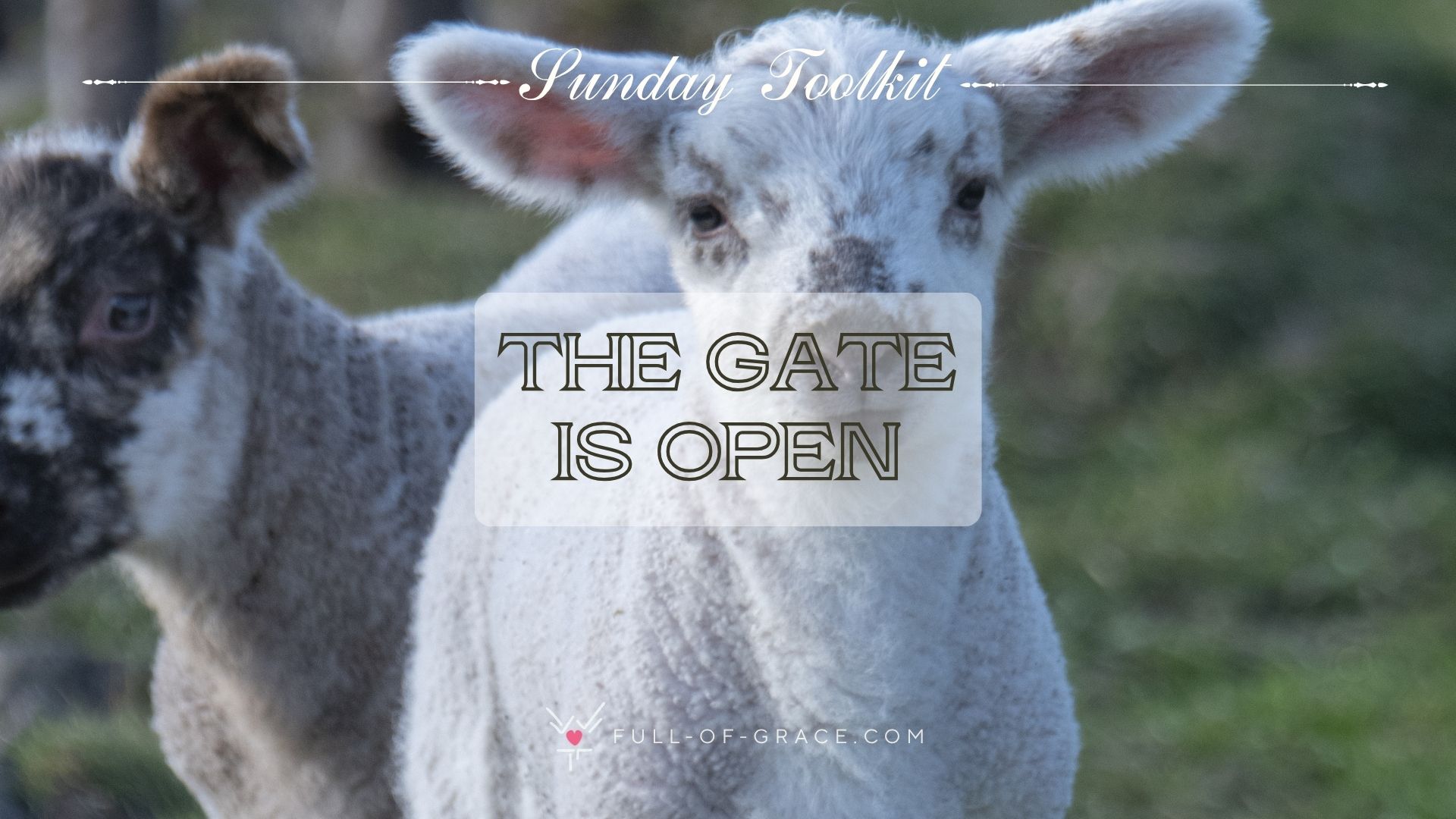
And now, in the same breath, Jesus begins to speak about sheepfolds and gates and shepherds and thieves – and names himself, twice, as the gate. Not yet the good shepherd. The gate. The body in the threshold. The one through whom all legitimate passage moves.
In Salvation History
From the beginning, God has been the one who goes looking. In the garden, after the hiding: where are you? In the wilderness, the pillar of fire that moved ahead of the flock. In Ezekiel’s grief over the shepherds who scattered the sheep: I myself will search for my sheep. In the Psalm written by the shepherd-king who was himself left with the animals while his brothers were summoned: the Lord is my shepherd.
The gate is not a new image. It is the culmination of a long story of a God who refuses to let the lost stay lost – and who asks, each time the sheep is found, not where have you been? but will you follow now?

The Spirit of This Sunday
There is a word underneath all four readings today that never quite gets named directly. It sits between the lines of Peter’s Pentecost speech, between the stanzas of Psalm 23, between the corrected translation of 1 Peter and the doubled declaration of the Gospel. The word is response-ability.
Not responsibility in the moral-duty sense – the weight of obligation, the ledger of what is owed. Something simpler and harder than that. The capacity to respond. The ability, when a voice calls your name, to open your mouth and answer.
Something happens before response is possible. In Acts, the crowd is katenygēsan – pierced, stabbed, stung. Something got through the skin. A word landed that could not be managed at a comfortable distance, and the wound it made produced the only honest question available: what must we do? That question is not the response itself. It is the moment the capacity for response opens. The skin was intact before; now it is not. Now something can get in – and something can get out.
But being pierced is only the beginning. Psalm 23 knows that the shepherd leads, but does not force. The pastures are green whether or not we lie down in them. The waters are restful whether or not we drink. The table is set, the oil is ready, the cup is held out – and every single image in that psalm is available now, in the present tense, in the ongoing imperfect of a God who has not stopped leading. The question the psalm presses this Sunday is not will he provide? It is will we receive?
And the Gospel gives us the image that holds it all together. Jesus does not describe himself as the destination, or the reward, or even the shepherd – not yet. He describes himself as the gate. The body lying in the threshold. The one through whom everything must pass, whose presence is the condition of all movement in or out. You cannot enter the fold without coming through him. You cannot go out into the morning pasture without passing over him. He makes himself the hinge of every belonging, every return, every sending-out.
The gate does not compel. It opens. It recognises. It waits.
Response-ability is simply this: coming to the gate. Standing before it. Letting yourself be known. And when morning comes – following through.

Symbols and Themes for Worship
The gate and the threshold – not as barrier but as body; the place of recognition, the hinge between safety and abundance. Consider how your physical space holds thresholds – the door of the church, the entrance to the sanctuary, the communion rail or step – as places where something passes between inside and outside.
The cup held out – the overflowing cup of Psalm 23 meets the cup of the Eucharist. This Sunday’s worship is an act of holding out our hands and not moving them away. The gestures of communion are the gestures of the psalm made literal.
Green and dry – the contrast between the pasture being offered and the familiar dry ground we return to out of habit. This is not accusation; it is recognition. The colour of Easter is already the colour of the pasture we are being led toward.
Morning and night – the fold as night shelter, the gate as the hinge of the day. The first light of Easter Sunday, the early morning of the empty tomb, the dawn breaking on the road to Emmaus – the whole season moves toward morning. This Sunday we ask: are we moving with it?
Silence as response – in a Sunday about lips and response-ability, the most powerful moment may be the one with no words: the post-communion silence, the space after the psalm of the sheep, the breath before what must we do? Design your liturgy to hold that silence rather than fill it.

Free Resources for This Sunday
The Body in the Gap – Biblical Background
For liturgy teams, homilists, and anyone who wants to go deeper before Sunday. This research-focused post explores what first-century shepherding practice looked like, why Jesus calls himself the gate rather than the shepherd this Sunday, the Greek behind katenygēsan (cut to the heart) in Acts, the mistranslated verse in 1 Peter, and how to read Psalm 23 as an examination of consciousness rather than a comfortable promise. Includes the etymology of ekklēsia – the church as those called out – seen from the sheep’s perspective rather than the institution’s.
For: homilist preparation, liturgy teams, Bible study groups, theologically curious readers.
The Sheep Who Answered – Post-Communion Experience
A few weeks ago, we inserted our own names into Psalm 23 and felt what it was to be called by the shepherd who knows us. Today, the psalm is written from the other side – in the voice of the sheep who has been found, and is learning what it means to stay. A meditative post-communion reading for communities ready to ask themselves, honestly and without judgment, which lines of that prayer feel true, which feel like a challenge, and which they quietly move past.
For: presiders, liturgy coordinators, retreat leaders. 5–6 minutes. No preparation required beyond reading the notes.
The Fold and the Morning – Prayer of the Faithful
Intercessions for the Church learning to gather and go out, for shepherds who need green pastures as much as any sheep, for communities with the capacity to receive the wandering without ceremony, for those who find their security in exclusion, for all who feel too broken to belong, and for ourselves – learning, one Sunday at a time, to hold out our cup. Complete with celebrant introduction and conclusion.
For: presiders, readers, liturgy teams. Stands completely alone – copy and use.
Looking Ahead
Next Sunday – the Fifth Sunday of Easter, Year A – the discourse continues. Jesus moves from the gate to the way: I am the way, the truth, and the life. Philip will ask to be shown the Father, and Jesus will answer with a question that lands like a quiet reproach and a deeper invitation: have I been with you all this time and you still do not know me?
The response-ability of this Sunday – the capacity to hear and follow – will be tested next week not by a hostile interrogation but by the bewilderment of someone who genuinely loves Jesus and still cannot see what is in front of him. The sheep who has learned to hear the voice will be asked, next Sunday, to recognise the face.
Born to Recognise continues
This Saturday the series continues midweek – two threads running in parallel.
The Born to Recognise spiritual practices offer a way to exercise the response-ability this Sunday opens: concrete, body-aware practices for training the senses to stay oriented toward the voice we have recognised.
And in Dust to Grace: Joseph’s Echoes of Yourself, the Joseph narrative invites us into biblical response-ability from the inside – because Joseph is a man who heard something, was stripped of everything, and had to learn over years and losses what it meant to keep following a voice that seemed to have gone silent. If you want to live this Sunday’s question rather than just think about it, Saturday is where to begin.








One thought on “The Gate Is Open – 4th Sunday of Easter, Year A: Resources”
Comments are closed.