
On findability, bringing clay to life, and living with a verdict
The Spirit of the Sunday
We’re deep in Ordinary Time – the long green season after Pentecost, the unhurried middle stretch where nothing liturgically dramatic happens and yet everything does. The 25th Sunday, Year A. No feast, no fast. Just Sunday. And this is where the readings hand us their most stubborn claim yet:
God is not waiting to be earned into presence.
He is not doling out nearness by the hour worked, or the ledger balanced, or the distance we manage to close on our own.

Isaiah opens with an imperative that turns out to be an invitation – seek, because he is findable, not because he is running out of patience. The psalm answers with a single Hebrew letter that legend once used to bring clay to life, and asks what it costs to call and actually be answered. Paul, writing from a cell with a verdict hanging over him, discovers a citizenship no sentence can revoke. And the landowner in Matthew’s parable keeps walking back to the marketplace – nine, noon, three, five – for the ones nobody else chose, and pays a full day’s wage for an hour’s work.
Four different rooms. One draft moving through all of them:
God keeps coming back for the overlooked.
Not because we finally deserved it. Because that’s who he already is.

1st Reading: Isaiah 55:6–9 – The Foundable One
“Seek the Lord while he may be found” doesn’t land as comfort at first – it lands as a task. Something in me hears it as an audit: have I shown up enough, prayed rightly enough, managed this relationship carefully enough to earn what’s being promised? That’s the discomfort this reading opens with – the fear that nearness has to be produced, that I’m the one who has to close the distance. But the language underneath the promise doesn’t describe a closing window. It describes what GOD already is. By verse 9 the question I walked in with – what must I fix in myself – has quietly become a different one: can I let myself be loved without paying for it in effort, without earning it in pain?
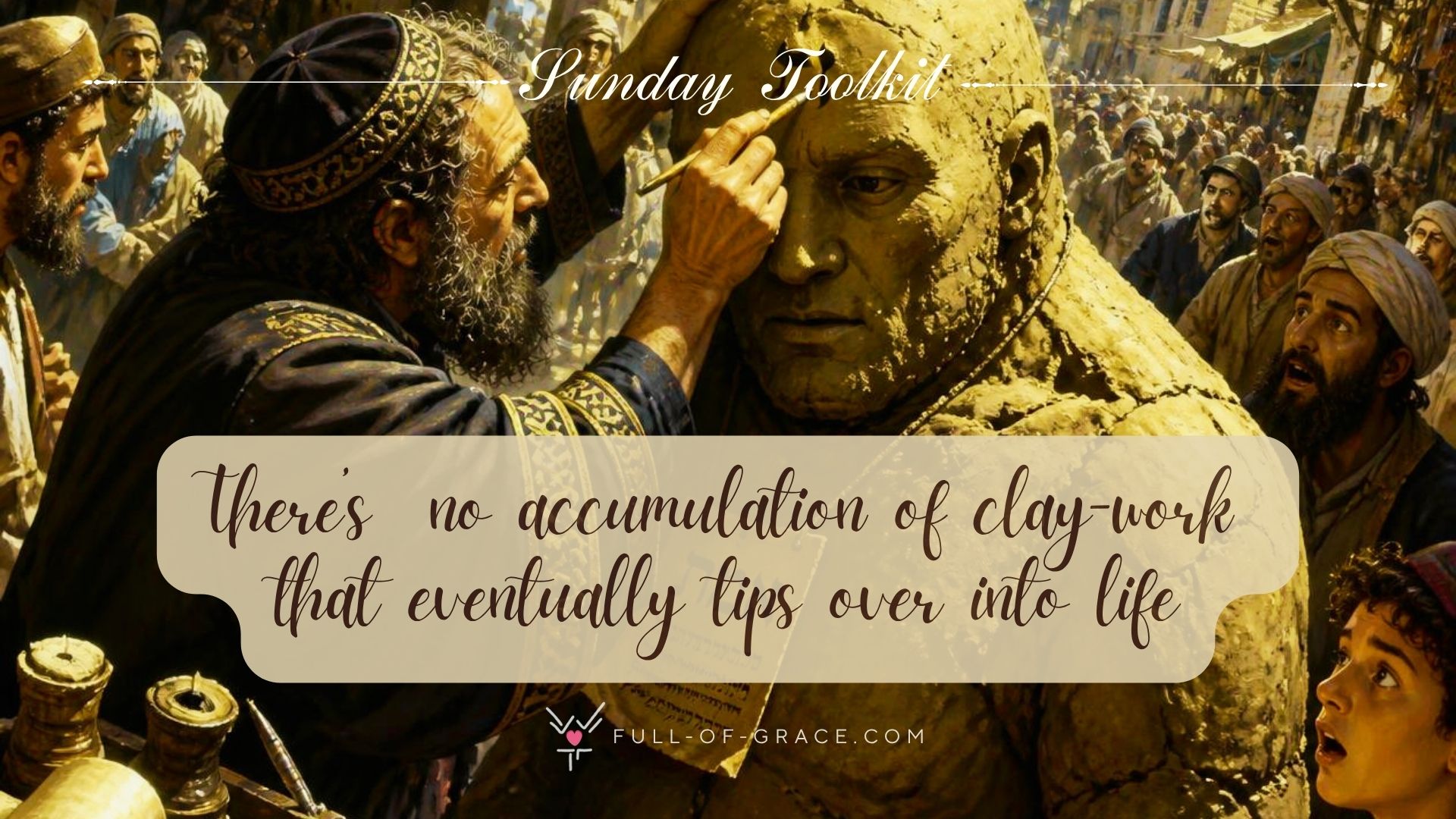
Psalm 145 — The Letter That Makes a Golem Live
So if God was never waiting on me to manage anything, why does “the Lord is near to all who call on him” so often not match what I actually feel when I call? That’s the question this psalm doesn’t let me skip. I know what it is to call into silence and wonder if I’ve been met, to feel like no amount of effort accumulates into the presence I was promised – dust piling up, never becoming life. The psalm answers with a single letter, the same one Jewish legend carved onto a golem’s forehead to make clay breathe, and it points somewhere I didn’t expect: not toward more calling, but toward rest- a weekly practice of making room instead of making things.
Read: The Letter That Makes a Golem Live →
2nd Reading: Philippians 1:20–24, 27 – Heaven’s Green Card
Making room instead of making things means letting go of the wheel, and that’s its own kind of fear. Prayer, it turns out, is an act of stepping out of the control zone – as control is the pathology of safety, the thing I reach for when I don’t trust that I’ll be held without it. Paul writes this from a cell, awaiting a verdict he cannot control, and somehow isn’t undone by that. Following the Greek back to his word for citizenship, I found something closer to communion than dissolution – not losing myself into safety, but being met inside what I can’t manage. Sunday doesn’t manufacture that freedom. It just gives us, weekly, the practice of resting inside what was already true.
Gospel: Matthew 20:1–16 – The Workers in the Vineyard
And this is where the fear finally says its real name: am I one of the chosen ones? Standing in the marketplace at the eleventh hour, still unhired, it’s hard not to read my own worth off the hiring order. But the landowner makes five trips that day, not one, and the last trip matters as much as the first. This reading brings the whole Sunday to rest – not the rest of doing nothing, but the rest of being allowed to be nothing but myself, already found, already paid, already wanted before I’d earned a single hour of it.
Read: The Workers in the Vineyard →





































3 thoughts on “Rest, Uninvoiced – 25th Sunday in Ordinary Time, Year A”
Comments are closed.