
On arrogance, choicefulness and surrender.
Reflection on Philippians 1:20-24.27
On arrogance
Read the following lines with no map of where they were written from, no name attached beyond “Paul,” no century, no cell:
Christ will be glorified in my body, whether by life or by death… I do not know which I shall choose.
Set beside a page, that sentence sounds like a man deciding his own mortality over breakfast. Do I live today, or do I go? Which will it be? It reads less like sanctity and more like a man who has confused himself with God.
Was Paul actually claiming that?
CORDINATES
Where are we in the Bible?
Paul’s letter to the church at Philippi, grouped among the “Prison Epistles” alongside Ephesians, Colossians, and Philemon – written from behind bars, to a church he could not visit. (Philippians 1:20-24, 27a – the second reading for 26th Sunday in Ordinary Time_A).
When was it written?
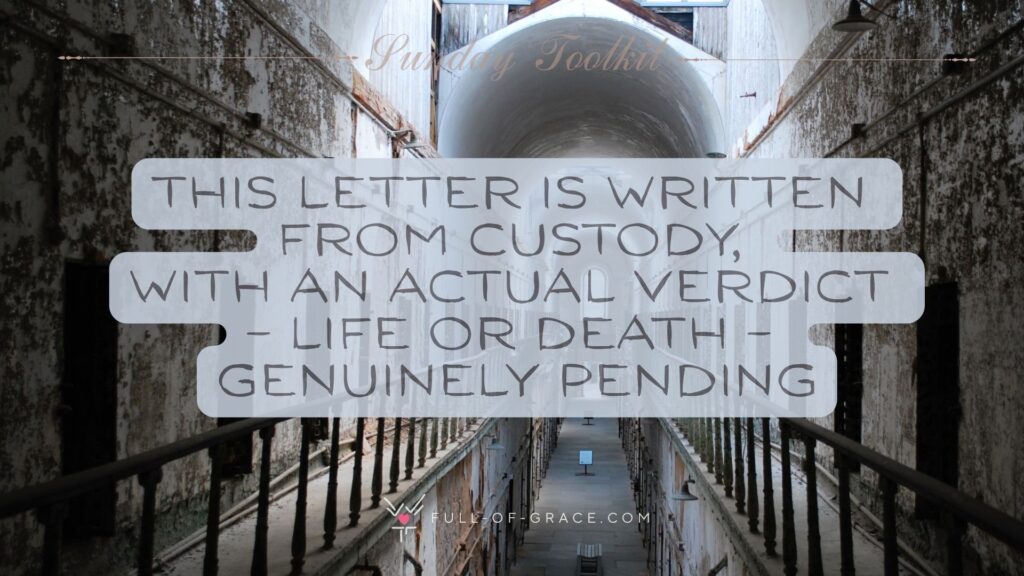
Most scholars place it around 60-62 AD, during Paul’s Roman imprisonment awaiting trial before Caesar; a minority argue for an earlier Ephesian imprisonment in the mid-50s. Either way, the letter is written from custody, with an actual verdict – life or death – genuinely pending.
What history does it answer?
Philippi was Paul’s first congregation on European soil (Acts 16), a Roman colony proud of its military veterans and its citizenship. Epaphroditus had carried the church’s gift to the imprisoned Paul, nearly dying in the effort. Paul writes back to thank them, to reassure a worried church that his chains have actually advanced the gospel, and to press them toward unity and joy in the face of their own suffering.
Where are we in salvation history?
This sits in the heart of the apostolic mission – the gospel now rooted in Gentile Europe, the church still small enough that one imprisoned apostle’s fate could shake an entire congregation, and Paul’s theology of union with Christ fully mature: already belonging to Christ completely, not yet released into what that belonging will finally look like.
Waiting for Footsteps: The Prison Behind Philippians 1:21-24
Years ago, producing documentaries for Polish television, I got access to a prison most people never see from the inside – over eight hundred men occupying an old monastery building turned into a house of punishment, different wings for different categories of sentence. What stays with me is how this place sounded. Gates buzzing open and shut, all day, no rhythm to it. Men shouting messages cell to cell, a whole parallel language moving through concrete. Being searched every single time you’re out or back in, even as a visitor, even for a couple of minutes.
One of the guards told me about the last man in that prison who’d been under sentence of death – with no date fixed for the execution. He said the man lived listening. Footsteps in the corridor meant one of two things, and there was no way to know which was comng: Dinner, or the end. That’s not a metaphor. That was his actual daily condition, for as long as it lasted.
I don’t know what Paul’s prison exactly sounded like. But I can connect to the shape of listening for a verdict with no date attached. The specific fatigue of a body kept in permanent readiness for news it can neither control nor schedule. That much crosses two thousand years intact.
And it isn’t only a prisoner’s condition – it’s ours, focused and intensified to fit our perception.
Every breath is already the difference between staying and going; we simply aren’t asked to feel that, most days.
Mercy keeps it out of focus. Paul’s cell strips the blindfold of mercy away.
Caught Between Two Loves
So though Greek for choose is here haireomai and it really means want, prefer, incline toward, we need to see the realistic capacity of Paul’s choicefulness.
And I do not know which I shall choose.
Right before this line, Paul says he’s synechomai – hemmed in, held tight from both sides, almost squeezed. That’s not a word a person reaches for at a control panel. It’s the word for being caught between two things that both have real weight, both pull at you honestly, while something else entirely decides which one arrives. A Roman court holds that particular decision. Not Paul.
And then there’s the word he chooses for departing, just a verse later – analysai – not really a word about dying at all. It’s a sailor’s word, a soldier’s word – untying a ship from where it’s moored, striking a tent to move on.
It’s the vocabulary of someone who has broken camp before, many times, and knows the motion in his hands. Not a martyr bracing himself. A traveler, mid-journey, half-listening for word to move.
So maybe choose was never claiming the outcome. Maybe it was only ever naming what it feels like to want two things at once, fully, while the actual door stays in someone else’s hand.

The God Who Needs Nothing and Still Chooses a Body
The real gift of surrender is not an excuse from decision making but freedom to accept any outcome. Life or death stops being Paul’s worry and becomes, instead, the material God is going to be visible in.
Christ will be glorified in my body.
Not “I will glorify Christ.” The verb isn’t his to perform. Something happens through him, whichever way the door opens.
Megalynthēsetai – “will be magnified.” It’s the same verb Mary sings in the Magnificat,
megalynei hē psychē mou ton Kyrion
my soul magnifies the Lord (Luke 1:42)
A magnifying glass doesn’t make a thing bigger than it is. It only makes what was already true visible to an eye that couldn’t perceive it unaided. God doesn’t become more glorious because of what Paul’s body goes through – glory doesn’t need adding to. It’s a God who, needing nothing, still chooses a body as the place to be found in.
And there’s a tender precision in the word we’re reading here – sōma, not sarx. Paul usually keeps these apart: sarx for the self turned inward on itself, sōma for the whole embodied person – the same word for “your body is a temple,” the same word for the body that will rise and still, somehow, be recognizably you.
So whatever glorifying and magnifying is happening here, it doesn’t ask the body to step aside first. It happens in the one he actually has – tired, aching, uncertain, listening for footsteps.
Nothing needs clearing out of the way before God can be seen in it. It was always the place God intended to be seen.
Communion Is Not Dissolution: The Saints on Being Close to God
There’s a longing that shows up often in prayer, and it’s worth naming honestly because it can pass for holiness while originating from the far end of God’ spectrum. The longing to dissolve – to stop being a separate ache, a separate tiredness, a separate self that has to keep showing up as itself, and instead just be absorbed. Gone into God the way sugar goes into water.
No more edges. No more the specific weight of being this person, with this body, in this cell or this kitchen or this week.
The saints point not toward less self, but toward a self finally met. Saint Faustina Kowalska, tasting what she calls Uncreated Beauty, doesn’t stop being able to report on it. Divine Mercy fills her entirely so that not a single drop of her blood wouldn’t burn with it, but it’s still her blood burning. That’s not a woman who has dissolved. That’s a woman whose every particular, down to the blood, is now saturated and still fully hers to feel.
Communion, in the saints’ account, is never the body being cleared out of the way so the “real” meeting can happen. The body is where the meeting happens. It’s the site, not the obstacle.
So what is this communion, if not dissolution? Instead of definition, let me share my taste of it, as it’s closer to something most of us already know from very ordinary love.
I remember the moment I realized I was falling for the man who’s now my husband. He’d driven 300 km to meet me, arrived earlier than I expected, and I was still upstairs blow-drying my hair – not ready, nothing composed. The doorbell rang. I ran down. And as my hand landed on the doorknob, I went to arrange a smile for him – the pleasant, prepared kind you put on for someone arriving – and found I didn’t need to. It was already there.
That’s the taste. Not a smile assembled for the occasion. Not a prayer performed because it was due. Just the face reflecting, on its own, what the heart had already discovered.
Communion isn’t the self disappearing into God. It’s the self arriving at the freedom from rearranging itself – because the person on the other side of the door isn’t a task to be gotten right. They’re just who you’re already, helplessly, glad to see.

From Slave to Citizen: Why Sunday Rest Is Not Optional
There’s one line still waiting, the one closing this whole reflection:
avoid anything in your everyday lives that would be worthy of the gospel of Christ
– or, closer to Paul’s actual wording (compare with NLT),
live as citizens of heaven
The verb is politeuesthe, and in the whole New Testament it appears in exactly one other place: Acts 23:1, where Paul stands before the Sanhedrin – his life genuinely on the line – and says,
I have lived my life with a perfectly good conscience before God up to this day.
Same word, same stakes. It’s the word Paul uses for his own integrity under threat – answerable, and unashamed of the answer.
There’s a reason that word carries weight beyond the civics of it, too. A slave has no citizenship to exercise. A slave’s days belong to someone else entirely – measured out, spent, with no rest that isn’t first permitted. What Paul names in this one deliberate word is a change of legal status as much as a change of address: these Philippians are no longer people whose time and body belong to another master. They are citizens.
Which means, they have something a slave never has – a self that is genuinely theirs to bring, to rest, to offer space to encounter God.
That’s what Sunday actually asks of us, underneath all the tradition and the habit of it. Not a task to complete before Monday resumes. Not one more thing owed.
Sunday is citizenship exercised – the weekly practice of remembering that our days are no longer extracted from us the way a slave’s are, but given back to us as something we’re free to bring, whole, into communion.
The same body we’ve been tracing this whole reflection – tired, aching, uncertain, listening for footsteps, and still the exact site where God chooses to be seen – that’s the body Sunday rest is for. Not a body set aside so the “real” worship can happen without it. The body itself, allowed finally to stop proving its worth for a day, and simply be received.
Paul in his cell had no Sunday obligation to keep. He had to find, inside a sentence with no date, the same freedom we’re handed every week almost without noticing: that we are already citizens, already children and not slaves, already loved before the day’s labor starts and regardless of how it ends.
Sunday doesn’t manufacture that freedom. It just gives us, weekly, the practice of resting inside communion.
This reflection is a part of a four movements journey.

























One thought on “Heaven’s Green Card: Paradise in Prison (Philippians 1, XXV_OT_A)”
Comments are closed.