Quick Reference
Date: May 31, 2026
Season: Ordinary Time (Solemnity of the Most Holy Trinity)
Lectionary: 164
USCCB: https://bible.usccb.org/bible/readings/053126.cfm
Readings: Exodus 34:4b-6, 8-9 | Daniel 3:52-56 | 2 Corinthians 13:11-13 | John 3:16-18
Theme:
The Name that God called out on Sinai – absurd, merciful, twice – has been carried across every generation by people who risked enormously to hold it.
The Readings in Context
First Reading: Exodus 34:4b-6, 8-9
Historical Placing
We are at Sinai, approximately the 13th century BCE in the traditional dating, in the immediate aftermath of the golden calf catastrophe. This passage belongs to the Yahwist and Elohist strands of the Pentateuch, reaching their final edited form during or after the Babylonian exile – a community that knew something about rupture and the desperate need for God’s face to remain turned toward them.
What’s Happening
What the lectionary gives us is the climax of a longer, extraordinarily intimate negotiation. Chapter 33 contains one of the most remarkable dialogues in all of Scripture – Moses pressing God like a bride pressing a reluctant lover: if I have truly found favour in your sight, then show me your ways, let me know you. God yields, step by step, until Moses asks the impossible: show me your glory. And God says:
I will make all my goodness pass before you. I will call out my own name.
Then comes the procession.
Moses is positioned in the cleft of the rock, covered by God’s hand until the presence passes, allowed only to see the back. And God – and this is the part we must not rush past – parades. Passes before Moses and calls out the divine attributes like a herald announcing himself. To an audience of one.
The rabbis felt the absurdity immediately. The Talmud (Rosh Hashanah 17b) has Rabbi Yochanan open his commentary with: were it not explicitly written, it would be impossible to say this, as it would be insulting to God’s honour – and then proceeds to describe God wrapping himself in a prayer shawl like a cantor and demonstrating to Moses the order of prayer. God is the shaliach tzibbur, the prayer leader. Leading a congregation of one.
The content of the self-proclamation is not power, not omnipotence, not sovereignty. It is mercy.
Rachum v’chanun, erech apayim, v’rav chesed v’emet
– compassionate and gracious, slow to anger, rich in kindness and faithfulness.
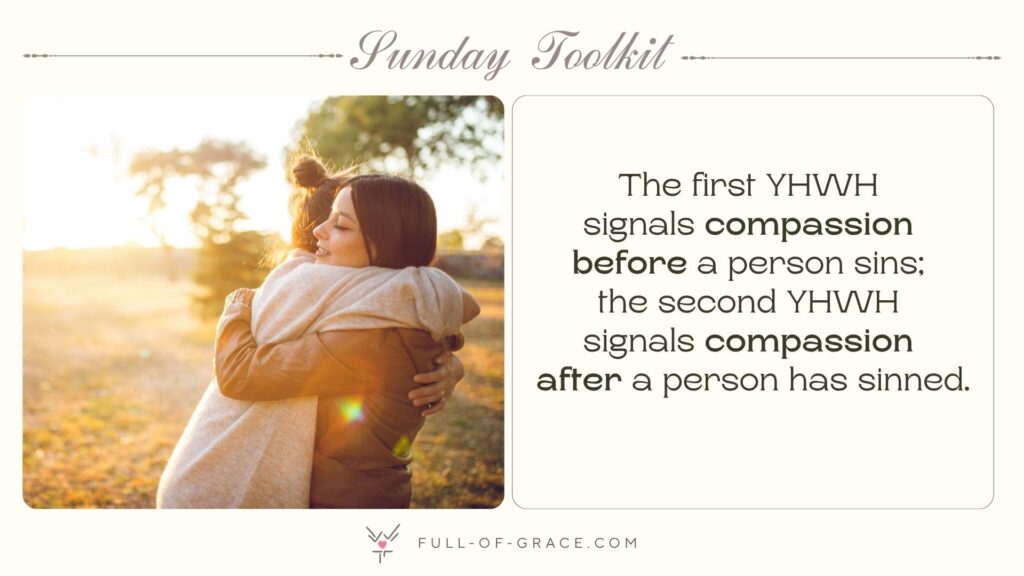
The Kabbalistic tradition reads the doubled Name – YHWH, YHWH – as two faces of the same mercy: the mercy that precedes a person’s sin, and the mercy waiting on the other side of it. The procession passes twice.
Moses responds not with theology but with need: take us along. We are stiff-necked. Pardon us. Receive us as your own. The most intimate moment of his entire relationship with God, and he uses it as intercession. The private revelation immediately becomes communal petition. The new stone tablets being prepared are for the whole people.
Key Insight
God does not reveal power on Sinai. God reveals mercy – in an act so personal, so bodily, so almost ridiculous that the rabbis could barely say it. And Moses, who receives this extraordinary intimacy, turns it outward in the same breath. The Name given in that private procession would become what every cantor chants, what every generation inherits. The most personal revelation becomes the most communal possession.
Responsorial Psalm: Daniel 3:52-56
Historical Placing
The Song of the Three Young Men comes from the deuterocanonical additions to Daniel, present in Catholic and Orthodox Bibles but absent from the Hebrew canon – one of those moments worth pausing on with our readers: yes, this is in our Bible. The book of Daniel reaches its final form around 165 BCE, during the Maccabean crisis, when Jews were being forced under Antiochus IV Epiphanes to abandon the Torah on pain of death.
What’s Happening
Hananiah, Mishael, and Azariah – known in the Babylonian court as Shadrach, Meshach, and Abednego – refuse to bow before Nebuchadnezzar’s golden statue and are thrown into a furnace heated seven times hotter than usual. The Song erupts from inside the fire.
They bless God from the throne, from the temple, from the depths, from the cherubim – the entire created order called as witness.
These three men have none of what Moses has. No tent of meeting. No face-to-face encounter. No private procession on the mountain. Their faith is entirely tradition-based – they know the Name because someone taught them, because a community of practice has carried it across generations. They have the inheritance, not the experience.
And it is enough.
Key Insight
The tradition, properly received and deeply held, can sustain us inside the furnace. We do not need mystical encounter to refuse the false god. We need to know whose name we carry – and to know, in our bones, that this Name is the actual difference between life and death. Not Nebuchadnezzar threatening consequences. God is the difference between life and death.

Second Reading: 2 Corinthians 13:11-13
Historical Placing
Paul’s second letter to Corinth, written around 55-56 CE, addresses a community in serious internal conflict. This closing – rejoice, mend your ways, encourage one another, agree with one another, live in peace – is not a warm sign-off. It is pastoral triage. The community is fractured.
What’s Happening
Paul does not explain the Trinity here. He invokes it as the ground of community repair. The grace of Christ – who took on fracture. The love of God – which is prior to merit. The fellowship (koinonia) of the Holy Spirit – the shared life, the communion that makes genuine repair possible at all.
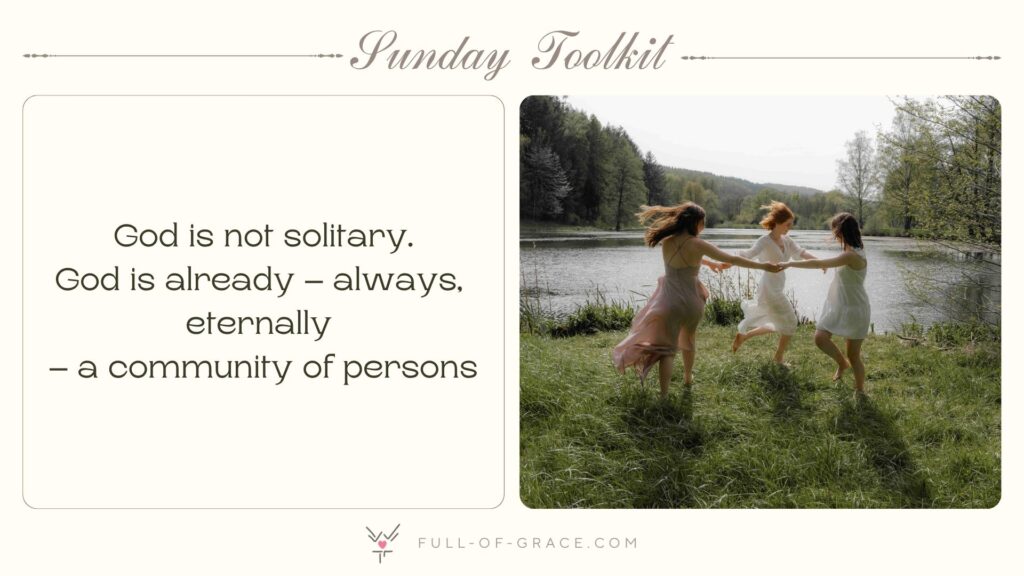
Three movements. One name. The reason reconciliation is possible is not human goodwill but the nature of the God into whose name this community has been baptised. God is not solitary. God is already – always, eternally – a community of persons. And the community they are being invited to rebuild mirrors, however imperfectly, what God already is.
Key Insight
The Trinity appears in this reading not as doctrine to be defended but as the ground of human community repair. Personal but not private. Communal but not collective. The trinitarian formula that has become so liturgically familiar that we barely hear it anymore was addressed, originally, to a broken community that needed to remember what they were holding.
Gospel: John 3:16-18
Historical Placing
John’s Gospel, written in its final form around 90-100 CE, addresses a community almost certainly experiencing expulsion from the synagogue. John uses the Greek word aposynagōgos – found only in this gospel – to describe what happens to those who confess Jesus as Messiah (9:22, 12:42, 16:2). To hold this Name had a cost. It meant losing your religious home, your social belonging, your place in the community that had shaped your entire understanding of God.
What’s Happening
John 3:16-18 sits within the Nicodemus conversation – a Pharisee coming to Jesus by night, beginning to approach the light while still preferring the cover of darkness. Into that context comes the most-quoted verse in Christianity, which is to say the verse we have most thoroughly stopped hearing.
God so loved the world – not the righteous, not the faithful, not the deserving. The kosmos. The whole disordered, idol-building, furnace-lighting world. That he gave his only Son – not sent a message, not issued a decree. Gave. So that everyone who believes in him may not perish – mē apōlētai, not merely die but be dissolved, scattered, lost – but may have eternal life.
The shadow side is present and should not be avoided: whoever does not believe is already condemned. In context, this is not a threat of divine punishment. It is a description of a condition. To refuse the light already given is its own darkness. Condemnation is not something God does to you. It is what happens when you turn from the only name in which there is life.
Key Insight
For John’s community, this verse was not a bumper sticker. It was the reason they were still standing after losing everything. May not perish meant something when perishing was an actual possibility. The verse narrows the entire Sunday’s communal arc to a single point: one person, one question. Do you believe it? Does it include you? Do you know what you are holding?
The Common Thread
The Name that God called out on Sinai – absurd, merciful, twice, to an audience of one – has been carried across every generation by people who risked enrmously to hold it. Moses received it and immediately turned it into intercession. Three young men carried it from tradition into a furnace and blessed the cosmos from inside the fire. A fractured community in Corinth was reminded that the Name they already carried was sufficient ground for repair. A community losing everything for confessing it was told: this name is the difference between perishing and life.
Trinity Sunday is not a feast of explanation. It is a feast of recognition. The God who parades God’s own mercy past a single human being on a mountain, who cannot help but call out who God is – this is the God whose name we carry. The question the readings circle and finally place directly before us is simply: do we know what we are holding?
Introduction to the Liturgy of the Word
Today the Church pauses at the edge of Ordinary Time to ask a question before we go further. Not a doctrinal question – not can you explain the Trinity – but a personal one: do you know this name? Not as formula, not as creed, but as the voice you have learned to recognise. The readings will carry us from a mountain in Sinai to a furnace in Babylon to a broken community in Corinth to a verse so familiar we may have stopped hearing it. Listen for what you already know. Listen for what still has the power to stop you.
More:
Toward Self-Disclosure – an overview of where we are This Sunday and why it matters.
One Sentence, One Community – a post-communion reflection built around the trinitarian blessing of 2 Corinthians 13
Set Apart – Seven unique intercessions for the Prayer of the Faithful