
The bucket scrapes the stone lip of the well and Joseph straightens, arms aching with the particular weight of water drawn from depth. He sets it down. Looks at his forearms.
Dirt. Sweat dried to salt. A stripe of dark clay from where he braced against the shaft wall, a streak of paler dust above it. The colors have no names worth giving them.
He stands still for a moment in the courtyard’s afternoon heat, holding the image.
There had been colors once that had names. His father had known every one of them – could describe the threads from memory, could tell the dyers what he wanted and why. I will know you from a distance, Jacob had said, settling the coat on Joseph’s shoulders. Anyone will know you. As though being seen were the same as being kept safe.
And then the memory that surfaces the way bad memories do – not announced, just suddenly there:
His brothers’ voices, low and practical, reaching him through the brush where he’d stopped to drink. Not shouting. Not raging. Worse than that – arranging. The matter-of-fact tone of men resolving a problem. Take the coat. Slaughter a kid. Bring it to the father. And someone – Judah, he thinks, the flat certainty of Judah’s voice – what profit is it if we kill him.
Not: we cannot do this to our brother. What profit.
He had understood, in that moment, that the coat had always been the point. The coat was the wound they were healing. He was almost secondary.
Joseph picks up the bucket. Carries it toward the grain store.
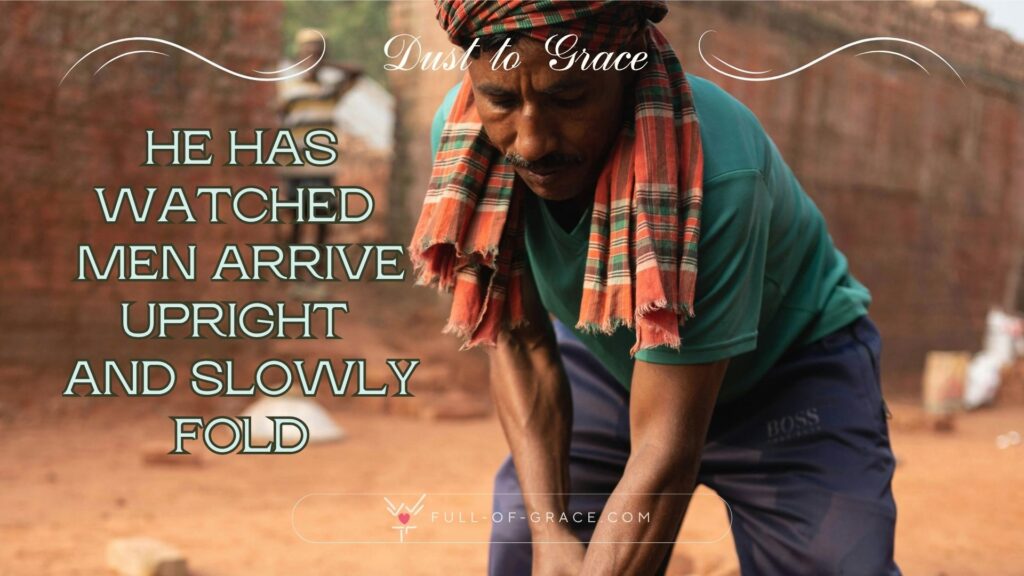
The courtyard is full of men bent into themselves – shoulders curved, eyes down, each one carrying his sentence like a stone tied to his neck. Joseph has watched this happen. Has watched men arrive upright and slowly fold. There is no one here to tell this to. No one who would understand why he is thinking about cloth.
He sets the bucket down again and looks at his arm.
He was sold, and landed on his feet – Potiphar’s house, real work, the satisfaction of a household running well because he ran it. He had thought: perhaps this is what the dreams meant. Perhaps this is enough. And then the floor gave way.
He was imprisoned, and landed on his feet again – the warden’s trust, the same work at a smaller scale, the same satisfaction. He had thought: perhaps even here. And then the cupbearer forgot him.
He has a gift. He knows what dreams mean – not the ordinary kind, not the processing of a day’s worry, but the ones that carry weight, that wake you certain something has passed through. He had read the cupbearer’s dream correctly. He had read the baker’s correctly. He knows he did. And he sits here.
The stripe of clay on his arm has dried lighter now. The salt-sweat is just dust.
No coat. No coat has ever been the real thing – he understands that now, here, in this courtyard, in a way he could not have understood it at seventeen in the fields at Dothan. The coat was his father’s love made visible, which meant it was also his brothers’ wound made visible, which meant it was the most dangerous thing he owned. A sign is only as safe as the people who have to look at it.
What he carries now has no outside.
It is not dignity, exactly. Dignity can be seen – in how a man holds himself, in whether his eyes stay level. Joseph is not sure his eyes stay level anymore. He is tired. He does not know how long he has been here or how much longer it will be.
It is something smaller than dignity and more durable.
A knowing. That the dreams are real – not his boyhood dreams of sheaves and stars, though those too – but the gift itself, the capacity, the thing that moves in him when a man describes a vision and Joseph feels the meaning rise in him like water finding its level. That did not come from Jacob. It did not come from the coat or the favor or the position in Potiphar’s house. It was there before any of that, and it is here now, in the dirt, in the heat, in the forgetting.
He believes – and there is no one in this courtyard to confirm it, no sign on his skin, no visible thread of any color – he believes it came from God.
That is all. That is what is left.
He picks up the bucket again and carries it inside.
What is left in you when every visible sign has been stripped away?
Follow the mystery of your senses with Born to Recognise Week 4 invitation to practice.