
QUICK REFERENCE
Date: February 22, 2026
Liturgical Season: First Sunday of Lent, Year A
Readings: Genesis 2:7-9; 3:1-7 | Psalm 51:3-4, 5-6, 12-13, 17 | Romans 5:12-19 | Matthew 4:1-11
USCCB Readings: February 22, 2026
One-Sentence Theme: Sin begins not in the eating but in the hiding — and salvation begins when one man walks into the open desert and refuses every invitation to put the disguise back on.
THE READINGS IN CONTEXT
First Reading: Genesis 2:7-9; 3:1-7
What’s Happening: The reading gives us two scenes separated by a chasm. In the first, God kneels in the dirt — the Hebrew yatsar suggests a potter shaping clay — and breathes into Adam’s nostrils. The word for “breath of life” is nishmat chayyim, and it’s the most intimate act in all of Scripture: mouth to mouth, Creator to creature. Then come the trees, the garden, the goodness of it all.
The second scene is the unravelling. The serpent speaks. The woman sees. They eat. And then: “the eyes of both of them were opened, and they realized they were naked; so they sewed fig leaves together and made loincloths for themselves.”
Key Insight: Notice what the reading includes — and what it cuts. The Lectionary stops at the fig leaves. We don’t hear God walking in the garden. We don’t hear “Where are you?” We don’t hear the hiding, the blaming, the expulsion. The Church leaves us suspended in that terrible moment of self-awareness: they knew they were naked. She trusts the Gospel to complete the story.
The movement between the two scenes is a movement of the gaze. In the first scene, Adam receives God’s breath — his attention is entirely on the One breathing into him. In the second, the first thing that changes after eating is where they look. Not at God. At themselves. At their own bodies. The focus collapses inward. From communion to self-consciousness.
What the Lectionary Doesn’t Say (But the Tradition Remembers)
For those who followed our Advent exploration of the story of hiding: from light to skin, this reading is familiar ground. There we traced the Kabbalistic tradition that Adam and Eve were first clothed in or (אוֹר) — light — and only after the Fall became clothed in or (עוֹר) — skin. Same sound. Different letter. A world of difference.
That earlier piece explored how the garments of skin required the first death in Scripture — God killing an animal to clothe the ones who could no longer clothe themselves. Today’s reading takes us to the moment just before that: the fig leaves. The first self-covering. The inadequate attempt to manage our own exposure.
We won’t repeat that exploration here, but carry it forward: every subsequent act of covering — fig leaves, skin garments, masks, roles, rituals performed without presence — traces back to this moment when the gaze shifted from God’s face to our own nakedness.
The Twelve Hours: A Rabbinic Key
The Talmud (Sanhedrin 38b) compresses Adam’s entire presence in paradise into twelve hours:
First hour: dust gathered. Second: shaped into form. Third: limbs stretched out. Fourth: soul breathed in. Fifth: stood on his feet. Sixth: named the animals. Seventh: Eve became his companion. Eighth: “they ascended to the bed as two and descended as four.” Ninth: commanded not to eat. Tenth: sinned. Eleventh: judged. Twelfth: expelled.
The eighth hour stops us cold. “Ascended as two, descended as four.” The traditional reading is that Cain (and his twin) were born. But sit with the image itself: two people enter a meeting and four emerge. How?
Because this is what happens whenever we cannot hold presence with another person. We enter as two — but each of us carries a projection of the other. Adam meets not Eve but his idea of Eve. Eve meets not Adam but her expectation of Adam. Two real people. Two phantoms. Four where there should be two.
Martin Buber would recognise this: the collapse from I-Thou to I-It. Whenever I relate to you through a role — you are my helper, my savior, my provider, my problem — I’ve doubled the population. I’m no longer meeting you. I’m meeting my script for you.
And notice the sequence in Sanhedrin: this multiplication happens in the eighth hour. The command not to eat comes in the ninth. The sin happens in the tenth. The relational fracture — the inability to stay present, the production of identities and phantoms — precedes the disobedience. The hiding begins before the eating.
This is what echoes through the desert when we reach the Gospel.
Responsorial Psalm: Psalm 51:3-4, 5-6, 12-13, 17
What’s Happening: The great psalm of confession — attributed to David after Nathan confronted him about Bathsheba (2 Samuel 12). Whether historically Davidic or not, it carries the weight of someone who has been seen — exposed, unmasked — and knows the only way forward is through, not around, that exposure.
But this isn’t grovelling. It’s a request — almost a demand — for re-creation. “A clean heart create for me” — the verb is bara, the same verb used for the creation of the heavens and the earth in Genesis 1:1. The psalmist isn’t asking for improvement. They’re asking for something only God can do: start again from scratch.
Key Insight: Two lines land differently when we’re listening for hiding and unhiding:
“Do not cast me away from your presence, and your Holy Spirit take not from me.”
Don’t let me hide. Don’t let me lose the face-to-face.
And then: “O Lord, open my lips, and my mouth shall proclaim your praise.”
This is the prayer of someone whose mouth has been closed — by shame, by fig leaves pulled over the face, by the refusal to speak what’s true. And it’s asking God to do the opening. Not “I will force my lips open.” But “You open them.” The same God who breathed into Adam’s nostrils is being asked to open the mouth that shame has sealed.
For those who pray the Liturgy of the Hours, this line comes every single morning as the opening versicle of the Office. Every day begins with the admission: I cannot unhide myself. You must do it.
Second Reading: Romans 5:12-19
What’s Happening: Paul writing to Rome, around 57 CE. This is the theological heart of the letter — the Adam-Christ parallel that structures his entire understanding of salvation history.
Paul builds the most audacious comparison in the New Testament. One man’s trespass brought condemnation to all. One man’s obedience brings justification to all. The logic is symmetrical — but Paul keeps breaking his own symmetry to insist that the gift outweighs the fall. “The gift is not like the transgression.” “How much more did the grace of God overflow.” The scales don’t balance. Grace is heavier.
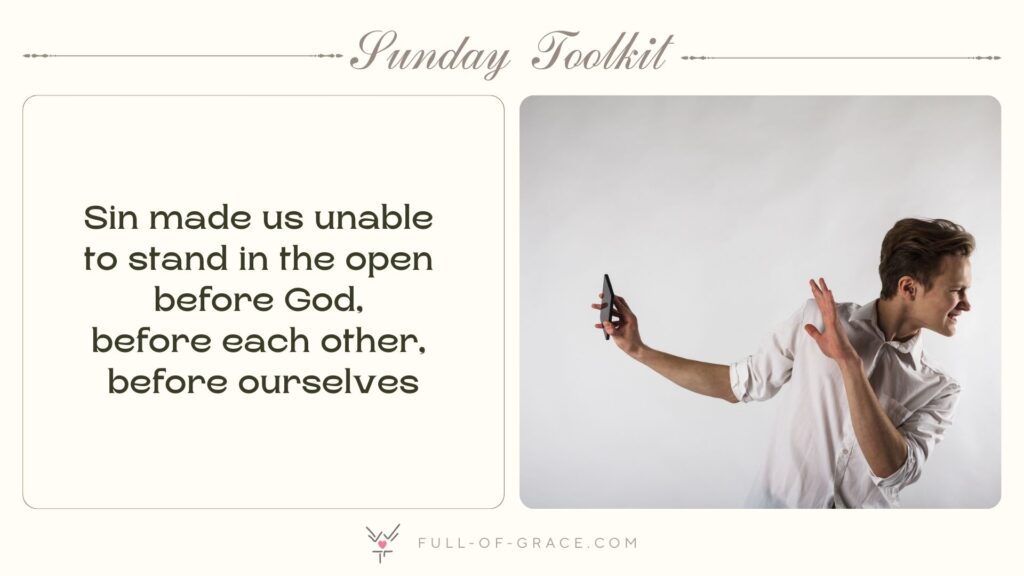
Key Insight: Read through the lens of hiding and presence, Paul’s “one man” language takes on new depth. What did Adam’s sin actually do? It introduced hiding. It broke the face-to-face. It made us unable to stand in the open before God, before each other, before ourselves.
And what does Christ’s obedience restore? Not mere legal acquittal. Presence. The ability to stand again. Paul’s word for justification — dikaiōsis — carries the sense of being “made right,” set in right relationship. Not made perfect. Made present again. Restored to the face-to-face.
And notice: “the gift, after many transgressions, brought acquittal.” After many. Not after one clean-up. After the whole accumulated mess of human hiding — the fig leaves and the skin garments and the masks and the roles and the projected phantoms — after all of it, grace still overflows. The math doesn’t work. It’s not supposed to.

Gospel: Matthew 4:1-11
What’s Happening: The Judean wilderness, immediately after Jesus’ baptism. The Spirit — the same ruah that hovered over the waters, the same breath blown into Adam’s nostrils — leads Jesus into the desert. Forty days and forty nights, echoing Israel’s forty years in the wilderness, Moses’ forty days on Sinai, Elijah’s forty-day journey to Horeb. Jesus is recapitulating all of Israel’s testing — and passing where they failed.
Then the tempter comes. The Greek word is ho peirazōn (ὁ πειράζων) — the one who tests, who probes, who pushes against the boundary to see where it breaks. It carries the sense of “how far can I go?” Not a frontal assault. An invitation. A suggestion. “If you ARE the Son of God…”
Key Insight: The three temptations are three invitations to put on an identity— three projections of who the Messiah should be:
First Temptation — Stones to Bread: “If you are the Son of God, command these stones to become loaves of bread.” The projected identity: God as problem-solver. You’re hungry, so fix it. Use your power to eliminate discomfort. Hide the vulnerability behind a miracle.
Jesus’ response: “One does not live on bread alone, but on every word that comes forth from the mouth of God.” Notice: mouth of God. The same mouth that breathed into Adam. Jesus redirects from the stomach to the breath. Not “I don’t need bread” but “there is a deeper nourishment.” He stays with the hunger. He doesn’t hide it.
Second Temptation — Throw Yourself Down: “If you are the Son of God, throw yourself down.” The projected identity: God as safety net. Force the relationship into a transaction. “If you really love me, catch me.” The devil quotes Scripture — Psalm 91 — to make it sound holy. This is the most sophisticated form of fig-leaf: Bible verses used as a costume. Ascending as two and descending as four — the phantom God who exists only to serve my need for security.
Jesus’ response: “You shall not put the Lord, your God, to the test.” Don’t probe the boundary. Don’t ask “how far can I push before something breaks?” That’s the serpent’s question in Genesis, repackaged.
Third Temptation — All the Kingdoms: “All these I shall give to you, if you will prostrate yourself and worship me.” The projected identity: God as power broker. Skip the cross. Skip the relationship. Get the result without the process. This is the temptation that Israel’s messianic expectation fed into — the powerful king who would overthrow Rome, the one who would change the order of the world from the top down.
Jesus’ response: “The Lord, your God, shall you worship and him alone shall you serve.” No mask. No shortcut. No phantom God constructed from our desires. The real God. The one who breathes into nostrils and walks in gardens looking for the ones who hide.
And then: “the devil left him and, behold, angels came and ministered to him.” The same pattern as Genesis, reversed. In Genesis: intimacy, then temptation, then exile. In the desert: temptation, then refusal, then intimacy restored. The angels come after Jesus stays in the open. The ministering comes after the vulnerability.
THE COMMON THREAD
God breathes into dust, and the dust comes alive. The alive ones eat, see themselves, and hide. A psalmist begs: don’t let me lose your face — open my lips. Paul says: the gift of one man’s openness outweighs all the accumulated hiding. And in the desert, a man who is fully God and fully human faces every invitation to hide behind power, transaction, and spectacle — and simply stays present. Stays hungry. Stays human. Stays in the open.
Two went up to the bed and four came down. But in the desert, only one goes in — and only one comes out. No phantoms. No projections. No masks. Just a man, and his Father, and the breath between them.
INTRODUCTION TO THE LITURGY OF THE WORD
Today’s readings trace the story of hiding and being found. In Genesis, God breathes life into dust — and the dust learns to hide. In the desert, Jesus faces every temptation to conceal his humanity behind miracles and power — and refuses. As we begin this Lenten journey, we listen for the question that echoes from the first garden to today: “Where are you?”
Readings: USCCB Daily Readings — February 22, 2026
For the story of how garments of light became garments of skin — and why the first death in Scripture was God’s sacrifice to clothe the ones who could no longer clothe themselves — see The Story of Hiding: From Light to Skin.
More resources for This Sunday, including Liturgical overview of the themes, The First Hiding: Embodied Penitential Rite, Called Back to Be Seen: Prayer of the Faithful. All resources are free to use.
More about a different way into Lent: From Hiding to Face

















5 thoughts on “The Memory of Breath – 1 Lent, Year A, Background”