
QUICK REFERENCE
Date: December 7, 2025 Liturgical Season: Second Sunday of Advent, Year A Readings: Isaiah 11:1-10 | Psalm 72:1-2, 7-8, 12-13, 17 | Romans 15:4-9 | Matthew 3:1-12
One-Sentence Theme: Baptism calls us out of hiding to believe the impossible—that we can inhabit a realm where no one has to pay the cost anymore, where God’s breath fills everything, and death itself is undone.
THE READINGS IN CONTEXT
First Reading: Isaiah 11:1-10
When & Where: Post-exilic prophecy, likely 6th century BCE, after the Davidic dynasty has been “cut down” and the people are in or returning from Babylon.
What’s Happening: The “stump of Jesse” assumes catastrophe—the royal tree has been felled, only a stump remains. This isn’t a vision of continuity but of new life emerging from apparent death. What comes before (Isaiah 10) describes Assyria as God’s tool of judgment, cutting down the forest of Israel’s pride. What comes after (Isaiah 12) is a song of thanksgiving for salvation.
Key Insight: This is resurrection language before anyone had language for resurrection. The shoot grows FROM the stump, not beside it. Hope comes through death, not around it.

Responsorial Psalm: Psalm 72:1-2, 7-8, 12-13, 17
When & Where: A royal psalm, possibly from Solomon’s coronation, praying for the ideal king whose reign reflects God’s own justice.
What’s Happening: This is a liturgical prayer for the king’s enthronement, asking God to give the king divine wisdom to judge justly, especially toward the poor and vulnerable.
Key Insight: “Justice shall flourish in his time, and peace till the moon fails”—this isn’t modest hope. It’s cosmic, impossible hope. Justice that outlasts the moon.
Second Reading: Romans 15:4-9
When & Where: Paul writing to Rome, around 57 CE, as he prepares to visit. This is near the end of his letter, moving from theological argument to practical instruction about community life.
What’s Happening: Paul has been addressing the tension between Jewish and Gentile believers—who’s in, who’s out, what practices matter. Here he appeals to Scripture (the “old” stories) as the source of hope that keeps us from giving up.
Key Insight: “Everything written was for our instruction…that we might have hope.” The impossible promises aren’t meant to discourage us—they’re meant to teach us not to give up on believing them.
Gospel: Matthew 3:1-12
When & Where: The Jordan River wilderness, around 27-28 CE. John breaks 400 years of prophetic silence. This is the hinge between the “old” and “new” covenants.
What’s Happening: Jesus’s public ministry hasn’t started yet. John is the forerunner, the voice crying in the wilderness. The whole region is going out to him—this is a massive movement toward confession and baptism.
Key Insight: John confronts the religious insiders (“brood of vipers!”) not because they’re worse than others, but because they’re coming for ritual without repentance—baptism as religious credential rather than actual transformation.

WHERE ARE WE?
In the Biblical Narrative
We’re at the threshold. The stump of Jesse points forward to Jesus. John stands at the edge of the old covenant, preparing the way for the new. The peaceable kingdom hasn’t arrived yet—we’re still in the “not yet” part of “already and not yet.”
In Salvation History
This is the long Advent of human history—we’ve been waiting for the peaceable kingdom since Eden. Isaiah offers the vision. John says the kingdom is “at hand” (close, near, almost here). Paul says: don’t give up on believing it’s possible.
In the Liturgical Year
Last Sunday (First Advent): Watchfulness—”Stay awake, the end is coming.” This Sunday (Second Advent): Preparation through confrontation—John’s fierce “Repent!” How do we actually prepare? Coming (Third Advent): Joy—”Rejoice, the Lord is near.”
We’ve moved from watching to preparing. But preparation isn’t decoration. It’s demolition. Clearing. Making space.
THE MYSTERY WE CAN’T IMAGINE
There’s something almost unbearably sweet about Isaiah’s vision. Wolf with lamb. Leopard with kid. A baby—a BABY—playing at the cobra’s den, reaching into the viper’s nest. The lion eating straw like an ox, as if death itself could be vegetarian.
I’ll be honest: I don’t want to look at it. It’s too much like a Renaissance painting or Slavic folk art—all rosy and pink and utterly alien to the world I know. It doesn’t feel real. It feels like religious wallpaper.
And the Psalm doubles down: “Justice shall flourish…and peace till the moon fails.” Till the MOON fails. As if justice could outlast astronomy. As if peace could be that permanent.
We’ve been hearing these promises for thousands of years. And we still can’t envision them. Paul knows this—that’s why he says, “Everything that was written long ago in the scriptures was meant to teach us something about hope…by the examples of how people who did not give up were helped by God.”
Don’t give up trying to believe the impossible. That’s the Advent work.
But why can’t we imagine it? Why does Isaiah’s vision feel so foreign?
THE STORY OF HIDING: FROM LIGHT TO SKIN
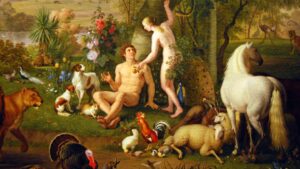
To understand why the peaceable kingdom seems unimaginable, we need to go back to the Garden—to the moment we first started hiding.
The Shift in Focus
Genesis 3 describes a catastrophic change in perception. Before the Fall, Adam and Eve walked with God in the cool of the day. They saw God. They conversed with God. Their attention was directed outward, toward the divine presence.
Then came the fruit, the knowledge of good and evil. And immediately: “They realized they were naked.”
The shift is devastating. Their focus moves from God’s face to their own bodies. From the transcendent to the flesh. From communion to shame.
They grab fig leaves—the first attempt at self-covering. “We’ll handle this ourselves. We’ll manage our exposure.”
But fig leaves are inadequate. They’re scratchy, they wilt, they don’t actually cover what needs covering.
God’s First Sacrifice
Then comes Genesis 3:21, a verse we often read right past: “The LORD God made garments of skin for Adam and for his wife, and clothed them.”
Skin. Not leaves. Not fabric woven from nothing. Skin.
Where did the skin come from?
There’s a mystical tradition in Judaism—found in Kabbalistic and rabbinic commentary—that plays with the Hebrew word for skin. In Genesis 1, when God creates light, the word is or (אוֹר). In Genesis 3:21, when God makes garments of skin, the word is or (עוֹר). Same sound. Different letter.
The tradition suggests: We were first clothed in light. After the Fall, we became clothed in skin—in flesh, in mortality, in the kind of covering that requires death.
Because that’s what skin garments require. God had to kill an animal.
This is the first death in Scripture. The first sacrifice. Not commanded by a distant deity, but performed by God Himself—looking at His beloved creatures in their inadequate self-covering, seeing they need something better, something that will actually keep them warm and protected.
And providing it. At cost.
The World We Live in Now
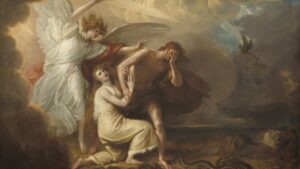
And here’s where everything shifts: We now live in a reality where someone always pays.
To keep me warm, an animal dies—or a forest is cut down for fuel, or a mountain is mined for coal. To feed me, soil is depleted, water is diverted, ecosystems are disrupted. To clothe me, cotton fields require pesticides, factories produce waste, workers labor in conditions I prefer not to imagine.
I cannot go back to Eden alone. Paradise cannot be inhabited by just one person. The strength of Eden—the beauty of it—was that there was no cost. No one had to die for Adam and Eve to be clothed in light. No one had to pay for them to eat from the trees. It was gift, pure gift, with no ledger of debt.
But now? Every comfort I enjoy, someone or something pays for in my place. Every fig leaf I grab to cover my shame comes at someone else’s expense.
This is what we lost: the possibility of existing without cost. The ability to live without taking. The vision of a world where the baby can play by the cobra because no one needs to eat anyone else to survive.
WE’RE STILL HIDING
And we never stopped reaching for fig leaves—whatever we can grab to cover ourselves, to manage our exposure, to look acceptable. We’re still hiding behind bushes, hoping God won’t notice. We’re still obsessed with our own nakedness instead of looking at God’s face.
And sometimes, ritual becomes another form of fig leaves.
John’s Confrontation: “You Brood of Vipers!”
This is what John sees when the Pharisees and Sadducees come to his baptism. They’re the religious insiders—the ones who have all their theological credentials in order, who know the Law, who perform all the prescribed rituals.
And John calls them “brood of vipers.”
Not because they’re worse than anyone else. But because they’re trying to download a heavenly reality without paying the cost for that. They want baptism without repentance. They want the ritual covering without the internal transformation. They want to be safe, to be credentialed, to have their religious identity confirmed—”We have Abraham as our father.”
John says: NO. “Produce good fruit as evidence of your repentance.”
Not evidence that you showed up. Not evidence that you got wet. Evidence of actual transformation. Evidence that something has shifted in you from the inside out.
Ritual without transformation is just more fig leaves. Fancier ones, maybe. Religiously sanctioned ones. But still inadequate. Still self-covering. Still trying to manage the cost ourselves instead of letting God clothe us.
“Even now the ax is at the root of the trees.” Not “coming eventually”—NOW. The judgment is present, not future. What in you is dead wood that needs cutting away? What are you still hiding behind?
And who is paying your debt?
Because that’s the question underneath everything: In this world where someone always pays, where every covering costs something, where paradise cannot be inhabited alone—who is paying for your attempt to return to God? Whose labor? Whose life? Whose sacrifice?

https://www.metmuseum.org/art/collection/search/436568
THE BREATH RETURNS: WHAT MAKES THE PEACEABLE KINGDOM POSSIBLE
But Isaiah’s vision isn’t just about wolves lying with lambs. It’s about what makes that peaceable kingdom possible. And the answer is: ruach. Spirit. Breath. Wind.
Look at how the reading begins: “The spirit [ruach] of the LORD shall rest upon him: a spirit [ruach] of wisdom and of understanding, a spirit [ruach] of counsel and of strength, a spirit [ruach] of knowledge and of fear of the LORD.”
Ruach. The Hebrew word that means breath, wind, and spirit all at once. When you say it aloud—roo-AHKH—you’re breathing. You can’t say it without using your breath.
This is the same ruach that hovered over the waters in Genesis 1:2. The same breath God breathed into Adam’s nostrils in Genesis 2:7. The breath that is life itself.
And now: “He shall strike the ruthless with the rod of his mouth, and with the breath [ruach] of his lips he shall slay the wicked.”
The Messiah doesn’t need weapons. He has breath. The same creative breath that spoke the world into being can speak wickedness out of existence.
And then—this is the key—the peaceable kingdom becomes possible because “the earth shall be filled with knowledge of the LORD, as water covers the sea.”
Not sprinkled with knowledge. Not partially informed. FILLED. Saturated. Covered completely, the way the ocean floor is covered by water—every square inch, no gaps, no dry patches.
This is what makes the impossible possible: inhabiting the spirit realm. Living in a reality so saturated with God’s presence that the old economy of cost and debt and sacrifice doesn’t apply anymore. When the earth is FILLED with knowledge of the LORD, no one needs to die for someone else to live. The lion eats straw. The baby is safe with the cobra. There is no cost.
When Paul speaks of “the encouragement of the Scriptures” and “endurance” in Romans, he’s speaking of the pneuma (Greek for ruach)—the Spirit-breath that keeps us hoping against hope, that sustains us in believing what we cannot yet see.
When John says, “I baptize you with water for repentance, but the one who is coming after me…will baptize you with the Holy Spirit [ruach] and fire”—he’s saying: Water is my tool. I can get you wet. But HE brings the breath. The actual life. The transformation that comes from being filled with God’s presence the way the ocean floor is filled with water.
That’s what makes the peaceable kingdom possible. Not our efforts. Not our fig leaves. Not our religious credentials. God’s breath filling everything.

BAPTISM: THE ATTEMPT TO RETURN TO LIGHT
So what is baptism, really?
In Catholic tradition, after the water is poured, the newly baptized receives a white garment. The priest says:
“You have become a new creation and have clothed yourself in Christ. Receive this baptismal garment and bring it unstained to the judgment seat of our Lord Jesus Christ, so that you may have everlasting life.”
White. Not skin. Not fig leaves. White—which in the early Church was understood as light.
Is this the return to or (אוֹר)—light instead of skin? Is baptism God’s attempt to clothe us again in what we lost, to undo the first death, to reverse the sacrifice He had to make in the Garden?
“Bring it unstained to the judgment seat.”
Of course, we can’t. We know we can’t. That’s why the baptismal garment echoes Revelation 7:14: “They have washed their robes and made them white in the blood of the Lamb.”
Another death. Another sacrifice. Not animal skin this time, but Christ’s own blood. Another covering we can’t provide for ourselves. Another gift that costs God something.
And yet—this sacrifice is meant to END the economy of sacrifice. Christ dies so that no one else has to. He pays the debt so that we can stop asking “who is paying for my covering?” and receive the answer: “It’s already paid. You’re already clothed. Now stop hiding.”
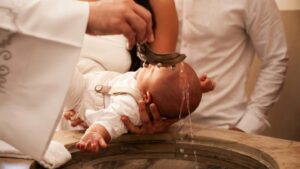
Baptism isn’t primarily about washing away legal guilt (though that language isn’t wrong). Baptism is about being clothed—being covered by God instead of covering ourselves. Being filled with ruach instead of gasping in our own breathlessness. Being brought out of hiding and into the presence of God.
MAKING STRAIGHT THE PATH = STOP HIDING
So what does it mean to “prepare the way of the Lord, make straight his paths”?
When I was a child in communist Poland, I remember how absurd it was when a big party leader would visit a town. They’d paint the fronts of buildings, plant flowers, put on a show—as if the leader needed things pretty before he could arrive.
But God doesn’t need us to paint the buildings. God straightens OUR paths (think of the Exodus, the parting of the Red Sea, the way through the wilderness). God makes ways where there are no ways.
So what does it mean for US to make straight the path?
I think it means: Remove the obstacles we’ve put there ourselves.
Stop hiding behind the bushes. Stop covering yourself with fig leaves and calling it transformation. Stop focusing on your nakedness instead of God’s face. Stop presuming on religious identity (“we have Abraham as our father,” “I was baptized as a baby”). Stop performing ritual as if getting wet is the same as being filled with Spirit.
The most radical repentance—the most dramatic “making straight”—is the turning FROM our own nakedness TO God’s presence.
It’s not that our shortcomings don’t matter. They do. But no amount of fig leaves will ever come even close to the clothing God wants to give us. So stop trying to manage it yourself. Stop calculating the cost. Stop hiding. Come out from behind the bush.
Call upon His presence. Ask for the breath. Let yourself be clothed.
THE COMMON THREAD: BREATH THAT FILLS EVERYTHING
All three readings circle the same mystery: God’s breath/spirit filling everything, making the impossible real.
Isaiah: The ruach rests on the Messiah. The breath of his lips defeats wickedness. Knowledge of the LORD covers the earth like water covers the sea. Result: the peaceable kingdom. Death undone. The economy of cost dissolved.
Romans: The Scriptures give us pneuma—breath, spirit, encouragement—so we don’t give up on believing the impossible promises. The Spirit helps us endure when we can’t yet see justice flourishing or peace lasting till the moon fails.
Matthew: “He will baptize you with the Holy Spirit [ruach/pneuma] and fire.” Not water for external cleansing. Spirit for internal transformation. Breath for the breathless. Life for the dead. An end to the endless cycle of sacrifice and cost.
THE HUMAN REALITY: WHO IS PAYING MY DEBT?
We live in this strange in-between time. We’ve been baptized—clothed in white, filled with Spirit (at least in potential). But we also still live in the world where someone always pays.
The whole creation feeds me, nourishes me, keeps me warm. God provides through the labor of farmers, the death of animals, the extraction of resources from the earth. I cannot exist without cost. I cannot live without taking.
And yet baptism claims: You belong to a different economy. You’re part of the vision where the lion eats straw, where no one has to die for another to live, where the earth is so filled with knowledge of the LORD that the old rules of predator and prey no longer apply.
How do we live in both realities at once?
This is the tension of the baptized life. We’re already clothed in light, already filled with Spirit—and we’re still clothed in skin, still living in a world of cost and debt. We’re already citizens of the peaceable kingdom—and we’re still learning not to hide, still practicing coming out from behind our bushes, still catching ourselves reaching for fig leaves.
Paul says: Don’t give up. Keep believing the impossible. Let the Scriptures teach you hope.
John says: Stop faking transformation. Produce actual fruit. Let the ax cut away the dead wood.
Isaiah says: Look at the vision. Keep looking. This is what you’re baptized into. This is the reality you belong to, even when you can’t see it yet.
And Christ says, through the sacrament of baptism: I’ve paid the debt. I’ve ended the sacrifice. You’re clothed. You’re filled. Now stop hiding and start living like it’s true.
WHAT DOES IT MEAN TODAY THAT I AM BAPTIZED?
It means I belong to the family of the impossible vision. I’m part of the people who believe—even when we can’t imagine it—that death can be undone, that wolves can befriend lambs, that babies can play safely with cobras, that justice can outlast the moon.
It means I’ve been clothed by God, not by my own frantic fig-leaf-grabbing. I wear light, not just skin. I breathe Spirit, not just air.
It means I’m called out of hiding. No more covering myself. No more bushes to crouch behind. No more focusing on my nakedness instead of God’s face.
It means the debt has been paid—not by me, not at someone else’s expense, but by Christ who entered fully into the economy of sacrifice in order to end it.
And it means I don’t have to give up—even when I can’t see the peaceable kingdom, even when the promises feel impossibly distant, even when my baptismal garment is stained again. Because the Lamb’s blood can wash it white. Because God’s breath can fill everything. Because the shoot can grow from the stump.
Second Sunday of Advent asks: Will you stop hiding? Will you let yourself be clothed? Will you breathe?
OPTIONAL INTRODUCTION
(for reading before Liturgy of the Word)
“Most of us here today are already baptized. We’ve already received the white garment, the seal of the Spirit, the promise of new life. But how often do we live as though our baptism were just a past event—something that happened once, long ago, checking a religious box? Today’s readings call us to remember: baptism is present tense. We ARE baptized. We belong to the impossible vision of the peaceable kingdom. As we listen to these readings, pay attention: How much of this message do we actually believe? How much do we claim as our own? How much are we willing to live out?”
For further resources on this Sunday—including liturgical planning suggestions, intercessions that flow from these themes, and a powerful embodied practice for experiencing your baptism—visit the Second Sunday of Advent Resources page. In particular, the Sunday Experience offers a guided meditation that allows you to enter the mystery of what happened to you spiritually at the Jordan River, even if you have no memory of your infant baptism.




6 thoughts on “Light – Skin – Spirit: 2 Advent (Year A) – Background”