
Born to Recognise – Week 1: The Ear
Quick Reference
| Date | Sunday, April 12, 2026 |
| Season | Second Sunday of Easter – Sunday of Divine Mercy |
| Lectionary Cycle | Year A |
| First Reading | Acts 2:42–47 |
| Psalm | Psalm 118:2–4, 13–15, 22–24 |
| Second Reading | 1 Peter 1:3–9 |
| Gospel | John 20:19–31 |
| USCCB Link | bible.usccb.org/bible/readings/041226.cfm |
| Series | Born to Recognise – Week 1: The Sense of Hearing |
| One-Sentence Theme | We hear before we see: Thomas received the news through his ears and his body refused it – until Christ came back to give him what witnessing of the others alone could not complete. |
Introduction to the Liturgy of the Word
Today the Church gathers still inside the Easter octave – and the Gospel points still to the Easter Sunday itself. The readings bring us into a locked room, into a community eating with exultation, into a letter written to people who have not seen and yet believe. The question running through every text is the same: how does what happened reach those who were not there? The answer is not argument. It is encounter – embodied, particular, patient encounter. The risen Christ comes through locked doors. He breathes. He shows his wounds. He comes back for the one who missed it.
This Sunday opens the Born to Recognise series – a seven-week Easter journey through the blessing of the senses toward Pentecost. We begin where the Gospel begins: with the ear. With Thomas, who was not there to hear the first news, and whose body refused to receive it secondhand.

First Reading – Acts 2:42–47
Historical and Literary Context
The Acts of the Apostles was written by Luke, probably between 80–90 CE, as the second volume of his Gospel. The passage we read today is one of three summary passages in Acts (see also 4:32–35 and 5:12–16) – Luke’s technique for compressing the life of the early community into a luminous portrait. These summaries are not strict historical records; they are theological icons, showing us what the community became rather than documenting what they did on specific days.
Historically, we are in Jerusalem, weeks after the resurrection. The community described here is entirely Jewish – they continue to attend the Temple and observe Jewish hours of prayer. The breaking of bread likely refers to a communal meal with Eucharistic resonance, though the full theology of the Eucharist is still developing. This is a community living inside Jewish practice while something new is breaking open within it.
What Is Happening
Luke gives us four pillars: the teaching of the apostles, the communal life (koinonia), the breaking of bread, and the prayers. Around these four things, a way of being human begins to form. There is awe. There are signs and wonders. There is daily Temple attendance and domestic table fellowship. And – crucially – the community is growing.
The word translated devoted themselves is the Greek proskarterountes – from pros (toward, alongside) and karterein (to be strong, to persist). It carries the sense of personal attendance, of staying close, of being constantly present. The NAB renders it devoted; but the texture is more physical than that: they kept near to, they stayed with, they persistently attended. It is a posture, not just a conviction.
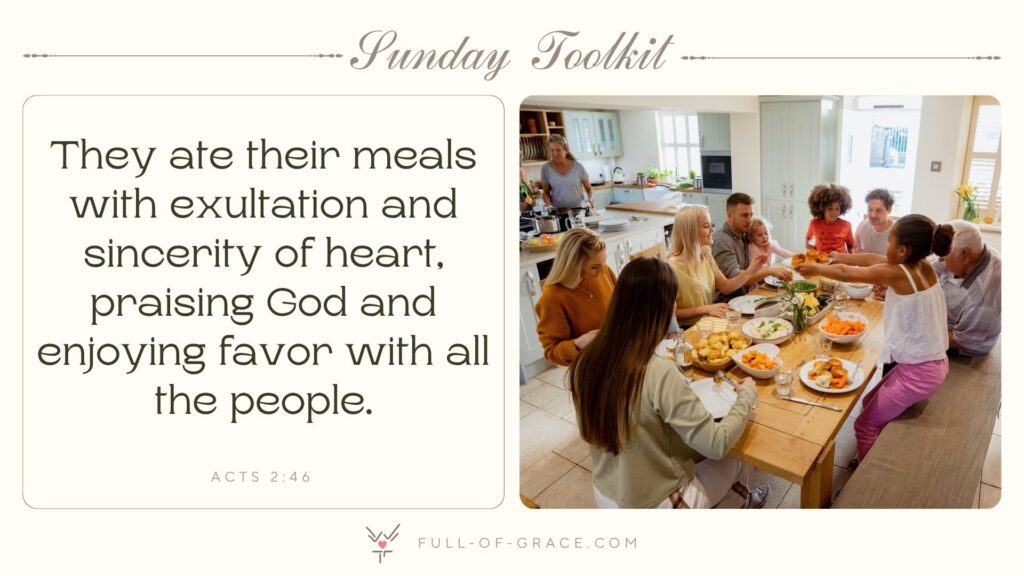
The meals described in verse 46 are notable for their emotional quality: with exultation and sincerity of heart (en agalliasei kai apheloteti kardias). The word agalliasei is an almost untranslatable joy – leaping, exulting, the joy that breaks out physically. And aphelotes means simplicity, singleness, an undivided heart. This is not polite gathering. This is a people whose senses have been restored to communal life.
Key Insight
The Acts community is a sensory portrait of what happens after the locked room. The breath of the Spirit has been received, and the result is not theological clarity – it is table. Awe. Common life. Exultation. Luke is showing us the fruit of Pentecost before Pentecost is described. This is what the body learns to do when it receives what it cannot yet name.
Hebrew / Greek Key
Proskarterountes (προσκαρτεροῦντες) – devoted, steadfastly attending; from pros + karterein. Carries physical presence, persistent nearness.
Koinonia (κοινωνία) – fellowship, communion, common life; the sharing of what cannot be held privately.
Agalliasis (ἀγαλλίασις) – exultant, leaping joy. Used of Elizabeth’s child leaping in the womb, of the angels rejoicing over one sinner who repents. Not quiet contentment but embodied delight.
Responsorial Psalm – Psalm 118:2–4, 13–15, 22–24
Context
Psalm 118 is the great Hallel psalm, sung at Passover and at Temple pilgrimage festivals. It is a psalm of survival – the psalmist has been pushed hard, nearly fallen, and has been rescued. In its original context it is most likely a communal thanksgiving after a military or political deliverance, but it was sung by individual pilgrims entering the Temple gates and has a strong personal resonance.
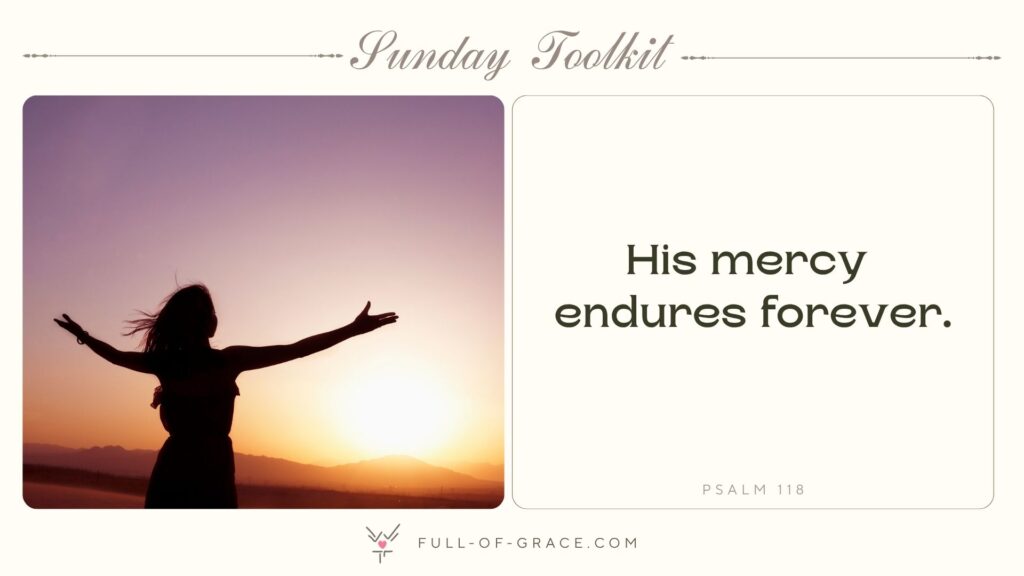
The Early Church read it as a resurrection psalm. The verse The stone which the builders rejected has become the cornerstone was applied to Christ’s rejection and vindication from the earliest strata of Christian preaching (cf. Acts 4:11; Matthew 21:42). This Sunday’s response – Give thanks to the Lord for he is good; his love endures forever – frames the whole psalm in the key of mercy.
Key Insight
The Hebrew behind his mercy endures forever is ki le’olam chasdo – and the word chesed (חֶסֶד) is doing enormous work here. It is often translated mercy or loving-kindness, but its range is wider: it is the faithfulness of covenant relationship, the loyalty that holds even when it has no obligation to hold. It is the word used for what a family member owes another family member – not charity from above but the loyalty of belonging.
And le’olam – forever, to the age, to eternity – carries the sense not just of duration but of inexhaustibility. The chesed does not run out. It is not a finite resource being carefully dispensed. This is the ground under Divine Mercy Sunday: a love whose fidelity is structural, not emotional.
Second Reading – 1 Peter 1:3–9
Historical and Literary Context
First Peter is a circular letter addressed to communities scattered across what is now northern Turkey – elect strangers of the diaspora, as the opening verse has it. It was written either by Peter himself (before 64 CE) or, more likely, by a Petrine school after his death, perhaps in the 80s. Either way, it is addressed to people living as a minority in a Greco-Roman world, experiencing social pressure and marginalisation.
The passage opens with a blessing – a berakah in form, blessing the God and Father of the Lord Jesus Christ – and moves into one of the most striking images in the New Testament for what faith actually is for people who cannot see.
What Is Happening
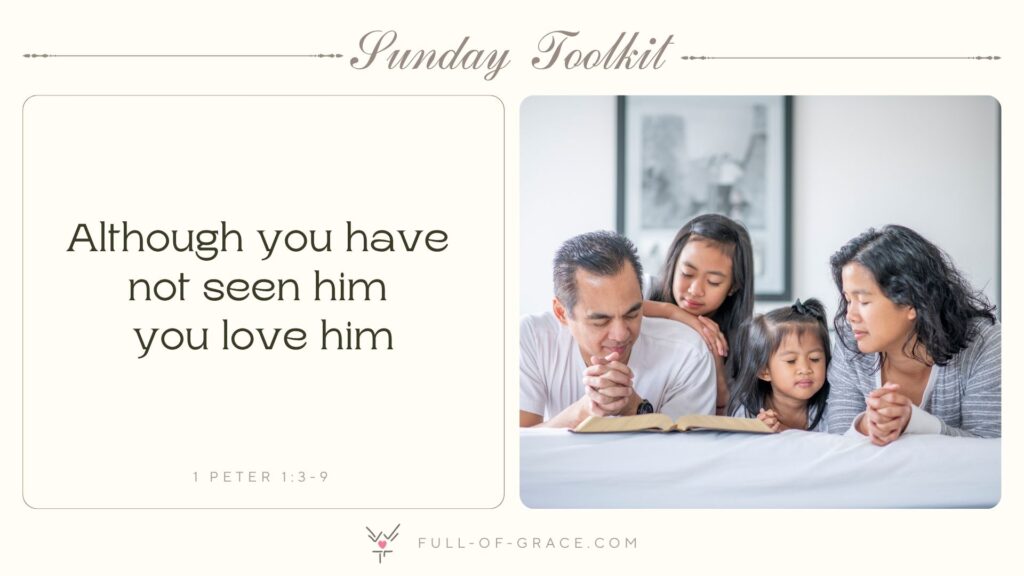
Peter addresses people for whom direct sensory encounter with the risen Christ is already closed off. They are not Thomas. They will never put their fingers in the wounds. And to them, Peter makes an astonishing claim: Although you have not seen him you love him; even though you do not see him now yet believe in him, you rejoice with an indescribable and glorious joy.
The word aneklaletos – indescribable, unspeakable, inexpressible – is extraordinary. Peter is saying: the joy available to those who have not seen is not a pale imitation of Thomas’s joy. It is a joy language cannot hold. And the word dedoxasmene – glorious, glorified, transfigured – suggests this joy has the same quality as the glorified body: it has passed through death and been transformed.
The image of faith as gold tested by fire (v. 7) is significant. The testing is not punitive. Metalworkers used fire to purify gold – the impurities rise to the surface and are removed. Peter suggests that trials function similarly for faith: they bring what is genuinely golden to the surface. The faith that survives testing is more precious, more real, than untested faith. The trial is not to prove our worthiness to God – it is God’s gift to us, so that we might see our own faithfulness, or discover our weakness in a place where grace is already waiting.
Key Insight
First Peter is addressed to us – to everyone who comes after Thomas, after the original eyewitnesses. It says: your faith, your love for someone you have never seen, your joy that exceeds description – these are not lesser than what the disciples had. They are the beatitude Jesus pronounced. Blessed are those who have not seen and yet believe.
This is not about rejecting the body’s need for evidence. It is about discovering that faith itself becomes a form of sensing – the lev as instrument of perception, the heart opened into a capacity that eyes cannot replicate.
Gospel – John 20:19–31
Historical and Literary Context
John’s Gospel was written late – probably between 90–100 CE – and circulated among communities who had been expelled from the synagogue and were working out what it means to follow a Christ they had not seen in the flesh. The resurrection appearance narratives in John 20–21 are shaped for this community: they are about recognition, about what it takes to see the risen Christ, about the gap between report and encounter.
The scene is set on the evening of that first day of the week – Sunday evening, hours after Mary Magdalene reported the empty tomb. The disciples are gathered behind locked doors. The Greek kekleismenon ton thurion – the doors being shut, locked, bolted – is emphatic. This is a sealed room.
The Seven Senses in John 20
Something remarkable emerges when we read this passage through the lens of the seven senses (vision, hearing, taste, touch, smell, movement, receiving) that structure the Born to Recognise series. The passage is not simply a story about faith. It is a systematic sensory journey.
The first appearance (vv. 19–23): Jesus enters through movement. He is seen. He is heard. His wounds are shown – an invitation to touch, even if touch is not yet taken. Then he breathes – the most intimate possible sensory act – and the invitation is to receive (labete – take, receive, hold).
Thomas’s response (vv. 24–25): He was not there. The other disciples tell him – hearing. But Thomas’s body refuses secondhand news. He says: unless I see, unless I touch. He does not initiate movement toward encounter. There is, notably, no receiving.
Eight days later (vv. 26–29): Again movement – Jesus enters. Again sight. Again hearing. And this time the specific, tender invitation: put your finger here, see my hands, bring your hand, put it into my side. Touch and movement and sight woven together. And then: do not be unbelieving but believing – the invitation, at last, to receive. And Thomas receives: My Lord and my God.
The Eighth Day
The detail that Thomas encounters Jesus eight days later is theologically dense. In Hebrew cosmology, the eighth day is the day beyond the seven-day creation – the new day, the day of circumcision (entry into covenant), the day that gestures toward eternity. Early Christians called Sunday the eighth day: the day after the Sabbath, the day of resurrection, the day creation begins again. The Thomas encounter is placed on the eighth day to signal: this is another creation moment. Another new beginning. Another breathing-into.
The Second Breath – Enephysesen
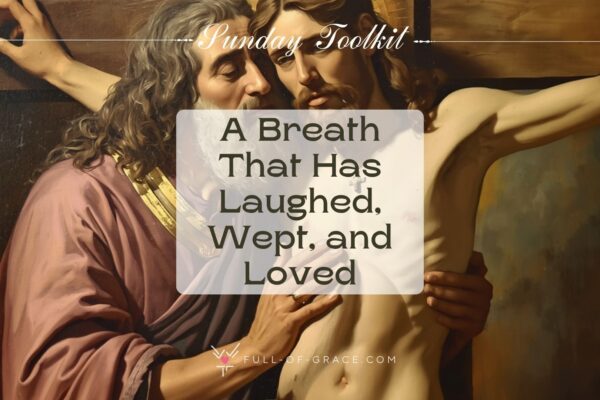
The Greek verb enephysesen – he breathed into/upon them – appears in the New Testament only here. It is a direct echo of Genesis 2:7 in the Septuagint (LXX), where God breathes the breath of life into the nostrils of the adam. This is a second creation. A new genesis is happening in a locked room.
The breath comes from a body that still bears wounds. The enephysesen is not from glorified lungs unmarked by the cross. It is from a pierced side and pierced hands. This is important: the Ruah enters through the wound, not around it. The new creation passes through death, not past it.
Why John Wrote This
John’s Gospel ends with a purpose statement: these things are written so that you may come to believe that Jesus is the Messiah, the Son of God, and that through believing you may have life in his name. The Thomas story is the last and greatest of the resurrection appearances precisely because it is for us – for everyone who has not seen, who has not touched, whose body still wants evidence. John closes with Thomas so that we can close with Thomas. His journey is our journey.
Key Insight
The locked doors are not an obstacle. They are the theological statement: the risen Christ passes through whatever we have sealed. Fear seals the room. Grief seals it. Doubt seals it. Theological condition seals it (unless I see…). And the risen Christ does not wait outside for us to unlock the door. He enters anyway – and he comes back for the one who missed it.
The Common Thread
Every reading today is about the gap between report and encounter – and about what bridges it. Acts shows us a community that has been breathed into: their response is not a set of beliefs but a way of living together in the body. First Peter addresses those for whom direct encounter is no longer possible: and he tells them their faith-without-seeing is not consolation prize but beatitude. The Gospel gives us Thomas, the body-knower who refuses secondhand faith – and shows us Christ coming back, through locked doors, to meet him exactly where he is.
The common thread is incarnational patience. The risen Christ does not demand that the body leap to abstract belief. He breathes. He shows wounds. He comes back. He says: put your finger here. And the community in Acts is the fruit of that patience – a people whose senses have been restored to communal life, eating with exultation, attending to one another, holding things in common.
For the Born to Recognise series, this Sunday is Week 1: the sense of hearing. Thomas is the archetype of the ear that refuses to trust what others have received. His journey is the journey we begin today – toward an encounter so particular, so bodied, so real that when it comes, the only possible response is: My Lord and my God.
Rabbinic and Patristic Keys
On chesed (Psalm 118): Rabbis noted that chesed is the characteristic of the anavim – the poor, the humble, the bent ones – who receive what the proud cannot. The Talmud (Sotah 14a) teaches that God covers the naked (Adam and Eve), visits the sick (Abraham after circumcision), comforts mourners (Isaac after Abraham’s death), and buries the dead (Moses) – all acts of chesed. Divine Mercy is not an abstraction; it is concrete bodily attention to vulnerability.
On Thomas (Augustine, Tractates on John, 121): Augustine saw Thomas’s doubt not as failure but as gift – he doubted so that we might not doubt. Thomas’s insistence on touch is, for Augustine, a mercy extended to all who come after: his encounter becomes the foundation of their faith. The wound is not hidden; it is offered.
On the eighth day (Justin Martyr, Dialogue with Trypho, 41): Justin identifies Sunday as the eighth day – the day that both follows the week and transcends it, the day of the new creation, the day circumcision pointed toward: not the cutting away of flesh but the circumcision of the heart, the opening of the inner senses. It is for this same reason that the baptismal font is traditionally octagonal: eight sides for the eighth day, the architecture of the building quietly saying what the rite enacts – you are being born into the new creation.

More
Check further resources:
We hear before we see – introduction to This Sunday Spirit including an overview of free resources.
Open My Ear – A three-part embodied experience attending to the quality of our own auditory anticipation and finding the one who listens within us.
Turned Toward the Voice – A complete Prayer of the Faithful centred on the gift of listening
The theme of locked doors and hidden selves connects to the Lenten arc of hiding and unhiding developed across Lent Year A – particularly the First Sunday’s desert exposure and the Fifth Sunday’s Lazarus emerging from the tomb. Divine Mercy Sunday is the resurrection answer to everything that sealed us: the locked room as the lenten cave, now entered from the other side.
The enephysesen – the second breath – connects directly to the Genesis anthropology explored in the Advent series: the neshama, the breath-soul that God breathes into the adam, is breathed again into a new creation in the locked room. The garments of skin become, in the resurrection, a body that passes through walls – yet still bears wounds.