
Born to Recognise Week 6: The Blessing of Hands
Think for a moment about everything your hands have already done today.
Before you were fully awake, your hands were already working – turning off an alarm, rubbing your eyes, reaching for a glass of water. Maybe before the first word spoken to another person your hands were already reaching for a phone. Typing. Scrolling.
Preparing your coffee. Brushing teeth. Cleaning a face. Setting food on a table.
We do not think about this. We are not supposed to think about this. The hands work so constantly, so faithfully, so far below the level of conscious decision, that they become invisible to us. And yet they are perhaps the most telling part of our stories – the part of the body that carries, more than any other, the full record of a human life.

What Hands Do
Hands are the place where the ordinary becomes almost absurdly intimate.
The hands that brushes your teeth are also the hands that once held to your mother’s hand crossing a road. The hands that type a work email are the hands that will reach for someone you love in the dark. The hands that clear dishes from a table and the hands that were once lifted in a moment of pure joy – singing, praying, greeting someone you had not seen in years – these are the same hands. The one set. Yours.
There is something almost overwhelming about this, when you let it land.
The catalogue of what hands do in a single day would take longer to read than the day itself: they cook and clean and carry and type and scroll and open and close and sort and grab, hold and release. They do the work of living so completely, so without complaint, that we have stopped noticing them entirely.
Until they hurt. Until something goes wrong with them. Until, for some reason, we are made to look.
The Space Between Us
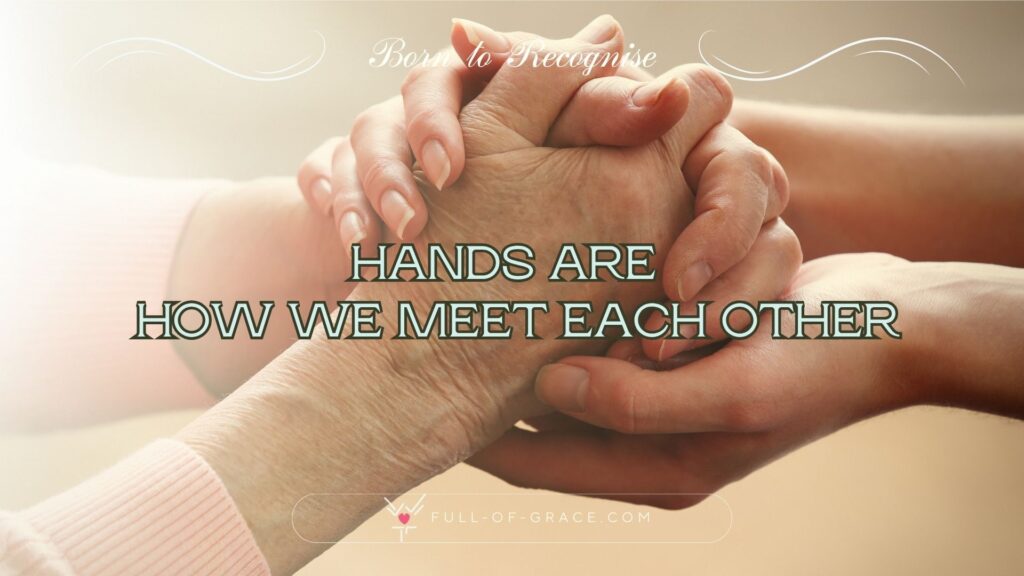
Hands are also how we meet each other.
The handshake – still the primary gesture of formal greeting in much of the world – is one of the most information-dense moments of human encounter. In those few seconds of contact, something passes between two people that no introduction, no title, no business card can replicate. You learn something about a person from their hand before they have said a word.
Held hands are different again. Holding hands is one of the oldest gestures of accompaniment – I am here, I am not leaving, you do not have to do this alone. It is what we do with children crossing roads, with people in hospital beds, with someone who has just received news they did not want to receive.
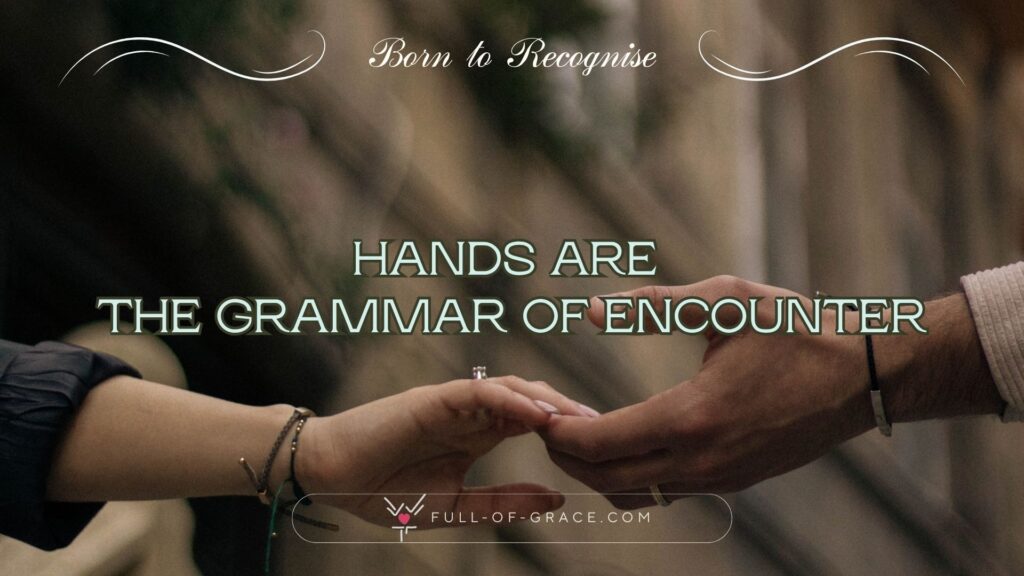
And then there is kissing hands – a gesture that has quietly disappeared from many places, including Poland, where it was once entirely ordinary. A man would take a woman’s hand and kiss it in greeting. It was also a gesture of gratitude, of reverence, of acknowledging that the person before you carried something worth honouring. That it has faded says something – not necessarily bad, but something – about how we have changed our grammar of encounter.
Hands are the grammar of encounter. They say things we do not have words for. They say things we would not dare to say in words.
What We Put On Them
We also use hands to signal who we are, where we belong, what we have promised.
A wedding ring. An engagement ring. A signet ring marking membership – a family, a school, an order. The ring of a bishop, kissed as a sign of respect for the office it represents. A bracelet that someone you love once put on your wrist. A tattoo, washable or permanent, that marks a moment or a belonging.
And then: the manicured hand, the decorated nail, the carefully maintained skin. This too is a kind of language. It says: I tend to this. I present this. This matters to me or to the world I move in.
None of this is vanity and none of this is depth. It is all, simply, human. We have always marked our hands. We have always used them to say this is who I am, this is whose I am, this is where I come from.
And Then We Pray With Them
Hands lifted – the oldest gesture of prayer in the human record. I am opening myself toward something larger than myself. Hands open, palms upward – I am receiving. I am not clutching. Palms pressed together – the universal gesture of petition, of reverence, of the self gathering itself into attention before the sacred.
A hand resting on a heart. A hand signing a cross on a forehead, a chest, a shoulder. A hand laid on someone’s head in blessing.
We worship with our hands. We have always worshipped with our hands. Long before we had words for what we were doing, we had these gestures – ancient, instinctive, carried in the body before the mind caught up with them.
The same hands that cleaned a nose this morning.
The same hands.
A Practice for This Week
Find a moment of stillness. Sit if you can.
Stretch your hands out in front of you, palms facing down.
Look at them. The shape of your knuckles. The condition of your skin. The state of your nails – whether they are painted or plain, attended or neglected, whether the cuticles are dry or smooth. Do not rush to judge any of it. Simply look at what is there.
These hands have a story. You do not need to narrate it right now. Just let the story be present. If the skin is rough and the nails are broken, that is the story of work and effort and showing up. If the nails are carefully tended and the skin is soft, that is its own story too. Neither is the point. The hands beneath the condition – those are the point.
Look a little longer than is comfortable.
Now turn them over. Palms facing up.
Look at your palms. The lines of them. The particular landscape of your own hands that belongs to no one else. These are the palms that have been open and closed, that have held and released, that have reached and let go. Just perceive them. You do not need to read them. Simply see them.
Now, with your thumbs, slowly trace a small cross on each palm.
Take your time with this. It is a gesture of blessing – of marking what is ordinary as also sacred, of saying: this too belongs to the holy.
Bring your palms together.
Notice what you feel. The temperature. The texture. The pressure of your own hands meeting. This is the gesture of prayer – the oldest one. And what comes together in it is everything your hands have carried: the ordinary and the sacred, the status and the service, the encounter and the solitude, the work and the worship.
Not one or the other.
This and that.
This is you – the wholeness of it. Not the version you present and not the version you hide. The whole thing, held between your own palms, for just this moment.
Stay there as long as you need to.
The blessing of hands is not about making the ordinary holy. It is about recognising that it already is.
Echoes of Yourself
Accompany Joseph, whose hands remember numerous expensive robes, the pit, the success and the prison, and now are helping him to navigate the threshold between accusation and freedom.