
The collar is wrong.
Joseph’s fingers find it before anything else – before the light, before the space, before the strange silence of a room that is not a cell. His hands go to the neck of the robe almost immediately, tugging, searching for where the fabric is cutting, trying to make a little more room between linen and skin. It is a gesture he cannot stop. The kind of thing your hands do before your mind has caught up with where you are.
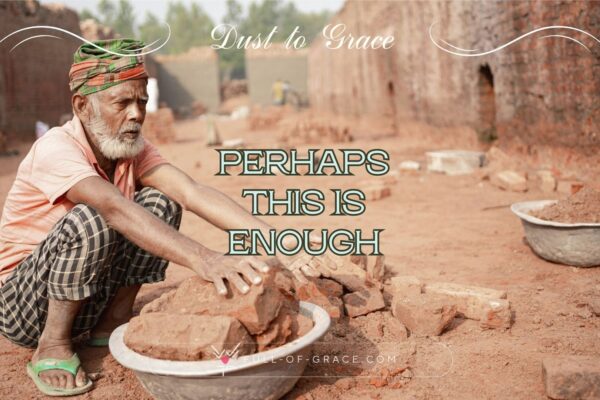
They have bathed him. Shaved him. Rubbed oil into his skin with the brisk efficiency of men preparing a surface, not tending a person. And the oil, which was meant to smooth and soften, is irritating his hands. He can feel it – the oil finding the cracks in his knuckles, the split places at the edges of his fingers, the cuticles dried to the point of peeling. Years of stone and dust and water and grain do not surrender to a single morning’s preparation. The oil sinks in and the skin drinks it and cracks a little more, and his hands, which were supposed to emerge from this morning looking like someone else’s hands, look more like his own than ever.
He notices this and looks away.

There is an instinct – he catches it happening – to hide them. To fold them into the robe, to clasp them behind his back, to find some arrangement that keeps them out of the sightline of the men around him. The nails are clean, someone has seen to that, but clean does not change the shape of them. Does not change the story written into the skin above each knuckle. Does not change what these hands are.
He has been here before.
He knows the sensation of another person’s idea of him, draped across his shoulders.
The coat his father gave him had weight. That coat – that coat of many colors, that coat of favoritism and longing and a father’s grief poured into fabric – he had worn it knowing, even then, that it was not quite his. It was Jacob’s love made visible. It was Jacob’s wound made wearable. Joseph had carried it with something close to tenderness and something close to burden, the way you carry a gift that is also a sentence.
And then the pit. And then the traders. And then the coat, held up, dipped in blood, carried back to his father as evidence of something that had not happened.
He had stood, stripped, in the bottom of the pit and understood something. Not immediately. Not cleanly. But he had understood, somewhere below thought, that the coat had never been him. That what was him – whatever that was – had gone into the pit with him, and the coat had gone with the messengers, and he was still here.
He had been more himself in the pit than in the coat.
They walk him toward Pharaoh’s hall and he is aware, with every step, of the linen moving around his legs in a way his body does not quite know how to answer. His hands hang at his sides and he does not know what to do with them. In the prison there was always something to do with them – to carry, to lift, to work. Here they simply are. Exposed. He tries once more to adjust the collar, finds nothing actually wrong with the fit, lets his hands drop again.
A man near him glances at the gesture and Joseph stops.

He looks at his hands.
The oil has settled now into the creases of his palms, darkening them slightly, pooling in the lines that years of labor have cut deep. Prison labor. Slave labor. The labor of a man with no choices about what his hands would be asked to do, and who did it anyway, and whose hands remember every morning of it regardless of what has been rubbed into them this morning in preparation for a different story.
He thinks, briefly, of the baker.
Of the particular stillness in that moment – both of them in the same cell, both carrying dreams that had not yet been translated, both waiting for someone to name what the night had given them. Joseph had named it plainly. The baker’s dream meant death and he had said so, without softening it, because there was no version of himself available in that moment that knew how to manage what came out of his mouth. He had simply said what he saw. He had nothing to protect and so nothing came between him and the truth of it.
His hands had been cracked then too.
Pharaoh is disturbed.
Joseph hears this before he enters the hall. The disturbance moves ahead of Pharaoh like a weather system – advisors in clustered uncertainty, the particular stillness of a court that has failed its king and knows it. Seven cows. Seven thin cows. A dream that stuck, the way only certain dreams stick, arriving not as image but as weight.
And here – here is where something in him goes very quiet, and very loud at the same time.
He knows what the dream means. The meaning is simple. Almost insultingly simple. The kind of thing that does not require elaborate apparatus, priestly ceremony, the long performance of wisdom being produced. It is the kind of answer that sounds like nothing. Like a child’s answer. Like something anyone might say if they were not afraid of sounding foolish.
And this is where the temptation arrives, and Joseph watches it arrive, because he has learned in prison to watch his own interior weather the way a man learns to read a cell’s shadows to know what time of day it is.

The temptation is to dress the answer. To surround the simple thing with the language of expertise, to give Pharaoh enough architecture around the plain truth that it feels worthy of the occasion. He is wearing Egyptian linen. He has been oiled and prepared and walked into this hall as a man of some expected significance. The answer should match the presentation.
He looks down.
His hands do not match the presentation.
His hands are where he has been. His hands are the prison and the slave quarters and the pit. His hands are every morning he woke with no horizon and did the next thing anyway. His hands are the baker’s face and the cupbearer’s relief and the long years after, when the cupbearer forgot and Joseph stayed in the cell and kept waking up and kept doing the next thing, because there was nothing else available to him and he had learned, somehow, that this was enough.
He cannot make his hands into a courtier’s hands by this afternoon.
And something about that – something about the impossibility of it – steadies him.
It is beyond my power to do this, he will say. But God can tell you what it means and set you at ease.
Not as performance. Not as the ritual modesty of a man who knows he is about to prove himself. But as the actual choice, made in full awareness of what it costs – to step back out of the coat, internally, to speak not from the linen but from the hands. To let what has actually happened to him be the ground he stands on, rather than the thing he hides.
Seven years of abundance. Seven years of famine. Store the grain. Find a man of discernment and set him over the land.
Simple. Plain. The kind of answer that does not earn fine linen.
He says it anyway.
And his hands – his same hands, the cracked and oiled and stubbornly honest hands – are still his hands. Even here. Even now. Even in the linen.
The coat cannot change what the hands know.
He had greater freedom stripped of everything than he feels standing on the edge of liberation with everything to lose. This is the paradox that the hands hold: the record of what you actually did, who you actually were, when no one was looking and there was nothing to protect. You can dress them in anything. The hands remember.
Practice
What is the story told by your hands?
Follow the mystery of sences with Born to Recognise series – Week 6 – Blessing on your hands.
Previous parts:
Week 1: Here Comes the Dreamer
Week 2: I am Ready
Week 3: What Kind of Dream Is That
Week 4: My son’s cloak
Week 5: Sleep With Me
More about Echoes of Yourself
More about Dust to Grace series