
QUICK REFERENCE
Date: December 7, 2025
Liturgical Season: Second Sunday of Advent, Year A
Readings: Isaiah 11:1-10 | Psalm 72 | Romans 15:4-9 | Matthew 3:1-12
Theme: Baptism calls us out of hiding to inhabit the impossible—a world where God’s breath fills everything and no one has to pay the cost anymore.
WHERE ARE WE?
In the Foreground: Isaiah’s Impossible Vision
Wolf with lamb. Baby at the cobra’s den. The lion eating straw like an ox.
Isaiah’s peaceable kingdom is so impossibly sweet it feels like religious wallpaper—pretty but unreal. And yet this Second Sunday of Advent asks: What if this is what baptism actually means? What if we’re baptized into this impossible vision, into a reality where death is undone and no one has to die for another to live?
The foreground reading (Isaiah 11) emerges from catastrophe. The “stump of Jesse” assumes the tree has been cut down—the Davidic dynasty destroyed, the people in exile. Hope comes not from what survived, but from what looked dead. The shoot grows from the stump.
This is resurrection language before anyone had words for resurrection.
In Salvation History: From Light to Skin to Spirit
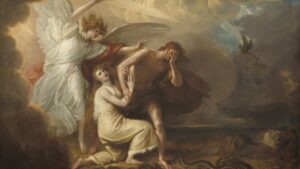
There’s a mystical Jewish tradition that plays with Hebrew words: In Eden, Adam and Eve were clothed in or (אוֹר – light). After the Fall, God clothed them in or (עוֹר – skin). Same sound. Different letter.
From light to flesh. From gift without cost to a world where someone always pays.
Genesis 3:21 records the first death in Scripture: God kills an animal to make garments of skin for Adam and Eve. God performs the first sacrifice—not because a distant deity demands it, but because He looks at His beloved creatures in their inadequate fig-leaf covering and provides what they actually need. At cost.
And we’ve lived in that economy ever since. Every comfort I enjoy, someone or something pays for. I cannot go back to Eden alone. Paradise cannot be inhabited by one person while the rest of creation bears the cost.
But Isaiah’s vision? The peaceable kingdom is only possible when “the earth shall be filled with knowledge of the LORD, as water covers the sea.” When God’s Spirit (ruah—breath, wind, life) saturates everything, the old rules dissolve. The lion eats straw. The cobra is safe with the baby. There is no cost.
In the Liturgical Year: The “How” of Preparation
Last Sunday (First Advent) we watched and waited: “Stay awake, the end is coming.”
This Sunday we face John the Baptist’s fierce confrontation: “Repent, for the kingdom of heaven is at hand!” The kingdom isn’t coming—it’s close, it’s near, it’s almost touching us.
But John doesn’t let us prepare with religious performance. When the Pharisees and Sadducees come for baptism, he calls them “brood of vipers”—not because they’re worse than others, but because they want the ritual without the transformation. They want to download a heavenly reality without paying its cost. They want baptism as credential, not conversion.
“Produce good fruit as evidence of your repentance.” Not evidence you showed up. Evidence something actually shifted.
This is preparation through demolition, not decoration. “Even now the ax is at the root of the trees.” What dead wood needs cutting away? What are we still hiding behind?
LITURGY PLANNING
Key Symbols & Themes
Breath/Wind/Spirit (Ruah):
The same word runs through the entire Isaiah reading—spirit of wisdom, spirit of understanding, breath of his lips. This is the ruah that hovered over creation, the breath God breathed into Adam, the life-force itself. John contrasts his water baptism with Jesus’s Spirit-and-fire baptism. Consider: How do we make breath visible? Incense as God’s presence? Attention to our own breathing during prayer?
Clothing: Light, Skin, White Garment:
The mystical tradition of or (light) becoming or (skin) after the Fall. The white baptismal garment as return to light. The impossible instruction: “bring it unstained to the judgment seat.” We can’t—but Revelation 7:14 promises robes “washed white in the blood of the Lamb.” For RCIA/catechumens, this is powerful: What does it mean to be clothed by God instead of covering ourselves?
The Stump and the Shoot:
Hope emerges from what looks dead. Not from strength, but from weakness. Not from the thriving tree, but from the cut stump. This is Advent’s paradox: new life through apparent death.
The Peaceable Kingdom:
Wolf with lamb, leopard with kid, cobra with baby. The vision we can’t imagine but are called to believe. Visual art of the peaceable kingdom could be powerful—but paired with the question: “Can we even envision this? Do we dare to believe it?”
Hiding and Revelation:
Adam and Eve hiding in the bushes, covering themselves with fig leaves. John calling religious leaders out of their hiding behind credentials and ritual. “Make straight his paths” = remove the obstacles we’ve put in the way ourselves. Stop hiding. Come out.
Cost and Sacrifice:
God’s first sacrifice in Genesis 3:21. The economy where someone always pays. Christ’s sacrifice ending the cycle. Baptism as entry into a reality where the debt is already paid.
Music Suggestions
- Wilderness/Desert themes
- Spirit/Breath
- Vision of Peace
- Baptismal Identity
- Hope against hope
Flexibility for Parish Context
This material is rich and layered—different communities will connect with different aspects:
- RCIA-focused parishes: Emphasize baptismal identity, the white garment, being clothed by God vs. self-covering
- Social justice communities: The peaceable kingdom as God’s vision of justice, the economy where no one pays for another’s comfort
- Advent penance services: John’s call to actual transformation vs. religious performance, the ax at the root, examining what we’re still hiding
- Contemplative/mystical bent: The ruah filling everything, the light-to-skin mystical tradition, breathing as prayer
- Families with young children: The peaceable kingdom animals (this resonates with kids!), but paired with the honest question: “Can we imagine this? What would it feel like to be that safe?”
The through-line for all: Baptism is present tense. We ARE baptized. Do we believe it? Do we live it?

FREE RESOURCES FOR THIS SUNDAY
Biblical Background: From Light to Skin to Spirit
Deep dive into the readings with context most homilies won’t cover:
- The mystical tradition of or (light) becoming or (skin) after the Fall
- God’s first sacrifice in Genesis 3:21—and what it means that we live in a world where someone always pays
- The Hebrew ruah (breath/wind/spirit) throughout Isaiah and its connection to John’s baptism
- Why the peaceable kingdom feels impossibly sweet—and why we’re called to believe it anyway
- What it means TODAY that you are baptized (present tense, not past)
Perfect for: Personal reflection, homily preparation, RCIA/catechesis, adult faith formation
Prayer of the Faithful: Called Out of Hiding
Intercessions flowing from the Sunday’s theme of baptism, transformation, and the impossible vision. Includes petitions for:
- Church leaders who call people to actual conversion, not just religious performance
- Courage to believe in justice that outlasts the moon
- Catechumens preparing for baptism—that they know they’re being clothed by God
- Those who’ve given up on the impossible promises
- Our community’s willingness to stop hiding and come out into God’s presence
Perfect for: Sunday Mass, penance services, prayer groups
Sunday Experience: Returning to the River
A guided baptismal meditation that invites you to experience—through imagination and the Holy Spirit—what happened to you spiritually in baptism. Most of us were baptized as infants with no memory of that moment. This embodied prayer takes you to the Jordan River, into John’s hands, under the water, and up again gasping for the breath that is ruah—Spirit—always available to you.
Perfect for: Post-Communion reflection, personal prayer, RCIA mystagogy, Adoration, baptismal anniversaries
Perfect for: Personal prayer after Communion, extended Adoration, small group reflection
DIGGING DEEPER: THE HIDDEN TRADITIONS
One of the treasures of this Sunday’s readings is how they connect to lesser-known traditions that bring fresh insight:
The Kabbalistic Wordplay: The mystical tradition that our first parents were clothed in or (light) which became or (skin)—same sound, different Hebrew letter—opens up the entire narrative of Fall and redemption. We moved from gift without cost to an economy of sacrifice. Baptism attempts to return us to light.
God’s First Sacrifice: Genesis 3:21 is usually glossed over, but rabbinic commentary wrestles with it: Where did the skins come from? Who died? This is the first death in Scripture—and God performs it Himself, clothing those He loves at cost to creation.
The Seven-fold Spirit: Isaiah 11:2 enumerates the Spirit resting on the Messiah—spirit of wisdom, understanding, counsel, strength, knowledge, fear of the LORD. This becomes the foundation for the Church’s understanding of the gifts of the Holy Spirit. The same ruah that creates the peaceable kingdom.
John as the Last of the Old Testament: We call John the Baptist the last prophet of the Old Covenant—the one who brings the Law to its perfection. But it’s in Jesus’s baptism with Spirit and fire that we find actual transformation. John knows the difference: “I baptize with water…but he will baptize with the Holy Spirit.”
These aren’t just academic curiosities—they’re invitations into wonder. What else have we read past? What other riches are hidden in plain sight?
CUSTOM LITURGY SUPPORT
Planning liturgy for Advent? Preparing catechumens for the Easter Vigil? Leading a penance service or Advent retreat?
These resources are designed to support your ministry, but sometimes you need something tailored to your specific community—your unique challenges, your particular charisms, your people’s questions.
I offer custom liturgy writing and coaching for parishes, liturgical coordinators, and ministers who want to go deeper. Whether you need help developing a retreat around this Sunday’s themes, creating Advent devotionals for your community, or discerning how to make liturgy more embodied and accessible, I’d be honored to support your work.
Contact me to explore how we can collaborate.
A WORD AS YOU PREPARE
Most of us reading this are already baptized. We’ve already received the white garment, the seal of the Spirit, the promise of new life.
But baptism isn’t a past event that we’ve moved on from. It’s present tense. We ARE baptized. Right now. Today.
As you prepare for this Sunday—whether you’re preaching, planning, praying, or simply showing up—ask yourself: How much of this impossible vision do I actually believe? How much am I willing to live out?
The peaceable kingdom isn’t just a nice image for children’s Bibles. It’s the reality we’re baptized into. The world where God’s breath fills everything, where no one has to pay the cost anymore, where death itself is undone.
Can we imagine it? Can we stop hiding long enough to look at it? Can we let ourselves be clothed by God instead of frantically grabbing our own fig leaves?
Second Sunday of Advent asks: Will you come out of hiding? Will you let yourself be filled with breath? Will you believe?
Related Posts:
First Sunday of Advent (Year A) Biblical Background
TheThreefold Coming: Understand the Season of Advent
Celebrating the Impossible Promise
The Hebrew Ruah: Breath, Wind, and the Spirit of God
These resources are offered freely to support Catholic liturgical ministers, parishes, and anyone seeking to go deeper with the Sunday readings. If they’ve been helpful to your ministry, please consider sharing them with others who might benefit.







2 thoughts on “Second Sunday of Advent (Year A) – Free Liturgical Resources”
Comments are closed.