Quick Reference
Date: July 5, 2026
Season: Fourteenth Sunday in Ordinary Time – Year A
Readings: First Reading: Zechariah 9:9-10 Responsorial Psalm: Psalm 145:1-2, 8-9, 10-11, 13-14 Second Reading: Romans 8:9, 11-13 Gospel: Matthew 11:25-30
USCCB: https://bible.usccb.org/bible/readings/070526.cfm
One-Sentence Theme:
A king arrives in the posture of the one who gleans, looking for the fallen, forgotten, neglected and omitted – and finding them, makes his home within.
Entering the Sunday
Before you read any further, try to sit still for a moment and notice your throat.
Not your thoughts about your throat. The throat itself – the passage the breath moves through before it becomes a word, the place where sound has not yet been shaped into anything sayable. In Hebrew, the word for this – nephesh, so often flattened into “soul” – carries that older, more physical sense in its root: throat, gullet, the seat of breath and appetite before either becomes language. Your nephesh is not first the part of you that speaks. It is the part of you that receives air, and wants, and waits, before a single sound has left it.
This Sunday’s readings keep returning to a moment just before speech – or just past the edge of what speech can hold. A king arrives who cannot be described by the usual words for kingship, because he comes carrying nothing to declare. A psalm, midway through naming everything praiseworthy about God from A to Z, falls silent exactly where it should speak of the fallen – and answers with an action instead of a word. An infant is named as the one who receives what the wise and eloquent cannot reach, precisely because an infant has no words yet to get in the way. And into a burdened crowd, Jesus does not offer an argument. He offers rest – the kind that begins before you have said anything back.
So let the invitation this week be this: before you move through the panels below, let your nephesh – your throat, your breath, the place in you that is still forming words – sit for a moment unshaped. Not searching for the right response. Not composing what you will say to God, or about this Sunday, or to the parish you serve. Just the throat, open, receiving air, the way it did before you knew any words at all.
What follows are four readings that keep circling back to that same threshold – the place just before language, and the deed or gaze or invitation that arrives there, long before we’ve found anything to say.
First Reading: Zechariah 9:9-10
Rejoice greatly, O daughter Zion! Shout for joy, O daughter Jerusalem! Behold: your king is coming to you, a just savior is he, humble, and riding on a donkey…
When and where
Chapters 9-14 of Zechariah are widely held by scholars to come from a later hand than chapters 1-8, likely the fourth century BCE, decades or more after the return from Babylon described in Ezra and Nehemiah. The temple had been rebuilt (Zechariah 1-8 concerns that rebuilding directly), but the restoration fell far short of what prophets like Zechariah had promised – no Davidic king on the throne, no visible glory filling the temple as it once had. So the community is still waiting for promises that had not yet caught up with their circumstances. The temple was rebuilt. The king had not returned. This is a text written into that gap.
What’s happening
The reading gives us a coronation scene, and every detail is a refusal. A king is expected on a warhorse – this one arrives on a donkey, the animal that carries loads, not the animal that leads charges. The Hebrew word rendered “humble” (ani) is not primarily a description of temperament. It is a legal and economic term: it names the one without property, without holdings, the one whose survival depends on what the harvest leaves behind – grain a landowner is required to leave standing at the field’s edge and in its corners, unharvested, for gleaning (Leviticus 19:9-10; 23:22). A king who is ani is not a king behaving modestly. He is a king standing, structurally, where the landless stand.
Then the verse turns from the king’s arrival to what his arrival ends: chariots gone from Ephraim, horses from Jerusalem, the battle bow broken. Not defeated in combat – simply no longer needed.
He shall speak peace to the nations.
Presence, not conquest, is what disarms.
The final line stretches his reign
from sea to sea, and from the River to the ends of the earth
– quoting, almost word for word, the royal enthronement language of Psalm 72. The River, capitalized in some translations though the Hebrew simply reads ha-nahar, “the river,” is the fixed shorthand Scripture uses, without further naming, for the Euphrates – the same river named as the outer edge of the land promised to Abraham (Genesis 15:18), and the same river Israel had, more recently, been marched to in chains. The line does not erase that history. It reroutes it: the river of exile becomes the starting point of a reign built on gathering, not taking.
Responsorial Psalm: Psalm 145:1-2, 8-9, 10-11, 13-14
The LORD is gracious and merciful, slow to anger and of great kindness. The LORD is good to all, and compassionate toward all his works.
When and where
Psalm 145 carries a Davidic superscription and closes the final block of psalms explicitly attributed to David (Psalms 138-145), functioning as a hinge into the five concluding “Hallelujah” psalms that end the Psalter.
The Psalm is an acrostic – twenty-two verses, one for each letter of the Hebrew alphabet in sequence, an attempt to praise God from A to Z, exhaustively, leaving nothing out.
Its acrostic form was likely intended as both a compositional discipline and a mnemonic aid – the alphabet as a container built to hold the whole of praise. It remains part of daily Jewish liturgical prayer to this day.
It is also the only psalm titled simply Praise – the Hebrew Tehillah, root of Tehillim, the traditional name for the whole book of Psalms.
What’s happening
At the point where the acrostic should turn to the letter nun, something is missing. Nearly every Hebrew manuscript skips straight from the mem verse to the samech verse – no nun line survives. The gap is old enough that the Septuagint, the Syriac Peshitta, and a Dead Sea Scrolls copy of the Psalms all preserve a line to fill it, one that entered the liturgy’s reading of this Sunday:
The LORD is faithful in all his words, and holy in all his works.
Ancient rabbinic tradition offers its own account of the silence – that David foresaw Israel’s fall, named in the very next verse, and could not bring himself to speak the missing line at all.
Whatever the cause, the shape is the same either way: the psalm’s declaration of God’s faithfulness in words falls silent exactly where the text turns to the fallen – and what follows the gap is not more speech but an act:
The LORD supports all who fall and raises up all who are bowed down.
An acrostic built to say everything sayable about God breaks its own pattern at the one place the poem needed a deed more than a word.
Second Reading: Romans 8:9, 11-13
You are not in the flesh; on the contrary, you are in the spirit, if only the Spirit of God dwells in you.
When and where
Romans was written by Paul from Corinth, likely in the mid-to-late 50s CE, to a church he had not founded and had not yet visited – written in part to introduce himself and his gospel ahead of an intended visit to Rome. Chapter 8 arrives after the long argument of chapters 1-7 concerning sin, law, and the self’s inability to save itself by effort.
What’s happening
The verb translated “dwells” is oikei – from oikos, house. It is not a visiting word. Paul is not describing an inspiration that touches briefly and moves on; he is describing residence, the Spirit taking up permanent home in what Paul calls, two verses later, “your mortal bodies” – not the soul in the abstract, but the body, as it actually is, still subject to death. The Spirit is never described directly in this passage – only by what it does: gives life to what is dying, puts to death what belongs to the flesh. It shows up the way a home shows up: not in a self-portrait, but in what it becomes possible to live inside.
Gospel: Matthew 11:25-30
At that time Jesus said, “I give praise to you, Father, Lord of heaven and earth, for although you have hidden these things from the wise and the learned, you have revealed them to the childlike…”
When and where
Matthew 11 falls within a section of the Gospel (chapters 11-12) marked by rejection and questioning – John the Baptist, imprisoned, sends disciples to ask if Jesus is “the one who is to come”; towns that witnessed miracles go unmoved. Jesus’ prayer of praise in 11:25-27, followed by the invitation of 11:28-30, is Matthew’s placement of unguarded intimacy with the Father directly beside public discouragement – not instead of it. It is out of that specific weariness that Jesus prays this prayer aloud, in the hearing of whoever was standing there.
What’s happening
The Greek word translated “childlike” is nepios – not a general word for a young child, but the term for the infant, the pre-verbal one, the one who has not yet acquired speech and therefore has nothing to argue, present, or prove. What is hidden from the wise is not hidden because they lack information. It is hidden because they have something to protect – an accomplishment, a case for themselves – and this particular revealing has no use for a case.
What Jesus says next is stranger than it first sounds:
No one knows the Son except the Father, and no one knows the Father except the Son.
This is not an opening statement. It is, on its face, a closed circuit – total, mutual, sealed. And then, in the same breath:
and anyone to whom the Son wishes to reveal him.
The circle does not stay shut. It opens from the inside, by the Son’s own will, not because someone outside earned entry. Come to me, all you who labor and are burdened, and I will give you rest follows directly on that opening – not as a separate offer to a separate audience, but as the sound of the door itself.
Rest – anapausis – carries the weight of Sabbath behind it: not a pause from exhaustion, but the seventh-day posture of Genesis, where God does not cease because creation has tired God out, but turns to look at what was made and calls it good, before anything made has said a word back. What Jesus offers the burdened is not primarily relief. It is that same being-seen, prior to speech, prior to argument, prior to having earned the gaze at all.
Take my yoke upon you
draws on a rabbinic idiom for Torah observance – “the yoke of the kingdom,” “the yoke of the commandments.” Jesus does not offer to remove the yoke. He offers his own in its place, and calls it light – not because it demands nothing, but because it is carried by someone who has already gone looking for what was left in the field.
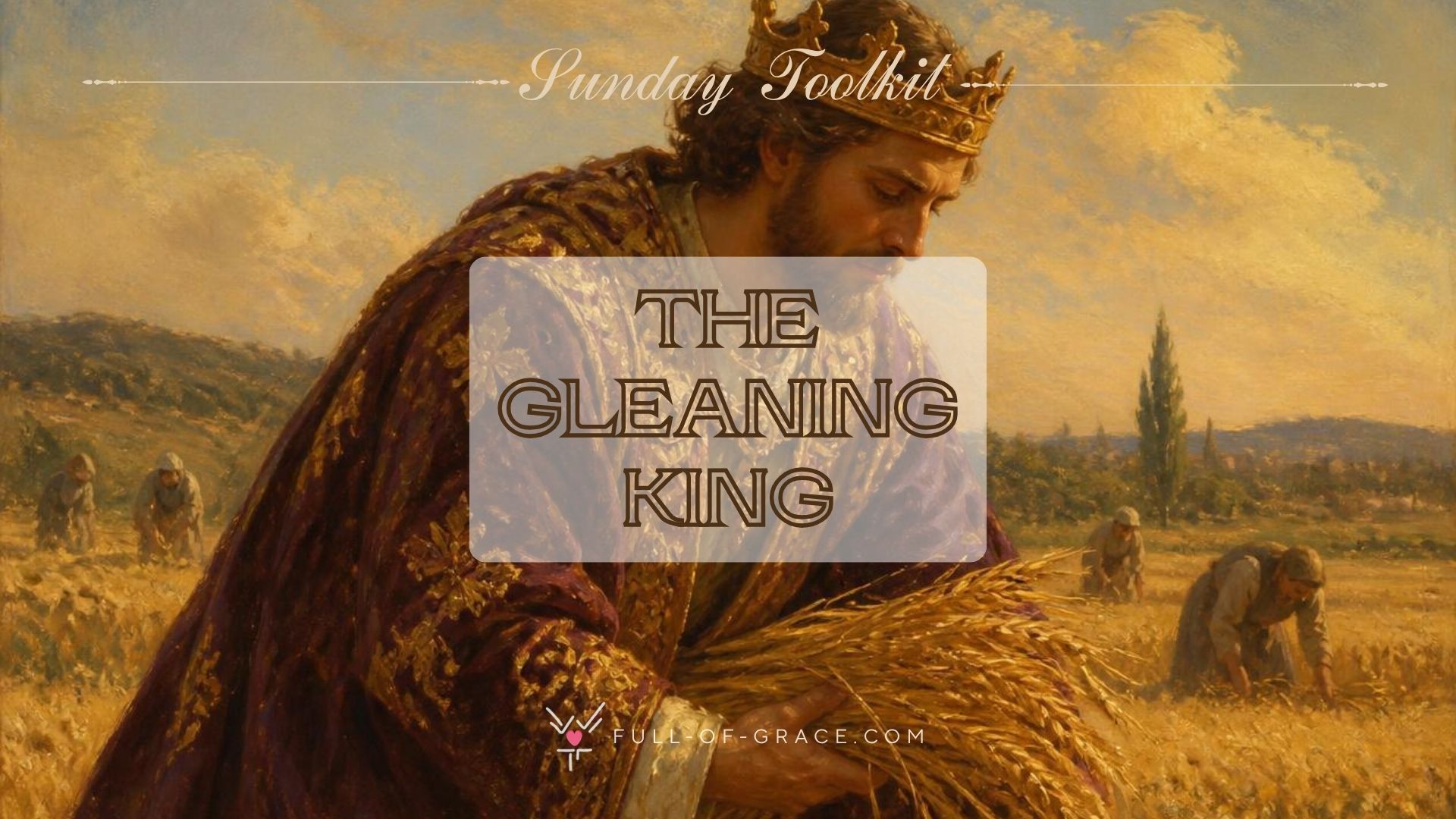
Closing Reflection: The Gleaning King
A field, after harvest, is not empty. There is always what fell – grain that slipped the hand, stalks bent under their own weight before the cutting even reached them, the corner left standing because the law required it to be left. Someone is entitled to that. Not the one who owns the field. The one who owns nothing.
Zechariah’s king rides in wearing that entitlement. Not a warhorse, not a throne carried in – the working donkey, the animal built to carry what others cannot carry themselves, and the word for “humble” that names a legal condition before it names a temperament: landless, without claim, without harvest of his own. A king arriving in the posture of the one who gleans.
He is not there to be fed. He is there to gather. He comes low, to the ground, to the stubble, looking for what the harvesters’ bags did not catch – and what he is looking for is not a category of person. It is a particular stalk. Fallen. Left. Maybe not even noticed as missing until he stoops down and finds it there.
There is nothing that stalk did to deserve the finding. That is the whole of it. It did not argue its way back into the sheaf, did not prove its worth lying in the dirt, did not gather itself up and walk itself to the granary. Its only part in the story is that it stayed where it fell, and let itself be seen.
This is the strange achievement the readings keep circling back to, in different words each time. The psalm’s praise runs out of words exactly where it turns to the fallen, and answers with a deed instead. The infant, in the Gospel, has no case to make and nothing to present – no argument, no accomplishment, only the willingness to be looked at before it can say a single word back. And what is offered in return is not first a lesson or a burden lifted. It is a gaze. Recognition, arriving before anything has been earned, the way God once looked at what had just been made and, before it could speak for itself, called it good.
Come to me – not because you have found the way to be found. Because he already came looking, into the field, low enough to reach what fell. The invitation was never the reward for understanding it. It was the hand already extended, waiting only to be noticed.
Further Resources
This week, the Biblical Background is the only new resource published. If you are looking for an embodied complement to today’s readings, you will find inspiration in previous Sunday Experience resources.
For intercessions, no Prayer of the Faithful has been written specifically for this Sunday. A full library of existing prayers is available here.