
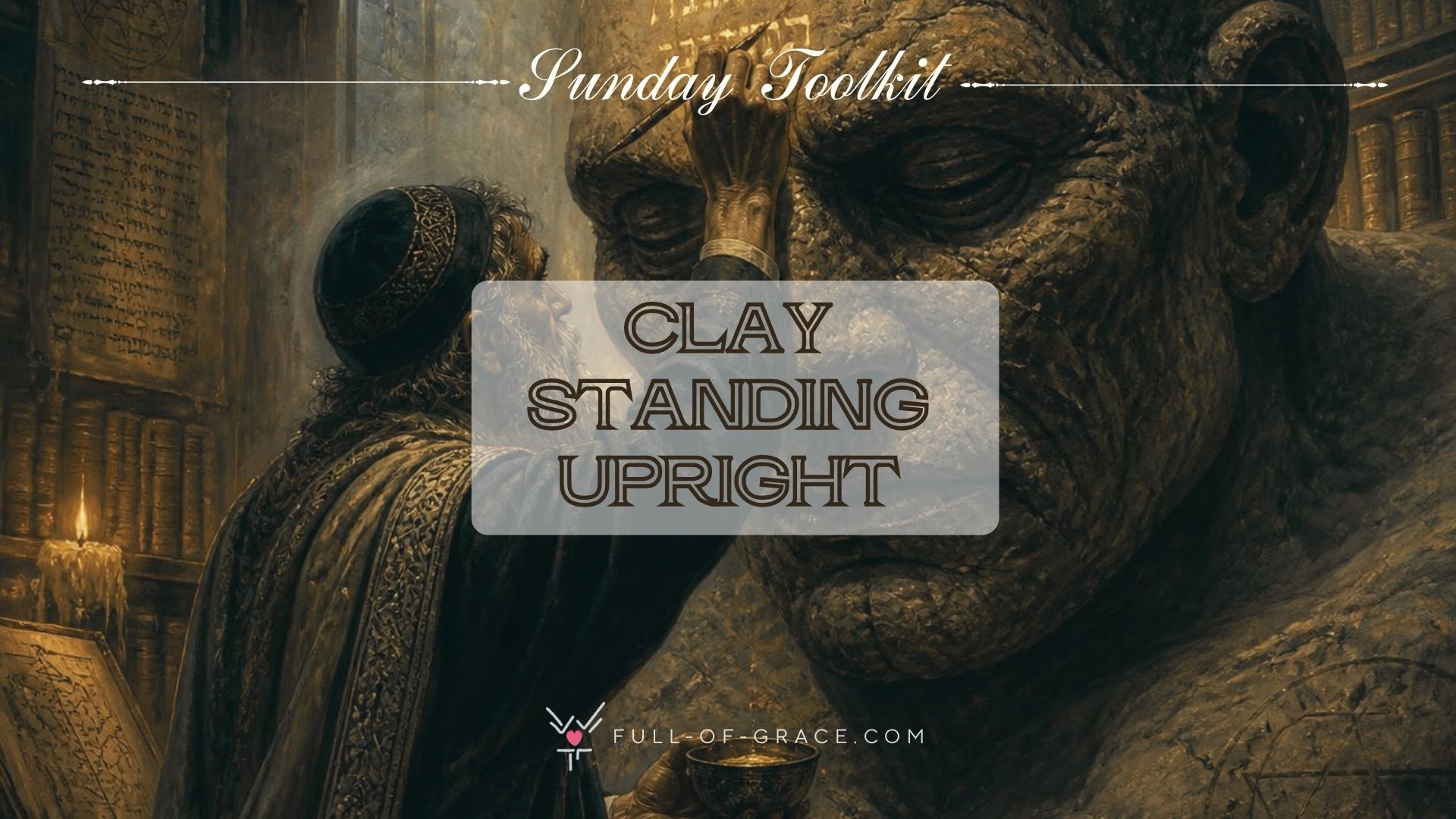
On calling into silence, the word written on a golem’s forehead, and the one letter that separates promise from dust.
Reflection on Psalm 145:2-3, 8-9, 17-18
This psalm makes a promise I’ve tested more than once and haven’t always found kept: nearness, to all who call, no exceptions. I go looking for why the closeness doesn’t always land, and find the whole answer sitting inside a single Hebrew letter – the difference between a word that lives and one that only looks like it does. I don’t arrive at a technique for feeling closer. I arrived at a breath.
Coordinates
Where are we in the Bible?
Psalm 145 (Psalm 144 in the Greek/Vulgate numbering) sits near the very end of the Psalter, the last psalm attributed to David before the closing run of five Hallelujah psalms (146-150) that bring the whole book to its final crescendo of praise.
– the responsorial excerpt for the 25th Sunday in Ordinary Time, Year A, verses 2-3, 8-9, 17-18.
When was it written?
An acrostic psalm – each verse begins with the next letter of the Hebrew alphabet – which is a late compositional technique, associated with post-exilic wisdom and liturgical writing even where Davidic authorship is claimed. It reads less like a spontaneous cry and more like something built to be memorized, prayed daily, carried.
What history does it answer?
Jewish tradition holds that whoever recites this psalm three times a day is assured a place in the world to come – not because of magic in the words, but because the psalm is a curriculum in right orientation, rehearsed until it becomes reflex. It answers the ordinary, recurring problem of a heart that forgets who it’s talking to.
Where are we in salvation history?
It’s the last word of David’s voice in the Psalter – an old king’s final, settled statement about the nature of God, handed forward as the door into the Psalms’ closing wall of pure praise.
It’s Not What It Sounds Like
Every day I will bless you, and I will praise your name forever and ever (Psalm 145:2)
That’s where the reading starts. Verse 1, however, the verse the lectionary skips, is aromimkha Elohai hamelekh –
I will exalt you, my God and King.
Before a single word of blessing, the psalmist has already done something with his body. Rom is a lifting verb. It’s the word behind Elyon, the Most High – height as a name for God, not a metaphor for God. So the psalm’s real overture isn’t gratitude. It’s positioning. I lift you up, and only from there do I bless you.
And bless itself isn’t soft. Barak carries the knee inside it – the same root that gives you berekh, knee. To bless is to bend. So the two opening verbs are the same gesture doubled: one lifts God up, one bends me down. Before the psalm tells me anything about who God is, it has already told me where I have to stand to be able to receive: Not close enough to analyze. Not level enough to negotiate. Aiming above me, and me bent toward that. I notice how easy it is to skip this.
We’re tempted to read I will bless you day after day and hear a devotional habit – something like gratitude journaling with incense.
But the Psalm won’t let me keep it that small. This isn’t a mood I’m cultivating. It’s a posture I’m assuming before I know a single thing about what I’m about to praise.

The Promise Before I Ask Anything
The text quickly switches into introductions:
Great is the Lord and highly to be praised, his greatness is unsearchable (Psalm 145:3).
Then, a few verses later:
gracious and merciful, slow to anger, and of great kindness… good to all and compassionate toward all his works (145:8-9)
This is the covenant language. In Exodus 34:6 God speaks about himself to Moses, on the mountain, after the golden calf. Moses asks to see God’s glory, and what he gets instead is a sentence. Not a vision. A self-description.
So when the psalmist recites these same words centuries later, he isn’t really discovering anything new about God. He’s repeating what’s already been said.
Is repeating always re-experiencing?
Nothing in this whole stretch of the psalm may be the psalmist’s own conclusion, yet all of it can be his experience. I doesn’t have to be: I have found God to be… But it may be more of: this is what has been spoken.
Testimony received, not testimony produced.
That resonates differently from the way I usually pray. Left alone, I still tend to build my sense of God out of how the last hour went – whether I felt anything, whether something worked out, whether the silence felt warm or cold. The psalm doesn’t do that.
The lines reach for the anchored sentence instead of the current mood. Gracious and merciful isn’t a report on today. It’s a formula older than the person saying it, handed down intact.
And it’s from inside that recitation – not after it, not as a separate step – that the promise arrives:
The Lord is near to all who call upon him, to all who call upon him in truth (145:18).
The nearness isn’t a new claim. It’s what the whole list of attributes was building toward the entire time. Which means I can’t get to the promise except by way of what’s already been said about the Promise-keeper. I don’t get to skip the recitation and go straight for the closeness.
But here’s where I stall.
The Promise I Can’t Seem to Collect On
The Lord is near to all who call upon him (145:18).
All. Not the especially devout, not the ones who’ve earned it – all who call. My experience, however, contradicts. Because I call. Repeatedly. And the sense I’m left with afterward is rarely nearness. More often it’s silence with the lights left on.
Any sense of presence I may experience, actually tends to show up most vividly in my imagination: working the scene out in retrospect. My God arrives mostly through my meaning making rather than in anything I could point to and say that was him, that just happened.
I can generate a felt sense of closeness on my own. That’s not nothing – but it’s also not what this verse is promising. It’s promising something closer to encounter than to atmosphere I can bring forth.
So what is wrong that I can’t collect on what I know is true? Maybe my calling is faulty? What does it actually mean to call on him, rather than just call toward him, or call at the idea of him?
The Word Behind “From the Heart” Isn’t Heart
The translation some of us grew up praying – the Grail Psalter, the one behind the Irish missal – renders the promise this way:
The Lord is close to all who call him, who call on him from their hearts.
It’s a beautiful line. It’s also not what the Psalm says. The word translated as heart is be’emet – in emet. In truth. Not heart at all.
That’s not a small swap. “From their hearts” points inward – and even knowing that biblical heart (lev) is a decision, not an emotion, the seat of the will rather than of feeling, I still don’t orient there when I read it. I orient toward sincerity in the modern sense: how much did I mean it, how did it feel while I was calling. Emet points somewhere else – not decision, not feeling, but structure. Its root, aman, means to be firm, load-bearing, established – the same root behind amen.
It’s the word for a pillar that holds weight, not for a choice I made or an emotion I had.
So “call on him in emet” isn’t asking whether I decided to call, and it isn’t asking whether I felt something while I did. It’s asking what I was standing on when I called – whether it could hold weight.
Which reframes my stall completely.
The problem was never whether my calling was sincere enough – sincerity was never the only bar. The question is what I’m actually standing on when I call, and whether it can bear weight.
I know this word from somewhere else entirely, and I can’t unsee that connection. Emet is the word Kabbalistic tradition puts on the forehead of the golem to bring it to life.

What They Wrote on the Golem’s Forehead
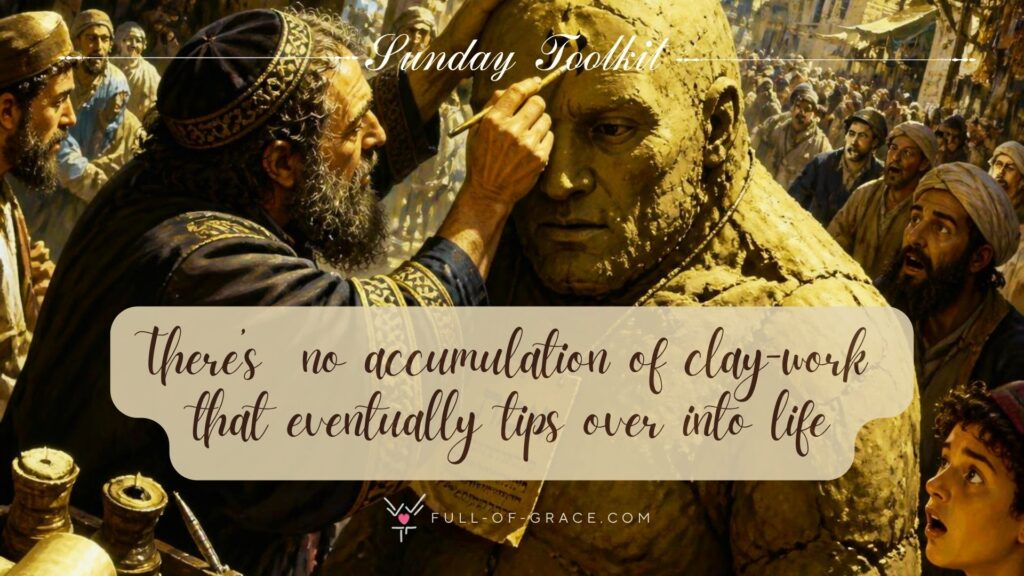
In the Kabbalistic tradition, a golem is a figure shaped out of clay or dust – formed, not born – and brought to life by writing one word on its forehead. Emet. Truth.
The same word the psalm just handed me. Write it on a pile of clay, and the thing stands up. It moves. It works. It can carry loads no human hand could carry, follow instructions without tiring, protect a whole community overnight.
And every version of the story arrives, eventually, at the same problem: the golem grows. It gets stronger and less controllable than the one who made it. It stops taking correction. What was built to serve starts to outgrow the household it was built for. And the tradition is very specific about what has to happen next – not destruction, not an unmaking from nothing, but a single letter removed. Erase the first letter, the aleph, from emet (truth), and what’s left on the golem’s forehead is met. Dead. Two letters out of three, unchanged. One letter gone, and the whole word – the whole creature – collapses.
Emet and met – “truth” and “death” don’t sound like opposites but more like total strangers to each other. Yet in Hebrew they’re almost the same word wearing one extra letter/layer.
Truth isn’t the far end of a spectrum from death. It’s more like death plus one thing.
Which means the aleph isn’t decoration. It’s not emphasis. It’s the entire difference between a thing that lives and a thing that’s only shaped like something living – clay standing upright, doing the motions, without whatever the aleph was actually carrying.
What is that letter? Not just symbolically, but specifically, mechanically, what is it doing that the other two letters can’t do on their own?
Dust Doesn’t Accumulate Into Life
Here’s what the golem story rules out: you cannot get to emet (faithfulness to the promise) by piling up more met (dust).
There’s no quantity of dust, no amount of careful shaping, no accumulation of clay-work that eventually tips over into life.
The golem-makers could refine their craft for a lifetime – better proportions, better material, more precise ritual – and it would still just be very well-made dust standing still, waiting for a specific task.
I evolve around that pattern more than I’d like to admit. My instinct, when the sense of nearness goes quiet, is to do more of what I already know how to do. Read more carefully. Pray longer. Refine the practice, tighten the discipline, get more skilled at the shape of devotion. All of that is met-work – legitimate, even necessary dust, incapable by itself of producing the thing I’m actually short on.
Faithfulness isn’t a threshold I cross by accumulating enough effort.
It’s not a spectrum where more of me eventually adds up to more of God’s nearness. Either the aleph is there or it isn’t. So the muscle I keep flexing – effort, discipline, getting better at managing my relationship with God– was never going to be the thing that closes the distance.
If it’s not something I build up to, what is it? What does the aleph do that no amount of dust can substitute for?
The Aleph Is a Breath You Already Know
Genesis places on the sixth day of creation, God forming Adam out of dust – clay again, the same raw material the golem-makers use – and the formed man stays exactly that, shaped ground, until
God breathed into his nostrils the breath of life, and the man became a living being (Genesis 2:7).
Not a word inscribed.
A breath given, directly, person to person.
The golem-maker has to substitute a written aleph for this gesture because the breathing itself can’t be performed by anyone except the one it belongs to. You can write the letter. You can’t write the breath.
And the breath, I think, is also why the next day – the seventh day – exists. Day six is the last day of making. Day seven all making stops – not because the work ran out, but because something in this order needs one full day where nothing is produced, only received. That’s the aleph’s native rhythm: given, not generated.
That’s what emet (faithfulness to the promise) -calling actually is. It isn’t better technique. It’s the seventh-day posture reaching into an ordinary Tuesday – arriving already addressed, and simply answering, instead of laboring to manufacture the encounter myself.
I feel this most concretely in the breath I take before opening my Bible to pray. I used to think of it as just lungs doing what lungs do. But in that breath I’m not producing the reading – I’m taking my stand on a whole reality.
I don’t have to reinvent who God is every time I sit down, deciding fresh whether today he’s the loving one or the demanding one, patching together a new God out of today’s passage.
I get to stand on the same ground whether the page in front of me feels like tenderness or judgment, because the ground was never made of my feelings about the page. It was given, once, and it holds.
Which is why this promise can’t be separated from Sunday itself. The day isn’t only the Eucharist I go to receive – it’s the whole day built to hold up the whole structure:
for making room instead of making things.
Rest isn’t what’s left over once the praying and the Mass are done. Rest is the aleph, practiced weekly. It’s how a whole day gets to be emet (Promise) instead of met (dust) – not produced, not earned, just breathed in, because GOD IS ALREADY CLOSE and the only thing left to do is be faithful enough to notice.
This reflection is a part of a four movements journey.























One thought on “The Letter That Makes a Golem Live – Psalm 145 (XXV_OT_A)”
Comments are closed.